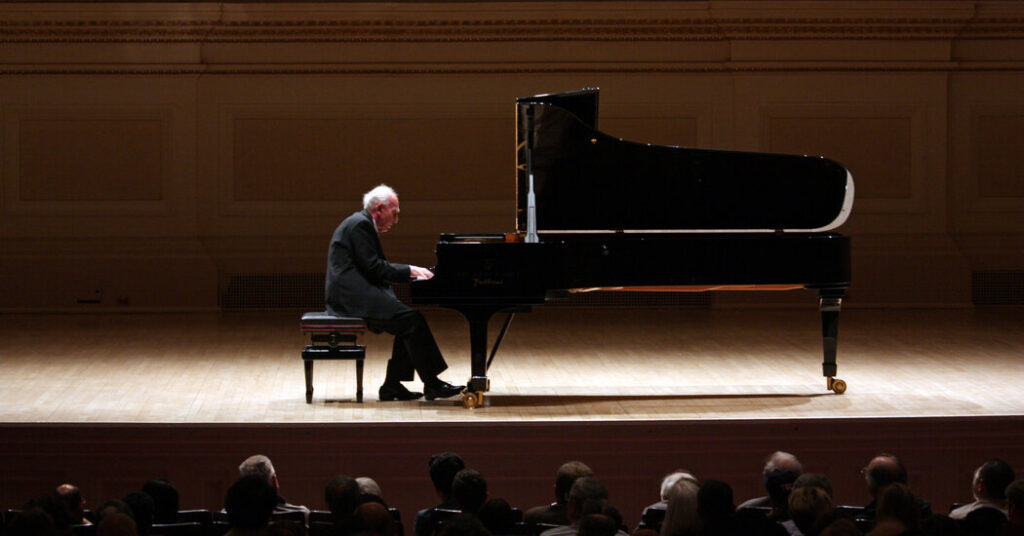
Who was Maurizio Pollini?
A sensation, for one thing: With his win at the 1960 International Chopin Piano Competition — he was the youngest winner ever, at 18, and the first Italian — he became an object of fascination throughout the music world. That impression was only reinforced, even deepened, when, not long after, he withdrew from concert activity and spent 18 months studying with the enigmatic Arturo Benedetti Michelangeli. And the attention would never wane.
The real question about Pollini, though — one that divided listeners throughout his career — centered on his pianistic technique, which at times seemed superhuman. It was there at least from the time of his competition victory, when Arthur Rubinstein declared that “technically, he already plays better than us on the jury.”
When asked about that comment in a 2014 documentary, the ever-modest Pollini played it down, insisting that it was Rubinstein’s way of backhandedly teasing his fellow jurors. Whether that was true or not, it became clear when Pollini began concertizing and recording that he was capable of playing even the hardest repertoire with a precision and X-ray transparency that few, if any, of his peers could match.
To partisans, of whom there were many, this bracing approach heralded a new, specifically modern form of musicianship that put technique at the service of composer and score rather than showmanship. “Clean, sharp-edged, objective interpretations, free of flourishes and exaggerations even in the most romantic repertory,” as Time magazine put it in 1980.
To his detractors, a smaller but often insistent minority, his playing was all cold calculation and no heart. It put the notes in the right places but was emotionally inert — a gleaming, modernist construction in which all the lights were on but no one was home, you might say.
There were elements of truth on both sides. Where you landed had as much to do with what you were listening for in a particular piece as with the pianist himself. At his best, Pollini’s technique and intellect were capable of revealing wholly new aspects of familiar music. When he died in 2024, the Icelandic pianist Vikingur Olafsson wrote in a Facebook post: “With Pollini, things were never simple. Chopin became the musical architect, Stockhausen the poet, Beethoven the philosopher. Many of us became better listeners and players.”
Recently Deutsche Grammophon, Pollini’s label for essentially his entire career, issued a box set of his complete recordings. Originally released in 2016 to honor his 75th birthday, the new version adds work from his final years. It now clocks in at a mammoth 62 CDs, along with a Blu-ray Disc and a couple of DVDs.
With the book presumably closed on Pollini’s recording career, you can judge the worth of his artistry for yourself, from the beginning of his career: Four of his prizewinning performances from the 1960 Chopin Competition appear on CD for the first time, and they confirm that his clarity, unforced power and a dash of bravado were there from the start.
If listeners were expecting him to continue with Chopin, they must have been shocked by his first Deutsche Grammophon LP, from 1972: Stravinsky’s Three Movements From “Petrushka” and Prokofiev’s Piano Sonata No. 7. Even more stunning was the impression it made — a young pianist taking on two pieces of treacherous difficulty and blazing through them with a speed and articulation that were hard to fathom.
As a debut, it ranks with Glenn Gould’s epoch-making “Goldberg” Variations from 1955. In the CD era, the Prokofiev and Stravinsky would be paired with two more 20th-century milestones: Webern’s Op. 27 Variations and Boulez’s frighteningly complex Second Piano Sonata. Heard together, they form a manifesto of musical modernism, executed with a proficiency that served notice of a fully formed talent’s arrival.
More 20th-century fare was to come. Pollini had an extraordinary sympathy for Schoenberg’s music, calling him “one of the most expressive composers in all history,” and his account of Schoenberg’s solo piano music smolders with intensity. A similar energy infuses the first two Bartok concertos, with his friend Claudio Abbado conducting the Chicago Symphony Orchestra. His live performances of Stockhausen’s Klavierstücke were legendary; sadly, he never recorded them.
In retrospect, the 1970s were the golden age of Pollini’s recording career, in which he could do almost no wrong. When he did return to Chopin, it was with both sets of Études, and his performances attained a reference status that they retain today, even if they were played, as David Allen once wrote in The New York Times, as “Brutalist edifices.” The same could be said of the Polonaises, which were sometimes terrifying in their single-minded drive.
Other early recordings, though, undercut the take-no-prisoners side of his musicianship. Listen to his account of Mozart’s Piano Concerto in A (K. 488), recorded with the Vienna Philharmonic under Karl Böhm. This is Mozart playing of Apollonian elegance, and if there is a hint of reserve, the elegiac slow movement makes as deep an impression as any account I know.
But the prize of the ’70s is Pollini’s account of Beethoven’s last five piano sonatas, an eye-raising choice for a first Beethoven recording. As expected, he meets the music’s performance demands, even those of the “Hammerklavier” Sonata, with seeming ease. The real achievement, though, is how technical facility serves other virtues — sonority, phrasing, structure, lyricism — that open up the entire world of the composer’s final works. Since the day I first heard these recordings, they have defined late Beethoven for me.
Perhaps unavoidably, Pollini’s work became more uneven as the years went on and more of his repertoire appeared on disc. His account of Liszt’s Piano Sonata in B minor is a classic, as are the ashen works that accompany it on disc. The Beethoven recordings that followed his triumph in the late sonatas were highly variable. His playing of sonatas and concertos from the composer’s middle period could be ear-opening in their lucidity, but he missed the charm and humor of many earlier, smaller-scale works.
You would think that Pollini would be a natural fit for the intellectual challenges of Bach’s music would, but his rendition of the first book of The Well-Tempered Clavier, the only Bach in his catalog, is smoothly played but somewhat faceless, with little variation among the individual preludes and fugues.
Perhaps no composer embodied the pluses and minuses of Pollini’s playing more compactly than Schumann. In the famous “Davidsbundlertänze” and “Kreisleriana,” his was technically faultless but brusque, even impatient, as if in control for control’s sake. By contrast, in lesser-known pieces — the First Sonata, the “Concerto Without Orchestra” and the Allegro in B minor — he found music of surging power and emotional resonance.
He, Abbado and the Berlin Philharmonic also did wonders with Piano Concerto, which demands hand-in-glove rapport among all participants. I saw these same artists perform it in 1999; no other account has matched its high-flying ensemble virtuosity. Pairing their studio recording with the Schoenberg Concerto was a brilliant choice, and an equally inspired success.
Two developments mark much of Pollini’s work in the 21st century. First, he began to rerecord works, which was perhaps inevitable given his small repertoire. He said in the 2014 documentary that he added music to his rotation only “based on the absolute certainty that I will never grow weary of the works I’ve selected.” This led to some puzzling omissions. Given his achievement in Debussy’s Études, it’s tantalizing to think what he could have done with, say, Ravel’s “Miroirs.”
His re-evaluations were a mixed bag but rarely wholesale improvements. Pollini recorded the Brahms concertos three times, and there is little in the final renditions that was not there the first time around. His 2011 take on the Chopin Preludes trades the bravura flair of his 1975 recording for an almost disinterested efficiency. Perhaps he thought this approach might bring out Chopin’s innovative harmony more effectively, but it strains credulity to say that this rethink constitutes an upgrade.
This era of recordings also reveals the waning of his vaunted technical prowess. Pollini was only human, after all, and there was a sense among some reviewers of his later performances that the limitations on his fingers could elicit some deeper engagement with the music. But this is difficult to sense in recordings, and it is hard to hear the messiness of passages once rendered with granitic specificity and not think that he should have left well enough alone.
Most disheartening was his decision, in some of his very last recordings, to revisit the late Beethoven sonatas, with which he had triumphed four decades earlier. The fingerwork is blurry and excessively pedaled. Rather than letting the music’s paragraphs unfold naturally, Pollini seems in a rush to get to the finish line. Everything feels intemperate, indistinct and unfinished.
Maybe what the elder statesman needed, toward the end, was an injection of youthful energy. In what would become his final recording, he teamed up with his son, Daniele, himself a fine pianist, for an all-Schubert album. While Maurizio’s rendition of the Sonata in G (D. 894) sounds heavy and earthbound, their performance of the Fantasie in F minor brims with nobility — very close to the crystalline, tragic beauty the elder Pollini brought to the composer’s late sonatas decades earlier.
Whatever the merits of those final efforts — or any other slice of Pollini’s recorded legacy, really — he inarguably changed pianism, not just by resetting expectations for his successors, but also, equally, by altering what listeners sought out and valued in a performance. At his apex, intellect, technique and imagination combined in a quest for something like artistic truth. To paraphrase Olafsson, we all became better listeners.
Pollini probably wouldn’t have claimed so lofty an achievement. Toward the end of the 2014 documentary, the interviewer suggests that the pianist is a kind of artistic missionary or pioneer. Pollini gives a wry smile and bursts into laughter.
“Absolutely not!” he says with amusement. “I do things for my own pleasure. Basta!”
The post A 62-Disc Set Offers a Last Word on a Magisterial Pianist appeared first on New York Times.