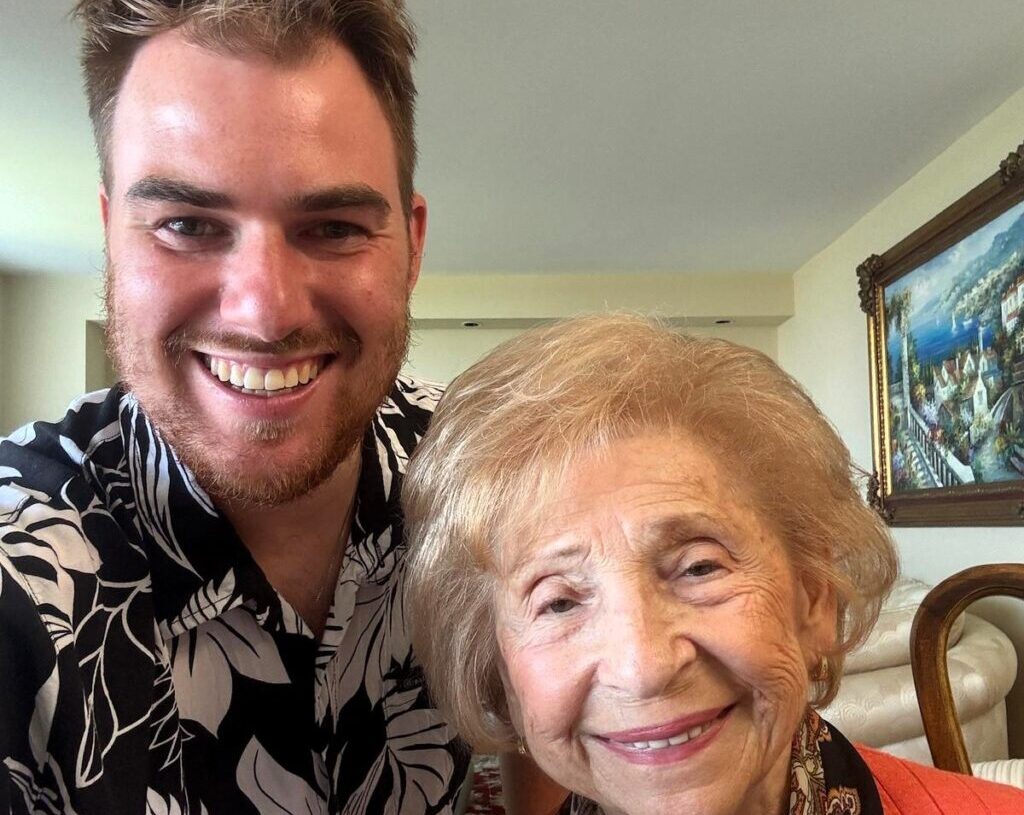
Jiri Kluc volunteered to help a group of Holocaust survivors living near his home in the Czech Republic when he was just 16 years old.
As he helped them buy groceries and clean their homes, a few showed him the prisoner number tattoos they received at the Auschwitz death camps. They recounted the days when Nazis killed their family members, knowing they could be next at any moment.
It wasn’t until a few years later — when some of those survivors died around 2018 — that Kluc recognized how precious their stories were.
“I realized that these people will be gone,” Kluc, 29, told The Washington Post, “and if their stories will not be preserved, we might forget.”
So Kluc, who now runs a tour-guide company in Prague, began devoting his free time to what is essentially a race against the clock: Finding and interviewing Holocaust survivors around the world.
Kluc said he has recorded about 700 testimonies from Holocaust survivors and World War II veterans. He sometimes posts small biographies about his interviewees on social media, but he eventually wants to preserve all of the interviews and documents he has collected in one place and make them available online, in museums and in books.
For now, he said he feels an urgent need to interview as many Holocaust survivors as possible before they’re gone. He has spent thousands of hours — and dipped into his pocket to spend thousands of dollars — to do this.
“I take it as a duty, and a lot of Holocaust survivors take it as a duty, to tell their stories,” Kluc said.
Kluc began by tracking down the remaining Holocaust survivors in the Czech Republic. He asked everyone he interacted with if they knew survivors, and sometimes, Kluc drove between nursing homes in search of people who lived through World War II. After he said he interviewed dozens of survivors, he interviewed survivors of the Theresienstadt ghetto — known in Czech as Terezin — who moved across the globe.
In 2018, Kluc planned a vacation to the Miami area. Before leaving, he learned Ernest Simon, a Holocaust survivor from Karlovy Vary, Czechoslovakia, lived in South Florida. Before Kluc left for Miami, he asked Karlovy Vary’s mayor to write a thank-you letter, which Kluc hand delivered to Simon as a surprise while interviewing him on the trip.
Kluc said since that trip, he saves his money to travel across Europe, North America and Australia for interviews. He also raises money through online fundraisers. Kluc, who speaks Czech, Slovak, English and Russian, said interviewing survivors for hours in-person is important to developing relationships and trust.
He began by recording survivors with a voice recorder before upgrading to his phone, and now he uses a Sony video camera.
Kluc decided around 2022 that he would not let distance or travel get in the way of reaching survivors.
“There’s not that many survivors left that I can be picky,” Kluc said.
About 6 million Jews were killed in the Holocaust. The Conference on Jewish Material Claims Against Germany, a nonprofit that secures compensation from the German and Austrian governments for Holocaust survivors, said in reports last year that about 220,800 Holocaust survivors were still alive but 70 percent of those survivors would be gone by 2035.
A handful of organizations record and collect testimonies from Holocaust survivors, including the USC Shoah Foundation. Susan Popler, director of the collections program for the foundation, said the group is grateful for people who conduct their own interviews with survivors, as those conversations often reveal new details and anecdotes.
“People that do it are people who really care about the survivors and history and the cause,” Popler said.
Some survivors, like Rosalie Simon, say they want to share their experiences with as many people as possible. Simon, who is not related to Ernest Simon, who Kluc interviewed in Florida, spoke with Kluc last summer in New York.
Rosalie Simon, who is from Czechoslovakia, said she was 12 years old when she was taken to Auschwitz, where she saw her mother, Regina, and teenage brother, William, for the last time shortly after arriving. Simon survived, she recalled, only because a red-haired woman discreetly took Simon’s place in a group destined for a gas chamber because the woman decided to die alongside her daughter.
“It is difficult for me to speak about the past,” said Simon, 94. “The memories are still very painful, but I feel it is my obligation to carry on the message of the Holocaust.”
Kluc hopes to be among those carrying on Simon’s message and testimonies of other survivors for decades to come.
Near the beginning of 2025, Kluc said he was interviewing survivors and veterans in Melbourne, Australia, when he met Annetta Able’s family, who told Kluc that Able was hesitant to discuss her time being experimented on at Auschwitz by Nazi doctor Josef Mengele. But Kluc said he was both honored and horrified when Able told him about the forced blood transfusions and injections she and her twin sister, Stephanie, endured.
While visiting Los Angeles in November, Kluc said Renée Firestone, who’s from Czechoslovakia and survived Auschwitz, opened up to him partly because she had not had a conversion in Czech in years.
Because of his financial constraints and the knowledge that survivors might die before his next visit, Kluc said he often conducts two to three interviews per day on his trips. Sometimes, that takes a toll on him.
In the Miami area in April, Kluc interviewed David Schaecter, who told Kluc that 104 of his relatives died in the Holocaust. The dread of that story — and the weight of completing multiple interviews — resulted in Kluc going to the hospital with a skin infection he said was triggered by stress.
While the conversations can be difficult, Kluc said he tries to find hope by asking survivors about their lives after the war. Hearing how they moved to new places, invested money, started families, learned new languages and found jobs is inspiring, Kluc said.
Kluc wants to cast his net wider and interview at least 1,000 Holocaust survivors and World War II veterans. He hopes to make the interviews available to the public — a project he said he plans to work on for the rest of his life.
Building relationships with survivors who often have just months to live is emotionally challenging, Kluc said. But he’s hopeful his work will keep their memories alive.
“They will be with us in the future,” Kluc said, “just not in person, but through the testimony they left for us.”
The post Man, 29, races against time to preserve voices of Holocaust survivors appeared first on Washington Post.