Long before “Heated Rivalry,” the smash hit TV show based on a popular romance series, shot sports romance into the cultural mainstream, an acclaimed literary novelist secretly published an erotic hockey novel under a pen name.
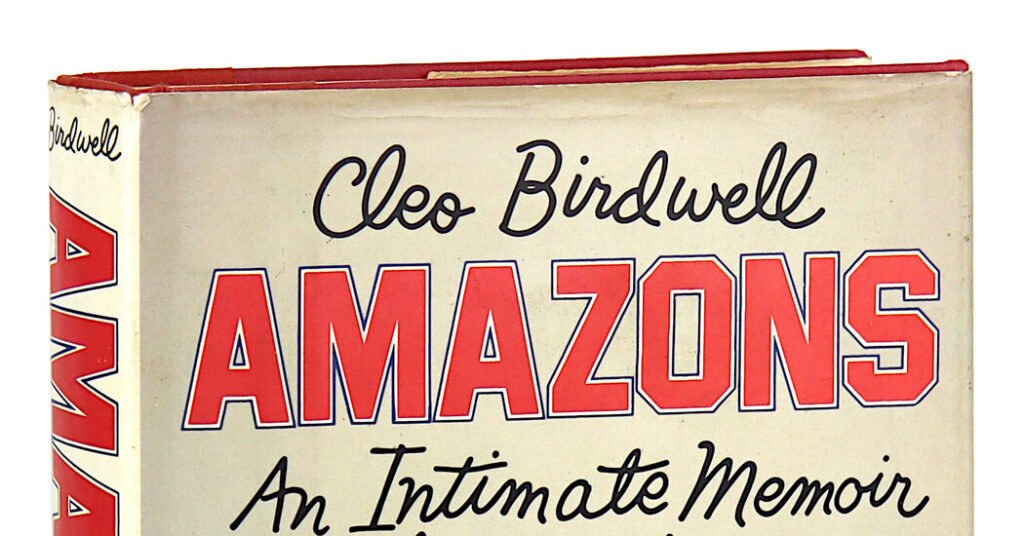
The book, “Amazons,” stars Cleo Birdwell, the first woman to play in the National Hockey League. A scrappy player for the New York Rangers, Birdwell is as aggressive and fearless in her pursuit of sex as she is on the ice: “With my knees first and then my breasts and then my full body, I pushed him against the wall,” Birdwell writes of an erotic encounter with a strapping defenseman, whose body is “rock hard top to bottom.”
The writer behind “Amazons” is Don DeLillo, who released the book under the pseudonym Cleo Birdwell, adopting the ruse that the novel was a memoir. When he was outed as its author, DeLillo distanced himself from the novel, and later tried to have the book expunged from the literary record, omitting “Amazons” from his official bibliography.
The novel, which came out in 1980, soon fell out of print, and it has since been largely forgotten. Few but the most committed DeLillo completists have tracked down the remaining circulating copies, which can sell for hundreds of dollars.
It may come as a surprise to fans of DeLillo’s later work — in which he explores heavy subjects like mortality, political violence, paranoia and conspiracy theories — that he wrote a gleeful sports sex romp. But close readers of his fiction see DeLillo’s fingerprints all over this smutty hockey novel, which is laced with his bone-dry wit, pitch-perfect dialogue and edgy social satire. There’s even a character in “Amazons,” the sportswriter Murray Jay Siskind, who later turns up in DeLillo’s breakout novel, “White Noise.”
“There were clues for the DeLillo partisans,” said the novelist Jonathan Lethem, a DeLillo acolyte and a fan of “Amazons.” “Lots of people don’t know it exists.”
In acclaimed novels like “White Noise,” “Mao II” and “Underworld,” DeLillo seemed to forecast seismic cultural, political and technological shifts: the war on terror, our numbness to slow-rolling environmental catastrophes, information oversaturation, social isolation. We can now add hockey erotica to the list of cultural trends that DeLillo’s fiction foreshadowed.
Hockey romance, which is suddenly all over the best-seller lists, television, late-night talk shows and social media, isn’t a new phenomenon. It started to gain popularity more than a decade ago and found a wide readership more recently through BookTok. The subgenre’s stars include writers like Hannah Grace, whose novel “Icebreaker” sold more than two million copies, and Elle Kennedy, whose “Off-Campus” hockey series has sold more than a million print copies and was adapted into a show that will run on Amazon’s Prime Video later this year.
The breakout moment for hockey romance came late last year, with the arrival to HBO Max of the TV show “Heated Rivalry,” based on Rachel Reid’s hit series “Game Changers,” a queer romance about two professional hockey players who fall for each other. Reid’s series, which has sold close to two million copies, currently occupies three of the top 10 spots on The New York Times’s combined print and e-book fiction list.
Stacy Boyd, an executive editor at Harlequin, which publishes Reid’s series, said hockey players appeal to romance fans because “they’re very masculine, in the sense of macho, aggressive, strong, fast, competitive, and then you have a romance, and you’re bringing out that vulnerability.”
As for whether DeLillo’s “Amazons” counts as an early example of hockey erotica, Boyd said she hadn’t heard of his book, but that back in 1980, he was certainly “ahead of his time.”
Sports have occasionally featured in DeLillo’s work. He wrote about football in his 1972 novel “End Zone,” a black comedy about a college football team in Texas. His novel “Underworld,” published in 1997, opens with a long prologue set at a 1951 baseball playoff game between the New York Giants and the Brooklyn Dodgers.
But hockey, it seems, was an unexplored subject for DeLillo. He collaborated on “Amazons” with Sue Buck, a copywriter he knew from his days working at an advertising agency, who helped supply details about hockey and growing up in Ohio. When he took the manuscript to Robert Gottlieb, his editor at Knopf, Gottlieb was unimpressed, but said DeLillo was free to publish it elsewhere under a pen name, according to Gerald Howard, a retired editor who worked with DeLillo on “Libra.”
Howard, who wrote about “Amazons” in Bookforum, learned about the origins of the novel from DeLillo’s literary agent, Lois Wallace, who passed away in 2014. While working with DeLillo in the late 1980s, Howard urged him to republish the novel, but DeLillo refused.
“There’s something about it that embarrasses him,” Howard said.
But to Howard, “Amazons” shows DeLillo at the peak of his comic powers.
“If you’re a careful reader of his work, his wit is absolutely delicious, and he can do a comic scene that will have you rolling on the floor, and that’s an aspect of his worldview that he let off the leash for ‘Amazons,’” Howard said. “I think not having his name on the book gave him a freedom that he didn’t experience with the other books.”
“Amazons” was published by Holt, Rinehart and Winston. The publisher leaned into the book’s artifice and packaged it like a real memoir, ignoring the inconvenient fact that no woman has ever been a member of an N.H.L. team. The jacket even had a phony author photo on the back, which featured a blond woman wearing a Rangers uniform. The first printing of 20,000 copies sold out, outpacing sales for DeLillo’s previous books.
It didn’t take long for attentive readers to suss out the author’s identity. In a 1980 review in The Times, Christopher Lehmann-Haupt wrote that the narrator’s “talent for grabbing clichés by the throat and strangling them until they cough up meaning” recalled DeLillo’s prose in earlier works.
For decades, DeLillo, who through his publisher declined to comment for this article, remained silent on the subject of “Amazons.” Five years ago, he tacitly acknowledged authorship during an interview with The New York Times Magazine. “Oh god. How do you remember that?” he said when asked about “Amazons.”
Others, however, believe the novel deserves to be ranked among his funniest books, as well as his most erotic, a mode that DeLillo isn’t known for. The sex scenes in “Amazons” are frequent, explicit, elaborate and often very funny.
In bed with a former Rangers player, Birdwell describes how he “took the gum out of his mouth and stuck it on the wall near his head. For later, I guess.”
Another romantic encounter, with a professional tennis player, begins with a game of strip Monopoly. Birdwell, who calls herself “a connoisseur of the male form,” reflects, “I felt as romantic and tender and young as someone can feel who has five full years of professional hockey behind her.”
The novel is studded with absurd, madcap moments, but it also sneaks in social satire that in retrospect looks, as DeLillo’s work often does, prescient.
“By featuring a woman in a hypermasculine environment, the novel revels in opportunities to explore gender roles and lust as comic themes,” Gregory Cowles wrote in a rundown of DeLillo’s essential works in The Times. “The book is every bit as much a sex romp as movies of the era like ‘Porky’s’ and ‘Night Shift,’ only written with DeLillo’s customary verve.”
Lethem counts “Amazons,” which influenced a scene in his novel “Motherless Brooklyn,” among his favorite comic novels, he said.
“I thought it was insanely funny, because he’s taken the brakes off,” Lethem said. “He’s just flooring it.”
Lethem once brought a copy of “Amazons” to a book event for DeLillo’s 1991 novel “Mao II,” hoping to have his edition signed. DeLillo was not amused.
“I had the experience of seeing his face when I placed a copy in his hands,” Lethem said. “He said in a characteristically direct, quiet, uninflected voice, ‘I don’t autograph that.’”
Alexandra Alter writes about books, publishing and the literary world for The Times.
The post Did Don DeLillo Invent the Racy Hockey Novel? appeared first on New York Times.