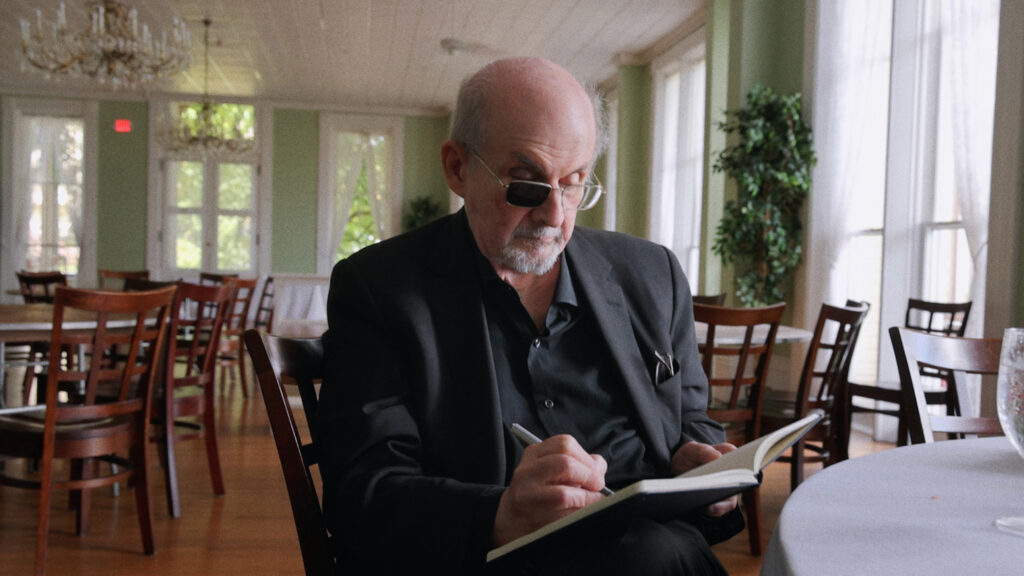
PARK CITY, Utah — The wounds are gruesome, and the camera does not waver. Salman Rushdie’s neck is a violent shade of red. The gash along his jaw looks like a canyon, impossibly deep and held together by staples. A large piece of flesh below his right cheek seems like it might fall off.
For weeks following his near-fatal stabbing attack at the Chautauqua Institution in Upstate New York — which left him with 15 stab wounds and blind in one eye — Rushdie’s wife, Rachel Eliza Griffiths, kept him away from a mirror.
“I had no idea how awful I looked,” the author says in “Knife: The Attempted Murder of Salman Rushdie,” a gripping and moving documentary from prolific director Alex Gibney that premiered Sunday at the Sundance Film Festival.
When the camera finally showed Rushdie’s right eye, swollen out of its socket and almost comically red, the audience cried out in shock.
If anyone’s thinking about getting stabbed in the eye, Rushdie jokingly suggests they reconsider. One doctor, he says in the film, cheerily told him, “You’re lucky the guy had no idea how to kill someone with a knife.”
One of the great ironies of this story is that Rushdie, 78, had been at that idyllic upstate lecture hall to talk about how to keep writers safe. He had spent years of his life in hiding after Iranian leader Ayatollah Ruhollah Khomeini issued a fatwa against him in 1989 and offered a bounty for his killing, deeming his novel “The Satanic Verses” blasphemous to Islam.
Rushdie’s attacker, Hadi Matar, a 24-year-old Lebanese American from Fairview, N.J., said in an interview from jail with the New York Postthat he’d only “read like two pages” of “The Satanic Verses,” but that he respected the ayatollah and was angered by Rushdie’s criticism of Islam that he’d seen on YouTube videos. Prosecutors argued that he’d been trying to carry out the fatwa. He’s now serving 25 years in prison.
Ever since the film was accepted to Sundance, in a state where it’s legal to carry guns openly or concealed, the festival has been working on adding extra security measures to Rushdie’s screenings. Everyone entering the theater was wanded with a metal detector, which isn’t the case normally, and bag searches were far more extensive than usual. A pair of burly bodyguards had accompanied them inside the theater.
As the lights came up and Rushdie and Griffiths walked out, the crowd rose to its feet for the longest, loudest standing ovation of the festival so far. Already there are rumors that this film could be one of the festival’s biggest documentary sales.
It’s been more than three years since his attack and Rushdie, who now wears special (very cool-looking) glasses with one black lens, is remarkably sanguine about it.
“I never expected to show that much of my body. You know, I’m a novelist,” Rushdie said, to a hearty round of laughter.
Premiering just one day after ICU nurse Alex Pretti was killed by federal agents on the streets of Minneapolis, this tale of political violence has hit a chord with industry buyers and Sundance audiences alike.
“I’m horrified, of course, by what’s been happening, the unleashing of uncontrolled, brutal force against American citizens,” Rushdie told The Washington Post. “I have some experience of that.”
Rushdie’s attack and its aftermath have been the subject of two recent books: his 2024 memoir and Griffiths’s “The Flower Bearers,” out this week. What the film offers that the books can’t is harrowingly intimate footage of Rushdie’s long recovery, confined to hospital beds, and a chance to watch the couple support each other through this cataclysmal, life-changing event no one would ever wish to experience.
“I think we both learned that we were able to survive it,” Rushdie told The Post. “You know, [it’s] something which could easily have crushed us, individually and together … and it did not. Here we are.”
As he lay in the hospital room in Erie, Pennsylvania, where he and Griffiths would live for nearly a month before he was well enough to even put on clothes instead of gowns that open at the back, Rushdie asked his wife to film him.
“We need to make a record because it’s not just about me,” Rushdie says in the film. “It’s about the freedom to say what we want about the truth.”
He thought Griffiths, a poet and a photographer, would just take some snaps on an iPhone, but instead, she sent for the professional camera equipment she had in their New York home and got to work. As with the mirror, she wouldn’t let Rushdie see the footage. “She thought it would be too upsetting for me to see what I actually look like,” Rushdie said during the Q&A. “She was right.”
It was only once he’d come home and was feeling better that they set up a projector and watched it together. Though they’d never intended for their video diaries to become a film, they both agreed that it was important for other people to see them. They reached out to Gibney, an Oscar winner for 2007’s “Taxi to the Dark Side.” Rushdie and Griffiths had long admired the documentarian’s films that dug into controversial subjects such as Scientology, Enron, WikiLeaks and sexual abuse in the U.S. clergy.
Gibney told The Post that he wanted to do the film because, “as Salman says, he went from an act of hate to a place of love,” and that seemed like an important story to tell in fraught times.
With “Knife,” Gibney intercuts stories of Rushdie’s childhood — growing up in India with an alcoholic father, being racially bullied at a British boarding school.
Rushdie had just started on his memoir when Gibney came onboard, and his writing from that and other novels pops up over hand-drawn animation. It’s a surprisingly wry and funny film, filled with tons of movie clips involving knives or eyes. Rushdie was delighted that Gibney included the famous Luis Buñuel scene of a razor cutting an eye. (The audience REALLY gasped at that one.)
“I suggested ‘Psycho,’” Rushdie told The Post, proudly.
There’s also startling archival footage of the vast and incredibly intense outrage against “The Satanic Verses” around the world. Six people getting killed at a gigantic protest over the book in Pakistan. A Japanese translator killed at a book event. An Italian translator beaten. An Islamic TV show that depicted him as a Jewish agent who kills Muslims and ultimately has to be shot down by laser beams and set on fire. Protests in New York. Britain’s largest booksellers pulling it from their shelves for fear of riots.
Amid all that are interviews with a young Rushdie questioning how killing someone for telling the truth fits into the teachings of the Quran, or calling religion “a poison of the blood,” or saying, “I wish I had written a more critical book.”
Rushdie hadn’t wanted Gibney to rehash all the 1989 stuff, but watching the film now, he thinks it’s vital.
“I think the fact is that it was so long ago that many people watching the film would not really have clear memory of what happened then,” Rushdie said at the Q&A. “And if you don’t understand what happened, then you don’t understand what happened now.”
Gibney’s most powerful decision in the film is to save the attack footage until the end.
Rushdie admitted that he had gotten a bit lax about security over the intervening decades. “I’d been doing this for 25 years and there’s never been a whiff of a problem,” he told The Post. “So I generally thought, ‘Okay, time passes. The world moves on, and that subject’s closed,’ which I think it actually is, except for this crazy kid.”
What baffles him the most is that Matar is so young that he had no way of knowing the riots that happened when “The Satanic Verses” came out. “He seemed to have no interest in actually familiarizing himself with the person he decided to kill, which is very odd, don’t you think?” Rushdie said. “To actually decide to commit the crime of murder, the biggest crime there is, and not even bother to know who it is you’ve decided to target?”
And what saddens him in a weird kind of way is that Matar didn’t just irrevocably alter Rushdie’s life — and Griffiths’s — but he absolutely ruined his own life in the process. “I mean, I’m sitting here at the Sundance Film Festival. He’s in jail. So who came off worst? Not me,” Rushdie said.
Rushdie and Griffiths first saw the film nine days before its premiere, and chose not to sit through the Sundance screening because it felt like it would be too much with a crowd.
Still, Rushdie wanted to let this audience know the kind of power they have.
On the day of the attack, he said at the Q&A, “I experienced, almost simultaneously, the worst side of human nature — violence led by ignorance, induced by the irresponsible — and, on the other hand, the best side of human nature.”
Had members of the Chautauqua audience not jumped onstage and subdued Matar, he would not be there.
In that attack footage, he said, “You see human nature and people rushing to defend me against an ideologically driven man with a knife,” he said. “And yet, they were willing to do that, to risk themselves to save me.”
Speaking to the room, but to perhaps anyone who might be feeling despondent right now, he ended with a loud declaration: “We’re back, too. We’re back, too.”
The post Harrowing Salman Rushdie doc ‘Knife’ leaves Sundance gasping appeared first on Washington Post.