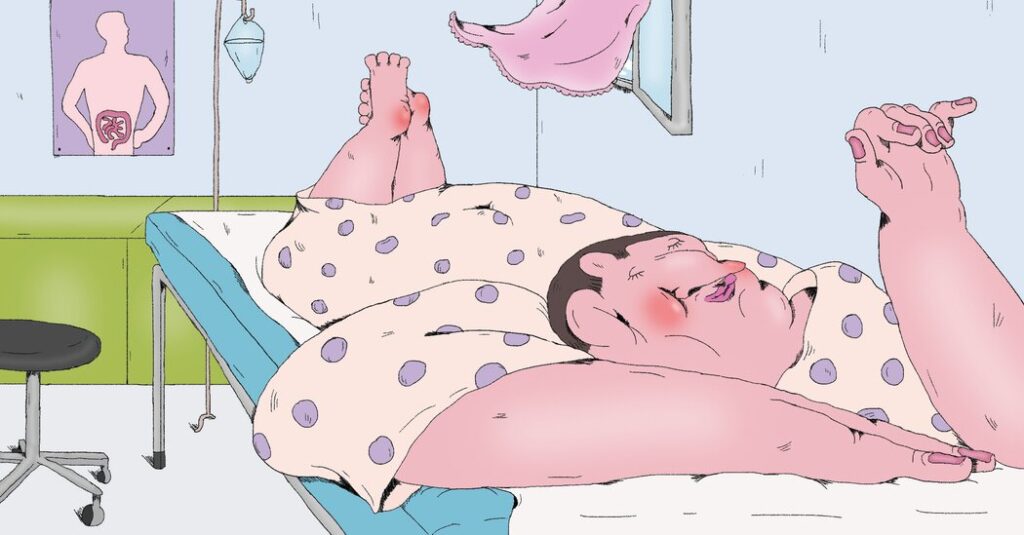
For many of us, a colonoscopy is a distant inevitable horror, like the heat death of the universe. It will occur, and it will be terrible — but we don’t really have to worry because we won’t be around to see it. Whoever happens to exist on that hypothetical day will, by definition, be someone else: ancient, wrinkly, alien, stardust. (The typical recommended age, 45, is basically unimaginable to anyone under 40.) The best we can do is wish our future self luck.
Well, I am writing today from that future — from the other side of the impossible divide. And I have come to share amazing news. It turns out that despite everything you’ve heard, getting a colonoscopy is wonderful. It’s the most fun I’ve had since the sunniest summer days of my childhood. I would like everyone to experience this bliss as often as possible.
You are skeptical. I can see it in your face. Allow me to explain.
First, let me clarify. I am not recommending colonoscopies solely for health reasons — to screen for cancer or Crohn’s disease or the other secret slimy dangers that might be lurking in your guts. That is extremely important, obviously, and it is the reason you will make the appointment.
But it is not the reason to love your colonoscopy. You don’t go on a religious pilgrimage to fulfill the step goal on your Fitbit; you don’t listen to Bach fugues because their clockwork precision might make you better at algebra. You do it for the joy of the experience itself — because it makes you feel human and alive. This is also why we get a colonoscopy.
The fun actually begins the day before the procedure itself, on what I have come to think of as Colonoscopy Eve. This is the so-called prep day. Like “Alice’s Adventures in Wonderland,” it starts with a magic potion: a big jug of thick liquid that tastes like a cursed mixture of Mountain Dew, antifreeze, melted Jell-O and unleaded gas. You drink it and wait. Then you basically explode.
I remember that day, fondly, as my diarrhea vacation. That might not sound fun, from a distance — but it was one of those miserable experiences so unpleasant that they wrap all the way back around to pleasure. It was as liberating as a spa day. I had zero responsibilities. All I had to do, all day long, was liquefy my entire insides.
“What are you up to today?” my wife asked.
“Oh, nothing,” I said. “Just BECOMING WATER. Just MERGING AT LONG LAST WITH THE SOURCE OF ALL LIFE.”
“Good luck,” she said.
I’m not sure I’ve ever lived a fuller day. I achieved a literal flow state. I felt pure consciousness, the sense of presence people spend lifetimes searching for in mountaintop monasteries. It had been waiting, all along, in my upstairs bathroom.
The next day, overflowing with emptiness, I reported to the gastroenterologist, a specialist whose job is to knock you unconscious and probe your innards like a chef deveining a shrimp. I was asked to put on a hospital gown, to lie down, to roll over on my side. And then, apparently, it happened — although I will have to take the doctor’s word for it. The last thing I remember is someone slipping a mask over my face and telling me to inhale a chemical fog. Immediately, I was Rip Van Winkled. I fell into an oceanic unconsciousness — did a high dive into eternity, circled the solar system infinite times, breathed the breath of my ancestors, became everything and nothing.
Back in the realm of my physical body, meanwhile, under harsh overhead lighting, the doctor was snaking my insides with a camera mounted on a flexible tube.
Eons later, I was reborn. I opened my eyes onto a new world. I would not have been surprised to have discovered myself cradled in my mother’s arms, unable to speak, ready to start my whole life over. Or to find that I had grown a long white beard and that everyone I knew was dead, including the gastroenterologist and his staff, and to have been informed (by the A.I. robots monitoring me) that I was actually the last surviving human being.
Instead, I opened my eyes to see a nurse wheeling me into a recovery room. My brain fumbled for a few seconds until it rediscovered a scrap of human language.
“How long was I out?” I asked.
“22 minutes,” the nurse said — the length of an episode of “Bob’s Burgers.” She gave me a box of juice and left me alone to get dressed.
As a souvenir, they gave me some very intense photos, the way they do after you ride a roller coaster at Disney Land. At home, I studied them. They were mysterious, disgusting. They showed places I was never meant to see: dark secret caverns, twisting pink tunnels labeled with scientific names (cecum, sigmoid colon). They were, supposedly, me — maybe the truest portrait I had ever seen of myself, and yet the self I know was nowhere to be seen. What they taught me is that I am a stranger.
Medically speaking, the results were clear and reassuring. No evidence of serious danger. I should come back, they said, in 10 years.
Which means I am now extremely jealous — of you. At least those of you who are still creeping toward middle age, who have yet to glance into the secret mystery of your lowest eye. Before you know it, that distant day will arrive. You will drink the potion and journey to the far shores of consciousness. You will see the deep reality of yourself. You will understand, in your deeply probed enlightenment, that a colonoscopy is nothing to fear — and you will join me in spreading the word.
I will be counting the days.
The post Want Nirvana? Try a Colonoscopy. appeared first on New York Times.