Head-butting was all the rage at the end of the dinosaurs’ reign.
During the Late Cretaceous period, several dinosaur lineages evolved dangerous headgear, including the dome-headed pachycephalosaur and the Pachyrhinosaurus, a horned dinosaur that sported a stump of gnarled bone on its face.
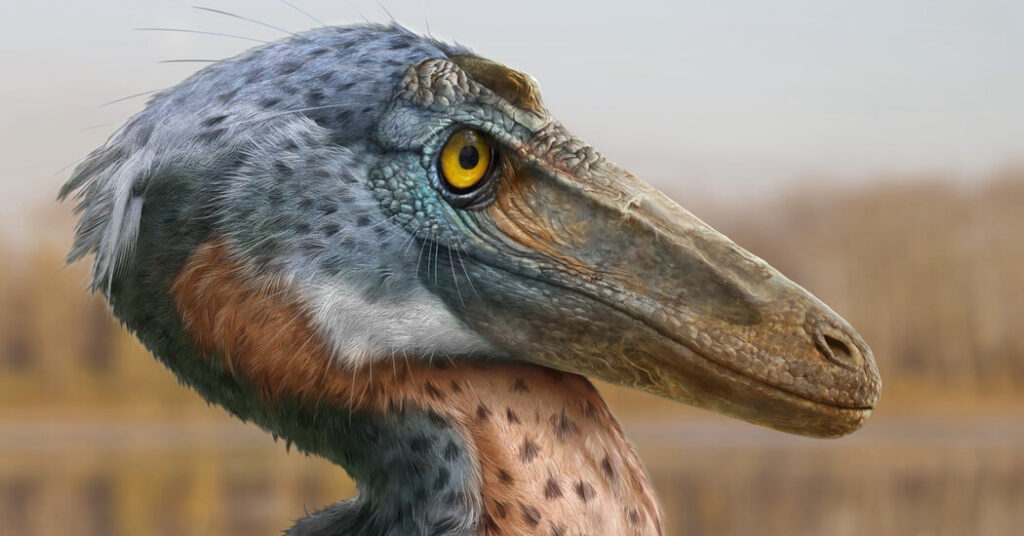
Other dinosaur groups, including birdlike theropods, appear to have avoided bashing one another head-on. But a newly discovered species of cassowary-size raptor from Mexico reveals that some of these featherweights may well have been more than capable of cracking skulls.
A team of paleontologists recently described a set of thick bones on top of the dinosaur’s braincase that fused together into a knobby bump. The scientists proposed that the new dinosaur, named Xenovenator (or “strange hunter”) espinosai, used the structure to ram into rivals. Their report was published this month in the journal Diversity.
“Raptorlike dinosaurs are often imagined primarily as agile predators using their claws and teeth,” said Héctor Rivera-Sylva, a paleontologist at the Museo del Desierto in Saltillo, Mexico, and the lead author of the paper. “Xenovenator reminds us that dinosaur behavior was likely far more diverse and nuanced.”
In 2000, Martha Aguillón-Martinez, one of Dr. Rivera-Sylva’s colleagues and co-authors, discovered Xenovenator’s fossilized braincase eroding out of the ground while she was surveying the Cerro del Pueblo formation, an outcrop of rocks in northeastern Mexico. Some 73 million years ago, this area was a marshy coastline inhabited by several dinosaurs, including duck-billed herbivores, lanky tyrannosaurs and Coahuilaceratops, which sported four-foot-long horns.
The researchers concluded that the fossilized braincase represented a troodontid, from a group of omnivorous, birdlike dinosaurs that had large, forward-facing eyes and possessed some of the biggest brains of any nonavian dinosaurs.
However, not all scientists are convinced that Xenovenator was a troodontid. “It’s such a weird specimen,” said David Varricchio, a paleontologist at Montana State University who was not involved in the new paper. Because the braincase was isolated, he said, he thinks it is possible that it could belong to the skull of a larger dinosaur. “It looks big brained because this is all we have, but maybe it was part of a massive skull.”
Accounting for the confusion is the odd shape of the new braincase, which has a bulge of wrinkled bone at the front. To peer inside the petrified noggin, the scientists did a CT scan of the fossil. They discovered that the bones, which fused together in zigzag patterns, were nearly half an inch thick in spots and exhibited a spongy internal structure.
Because the reinforced skull probably did not help Xenovenator hunt, the researchers have theorized that the structure was a sexually-selected trait used to bludgeon rivals. “Fossils rarely preserve behavior directly, so finding such strong morphological signals of combat in a small-bodied theropod was unexpected,” Dr. Rivera-Sylva said.
The bony bump on Xenovenator’s head resembles structures seen in several other head bashers, past and present. In addition to resembling the pachycephalosaur’s dense dome, the raptor’s fused skull bones are similar to those seen in buffalo, musk oxen and giraffes. And the spongy structure inside Xenovenator’s bones also resembles the shock-absorbing tissue inside the bony casques of helmeted hornbills, which ram into each other in midair.
Dr. Rivera-Sylva is not surprised that these big-brained raptors competed for resources. Dr. Varricchio also thinks it is likely that troodontids tussled with one another. For example, his team has discovered that troodontids often returned to the same sites to lay their eggs, which may have caused conflicts over prime nesting spots.
Competition increased during the Late Cretaceous period, when a diverse assemblage of dinosaurs crowded ecosystems. Some developed deadly weapons to duke it out with rivals, while others evolved showy horns and fleshy crests to woo mates.
This made Xenovenator a creature of its time. “Rather than being an anomaly, Xenovenator fits into a broader pattern,” Dr. Rivera-Sylva said. “Dinosaurs at the end of the Cretaceous were not just evolving new ways to eat or move, but new ways to interact with one another.”
The post You Wouldn’t Want to Butt Heads With This Small Dinosaur appeared first on New York Times.