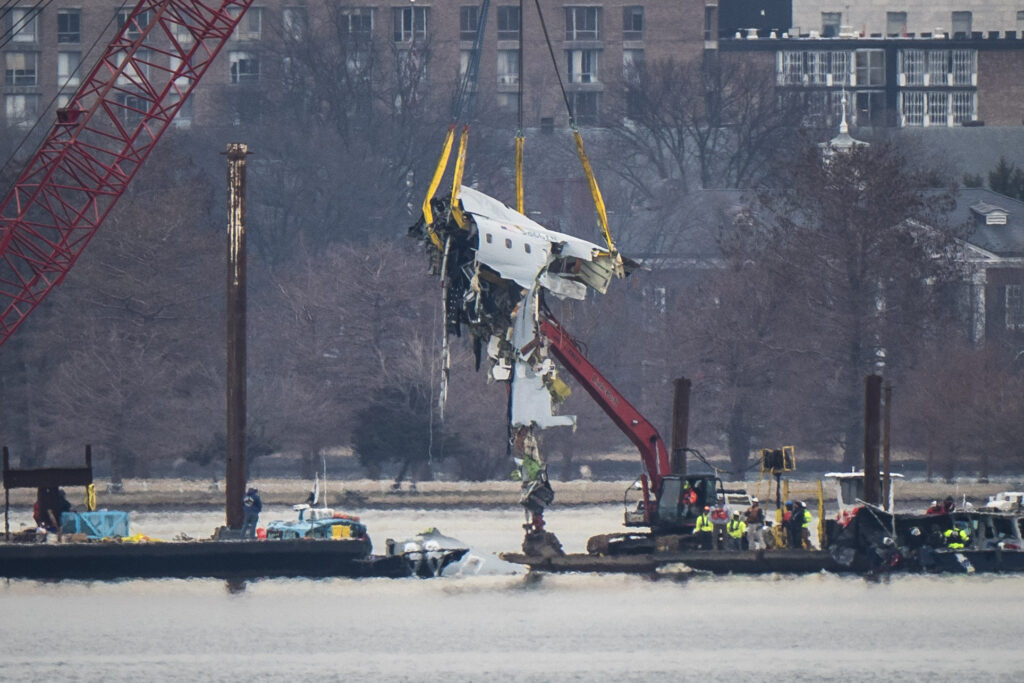
Nearly a year after a deadly midair collision near Reagan National Airport took the lives of 67 people, federal investigators will offer new details Tuesday about the factors that contributed to the fatal encounter and outline recommendations for preventing future tragedies.
The hearing, held at the National Transportation Safety Board’s headquarters in Washington, D.C., comes two days before the first anniversary of the crash between an Army Black Hawk helicopter and an American Airlines regional jet. On Wednesday, family members will gather at an event to honor those who died and the first responders who helped with the recovery efforts.
Several family members said they hope the findings of the nearly year-long NTSB investigation, as well as those of a separate review by the Army expected in about two months, will answer questions that have lingered since the board held three days of hearings last summer.
Chief among them: Why did the Federal Aviation Administration, the agency charged with ensuring the safety of the national airspace, fail to address the dangers posed by the unique mix of military, civilian and law enforcement aircraft in the crowded airspace near the airport, despite its own internal data and years of warnings from frontline controllers? And why did the Army, before the crash, not address known problems with the barometric altimeter on its older Lima helicopters, like the one involved in the crash? Those devices, which measure altitude by tracking changes in barometric pressure, could give readings that could be off by 70 feet or more, which was a factor in the accident.
There were 60 passengers and four crew members aboard Flight 5342, which began its journey in Wichita and was on final approach to National when it collided with an Army Black Hawk helicopter on a training mission carrying three crew members aboard. Among the passengerson the regional jet were young figure skaters and coaches returning from a special development camp.
In the wake of the crash, both the Army and the FAA have made changes. The Army has since recalibrated altimeters across its fleet and prohibited missions from the Pentagon’s helipad after an incident in May in which radar at the Pentagon lost visibility of an approaching Black Hawk.
The FAA, for its part, has banned nonessential helicopter traffic near National and permanently closed the helicopter route the Black Hawk took on the night of the crash. It also has slowed arrival rates for planes at the airport — a change that air traffic controllers had lobbied for unsuccessfully in the years before the Jan. 29 crash.
Ben Shtuhl, whose partner, Melissa Nicandri, was among the passengers aboard Flight 5342, said the changes were necessary but don’t go far enough.
“The NTSB report is another step in getting real accountability from agencies and others,” Shtuhl said.
Families have already witnessed how quickly reforms they have spent months lobbying for can be undone, he noted. In December, a provision in a Pentagon policy bill raised concerns among family members and drew an usually harsh rebuke from NTSB chair Jennifer Homendy after it appeared to undercut a postcrash change from the FAA requiring aircraft be equipped with technology that transmits their position to others operating in the same airspace. The Black Hawk helicopter was equipped with the technology but had a waiver that allowed it to operate without it switched on.
Shtuhl said he hopes the NTSB’s findings will bolster congressional efforts to repeal that provision by passing a bipartisan measure known as the Rotorcraft Operations Transparency and Oversight Reform Act (ROTOR).
The post A year later, federal authorities will reveal what caused fatal DCA crash appeared first on Washington Post.