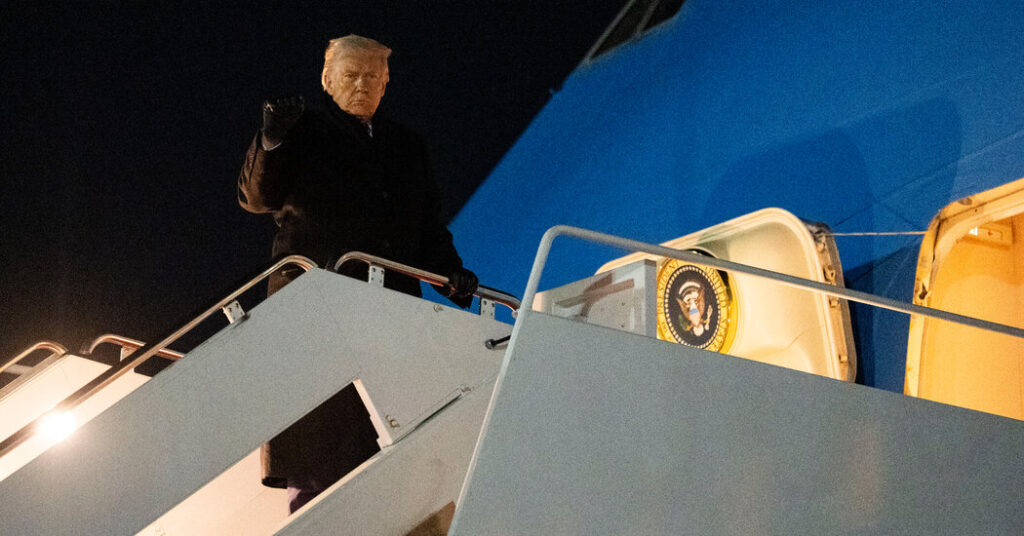
The relationship between President Trump and Europe’s far right was always an awkward one. European nationalists have long welcomed the momentum that the president has given their parties even as his “America first” doctrine spelled trouble for their countries.
Now, their association with Washington is emerging as an outright liability as Mr. Trump poses challenges to national sovereignty and chastises Europe.
In recent days, Europe’s nationalist leaders have taken a more strident stance against Mr. Trump after his military operations in Venezuela; his threats to take over Greenland, an autonomous Danish territory; and a rambling speech in Davos, Switzerland, that underscored his disdain for the continent.
Nigel Farage, the leader of the British far-right party Reform UK and long an ally of the American president, described Mr. Trump’s threats around Greenland as a “very hostile act.” Giorgia Meloni, Italy’s right-wing prime minister, who is largely seen as friendly to Mr. Trump, rejected his assertion that European soldiers had played only a minor role in Afghanistan.
Jordan Bardella, the president of the French far-right party National Rally, who has long expressed wariness of the U.S. leader, sharpened his criticism last week by describing Mr. Trump’s stance on Greenland as “unacceptable” and calling his recent threats to impose tariffs on France “blackmail.”
The European far right still shares key ideas with Mr. Trump and his political movement — including a push for less immigration, a desire for tightly controlled borders and worries about the erosion of European culture.
The Trump administration has officially praised “patriotic European parties,” and that affinity could quietly sustain ties between far-right leaders on either side of the Atlantic. But right now, public association with the U.S. president is increasingly looking like a politically treacherous high-wire act, especially for parties that make national pride and sovereignty cornerstone issues.
“Whatever the AfD or Rassemblement National believe about civilizational erasure and migration, they’re not for the American annexation of a big chunk of Europe,” said Justin Logan, a foreign-policy analyst at the libertarian Cato Institute in Washington, referring to far-right parties in Germany and France.
A year ago, Mr. Trump’s return to office seemed likelier to give European nationalists a tailwind than a headwind.
The Trump administration swiftly presented itself as a staunch defender of Alternative for Germany, or AfD, a far-right party that German intelligence services have called a “proven right-wing extremist organization.” Vice President JD Vance gave a speech in Munich last February urging German leaders to allow the AfD to enter the federal government, without mentioning any of the reasons, such as the use of Nazi slogans by some members, other parties have shunned it.
Then Mr. Trump and Mr. Vance expressed support for Marine Le Pen, a French far-right leader, after she was found guilty of embezzlement and barred from running for office — a conviction she is currently appealing.
The Trump administration’s national security strategy, released in December, codified what had long been apparent from its public statements: The White House sought to throw its weight behind far-right parties across the continent.
That felt like a “shot in the arm” to right-wing nationalist movements in Europe, said Jacob Reynolds, the head of policy at MCC Brussels, a research group that hosts events for European far-right politicians and is closely associated with Prime Minister Viktor Orban of Hungary, a Trump ally.
Yet, weeks later, Mr. Trump’s affronts to European sovereignty and dignity have left his ideological allies in a tight spot — especially after he insisted that he needed to own Greenland and threatened to impose more tariffs on European nations that got in his way, only to walk back those ultimatums.
“It damages populist, patriotic parties when these things are conducted in the open,” Mr. Reynolds said.
The challenge is all the greater for European nationalists because their voters were already eyeing America with increasing suspicion. A substantial share of voters aligned with the far right in Britain, France and Germany viewed Mr. Trump negatively even before recent weeks, polls have shown. Only 15 percent of Germans, the lowest figure ever recorded, now consider the United States a trustworthy partner, a survey carried out early in January found.
Now, Mr. Trump’s threats are being seized as an opportunity by the political center, which senses a chance to skewer its right-wing political opponents.
Manfred Weber, a German center-right politician who leads the largest party in the European Parliament, said in a speech last week that far-right lawmakers “have to decide if they want to be real Europeans, or they are a colony of Washington.”
Against that backdrop, Mr. Trump’s allies across the continent have sought to distance themselves from him.
In Italy, Ms. Meloni — who has long positioned herself as a bridge between Europe and Mr. Trump — reacted unusually strongly to Mr. Trump’s assertions last Thursday that NATO troops had “stayed a little back, a little off the front lines” in Afghanistan. She pointed out in a statement that 53 Italian soldiers had died, and that more than 700 had been injured.
“Friendship requires respect, a fundamental condition for continuing to ensure the solidarity that underpins the Atlantic alliance,” she said in a statement.
Other far-right parties that had already been edging away from Mr. Trump have now widened that space. Mr. Bardella in France had already been careful in how he talked about the American president. Early last year, he called Mr. Trump’s election “good news for America, but bad news for France and Europe.”
After the United States captured Venezuela’s president earlier this month and then promptly escalated its threats over Greenland, Mr. Bardella took an even stronger stance. The choice Europe faces, he said in a speech last week, is between accepting “a form of vassalization under the guise of trans-Atlantic partnerships” or responding strongly.
Renaud Labaye, a senior official in Mr. Bardella’s party, said in an interview: “We are sovereigntists. We believe every state should do what it wants and defend its own interests.”
In France, Mr. Trump has become so unpopular that any tie to him could seem politically toxic. Eric Ciotti, who leads a small party affiliated with National Rally, deleted two congratulatory social media posts that he put out after Mr. Trump’s election. Mr. Ciotti’s office did not respond to requests for comment.
Some nationalist parties, particularly those that had long benefited from their association with Mr. Trump and his supporters, have stayed silent or wavered over their response.
Robert Fico, the Slovakian prime minister, was at Mar-a-Lago, Mr. Trump’s home in Florida, on the day Mr. Trump threatened to raise tariffs on several European nations to punish their support for Greenland. Mr. Fico later posted about his visit on social media — without mentioning Greenland.
In Germany, the AfD’s leaders publicly disagreed over whether to criticize Mr. Trump’s actions over Greenland and in Venezuela or present it as a necessary realignment of the international order.
Beatrix von Storch, one of the AfD’s most prominent trans-Atlanticists, rejected any American claims to Greenland, saying on public television that the territory “clearly” belonged to Denmark. Alice Weidel, one of the two party leaders, said that Mr. Trump’s incursion into Venezuela had “violated a fundamental campaign promise, namely not to interfere in other countries.”
But the other party leader, Tino Chrupalla, reacted more favorably to Mr. Trump’s actions, saying that international law “must be renegotiated” and adding that “Venezuela belongs to America’s sphere of influence, just as Ukraine belongs to Russia’s sphere of influence.”
Maximilian Krah, another AfD lawmaker, backed American ownership of Greenland in an article on The Asia Times. “The U.S. cannot allow a significant part of the North American landmass — with considerable mineral resources — to remain outside its control,” Mr. Krah wrote.
Anton Troianovski contributed reporting from Washington, Christopher F. Schuetze from Berlin, and Ana Castelain from Paris.
Jeanna Smialek is the Brussels bureau chief for The Times.
The post How Trump Became a Liability for Europe’s Far Right appeared first on New York Times.