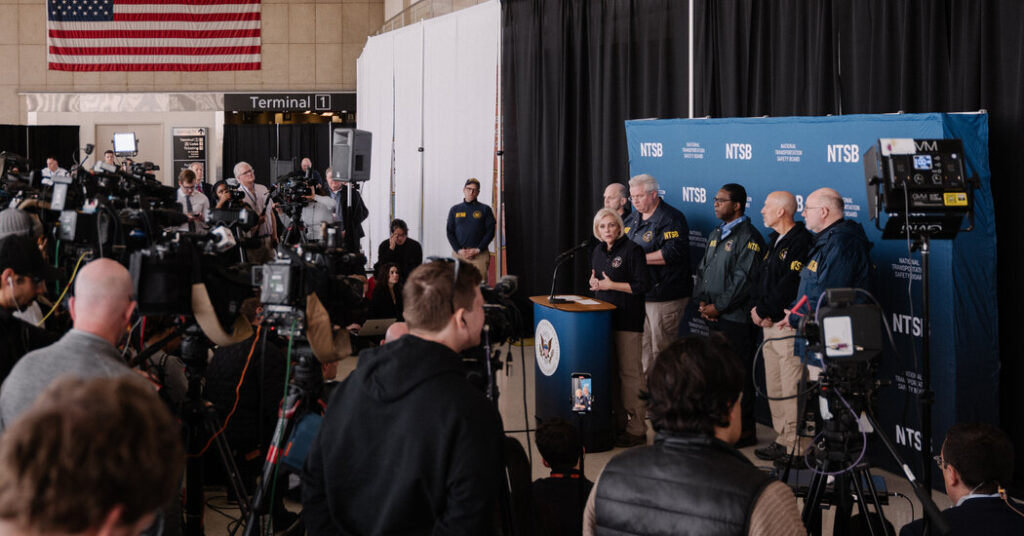
The National Transportation Safety Board is expected to decide Tuesday on the probable cause of a midair collision near Ronald Reagan National Airport last year that killed 67, and recommend changes to avoid similar aviation accidents in the future.
The meeting comes almost a year after an Army Black Hawk helicopter on a training mission collided with an American Airlines commercial jet bound from Wichita, Kan., to the Washington area. The deadliest aviation incident on U.S. soil in a generation, near a regional flight hub favored by federal officials, touched off a public outcry for changes to aviation safety, many of which have yet to materialize.
During a series of investigative hearings before the N.T.S.B. last summer, a number of harrowing details emerged about how systematic failures — as well as pilot errors — contributed to the accident.
Witnesses testified that Federal Aviation Administration officials ignored internal warnings that certain helicopter flight routes were putting pilots in dangerous proximity with airplanes landing at the airport. Others pointed out that understaffing at the control tower was straining air traffic controllers’ ability to juggle traffic.
Transcribed interviews released as part of the probe’s docket illustrated how frequently military pilots would fly helicopters under incoming planes to avoid collisions — and how many of the Black Hawks operating around the airport either did not turn on or did not have functional advanced tracking technology when they flew through the area’s congested airspace.
Witnesses spoke about the inherent flaws of altimeters that could have led the pilot of the Army Black Hawk to think she was flying at a lower altitude than she actually was. And the panel heard testimony about how the inexperience of the pilot, on a training mission, and the hesitance of her instructor, a more experienced pilot of a lower rank, could have contributed to the accident.
On Tuesday, investigative staffers will deliver their assessment of what role each of those factors might have played in the accident, as well as an overview of the probable chief cause. But it will be up to the board to vote on a verdict.
The board is also expected to issue a number of recommendations regarding flight routes, equipment and the requirements that planes operating in congested airspace turn on tracking technology that broadcasts their locations to other pilots — which the N.T.S.B. has been urging for decades. But with no regulatory authority, it will be up to the administration and lawmakers to determine whether to implement the changes.
The F.A.A. has already limited what aircraft can fly through the airspace surrounding Reagan National Airport, and reconfigured helicopter flight routes in the area, in response to urgent recommendations that the N.T.S.B. issued last March.
The agency also has been making significant investments to modernize the country’s aging air traffic control system. A funding bill pending before the Senate would pump billions more dollars into the F.A.A. to help with hiring more controllers, but the legislation could falter amid a political standoff over funding for immigration enforcement.
Late last year, the Senate passed bipartisan legislation setting requirements for using advanced tracking technology in congested airspace, securing endorsements from the Pentagon and the White House after a provision of the annual defense bill appeared to roll back restrictions on the military’s ability to operate in the vicinity of Reagan National Airport.
But the bill has stalled in the House, where transportation leaders have bristled at the idea of adopting the Senate’s legislation wholesale, and say they are waiting to review the N.T.S.B.’s recommendations.
The N.T.S.B. plans to publish a full report detailing the findings, causes and recommendations stemming from the accidents in the weeks after Tuesday’s meeting.
Karoun Demirjian is a breaking news reporter for The Times.
The post Transportation Safety Board Set to Declare Cause of Midair Collision appeared first on New York Times.