Diplomats often reach for a favorite phrase when civilians are being gunned down in the streets: We are monitoring the situation. I heard similar words when I was invited by the U.S. Mission to the United Nations to brief the Security Council earlier this month on Iran’s crackdown on protesters.
We are watching, diplomats at the session said. We are concerned. We condemn. It felt ritualistic — observe, express sorrow, move on.
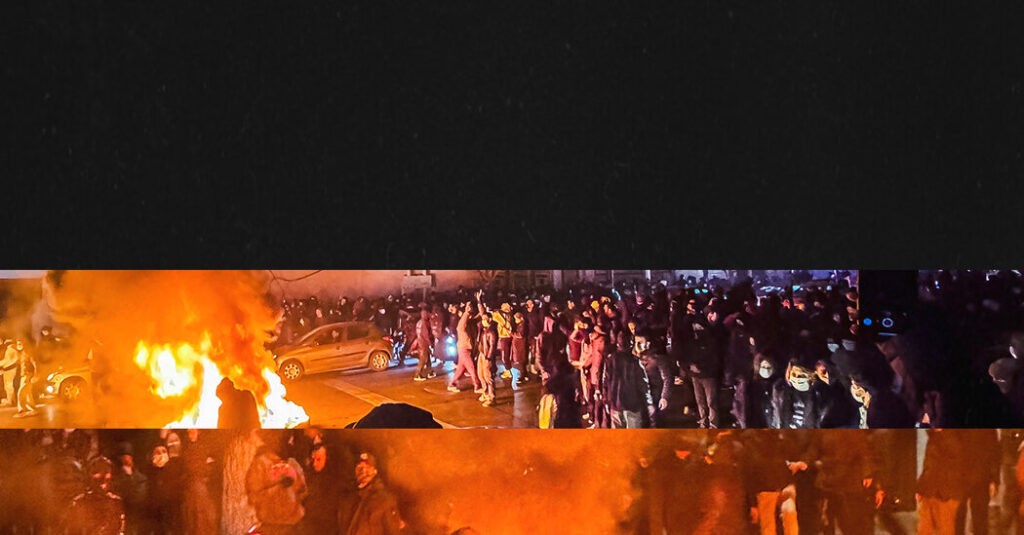
Iran’s rulers understand this ritual better than anyone. On Jan. 8, facing nationwide protests, the Islamic Republic imposed a near-total communications blackout, while security forces launched a military-style assault on unarmed protesters in dozens of cities. Now that some internet service has returned, the world can witness how the Iranian regime attacked its own civilians as if they were enemy combatants.
Its leader, Ayatollah Ali Khamenei, has acknowledged that “several thousand” people were killed. Independent accounts suggest that the toll is far higher. Some reports say the number could be as high as 16,500; activists in Iran talk of 20,000.
I’m in constant contact with Iranians inside the country, and what I hear from activists who witnessed killings, and mothers who are now mourning their children, is that we need the world to act. Iranian officials sent assassins to kill me on U.S. soil three times. I was saved only by the vigilance of U.S. law enforcement agencies. My dream, and the dream of millions of my compatriots, is to see Mr. Khamenei held accountable, and be tried for the crime of killing so many Iranians.
Earlier this month, President Trump repeatedly threatened leaders of the Islamic Republic, saying that if they used force against the protesters, the United States is “locked and loaded,” and would come to the protesters’ “rescue” if the killing continued. He encouraged Iranians to intensify their mass protests, writing, “HELP IS ON ITS WAY.”
That help never came, and many protesters now feel betrayed. Still, the U.S.S. Abraham Lincoln aircraft carrier strike group has recently arrived in the Middle East. Mr. Trump has not said what he plans to do now that it is there, but it does give him the option of striking a blow against government repression.
I’m no military planner, but it’s clear that attacks on the infrastructure of the Islamic Revolutionary Guards Corps and the Basij militia that it controls would damage the Islamic Republic’s protest-crushing machinery. The goal should be to disrupt the regime’s ability to shoot, jail and terrorize. The strike could also encourage fence-sitters inside the security services to stand down, if not actually join the protesters.
Europeans should designate the Islamic Revolutionary Guards Corps as a terrorist organization, something they have yet to do despite a mountain of evidence about the violence it has perpetrated. While they are at it, they should expel Iranian diplomats and close the country’s consulates.
Along with the standard expressions of concern I heard at the United Nations, Western governments reached for another familiar warning as the crackdown escalated this month: We cannot intervene. Experts invoke the disastrous war in Iraq or the chaotic violence in Libya. The conversation ends.
Both of those military misadventures are real scars. Skeptics of military action in Iran may argue that the United States would be violating Iran’s sovereignty with an attack and that it may trigger a “rally around the flag” effect. But sovereignty comes from the will of the people, and a regime that mows down thousands of its own citizens has lost its legitimacy. During the recent protests, Iranians burned the Islamic Republic flag and instead waved the pre-revolutionary Lion and Sun flag, a sign that limited strikes might not ignite wide-scale anti-American feeling.
Too often, the argument about the dangers of intervention is less about prudence than paralysis. It turns failures into a permanent permission slip for every dictator watching: Kill enough people and the world will be too afraid of past mistakes to stop you. The argument is dishonest because it pretends that intervention means invasion.
Iranians are not asking for foreign tanks to roll down the streets of Tehran. They are asking for the world to stop acting as if the only options are occupation or indifference. Inaction gives a regime time to regroup, rebuild its machinery of repression and return with a cleaner narrative and a longer list of prisoners.
In Bosnia, the world delayed until the Srebrenica massacre made inaction politically unbearable; eventually, a combination of pressure and force helped to end the slaughter in the former Yugoslavia. The peace was imperfect, but the killing stopped. In Kosovo, NATO intervention prevented a humanitarian catastrophe.
Outside of NATO’s backyard, after a referendum favoring independence triggered violence in East Timor in 1999, the U.N. Security Council authorized a multinational force to restore security and allow for humanitarian assistance. It was a focused intervention to stop militia violence and protect civilians. In Gambia in 2017, a dictator refused to give up power after losing an election. The region didn’t shrug. West African states brought pressure to bear, backed by a credible threat of force, to ensure a peaceful transfer of power. The dictator stepped down and fled into exile.
These are not fairy tales. They are evidence that the world has options besides the two extremes we sometimes pretend are the only ones.
When the world doesn’t choose one of the available options, we are left with graveyards.
Ask the Rohingya in Myanmar, where top military leaders are accused of genocide against the Muslim minority. Look at the Darfur region in Sudan, where civil war has led to the killing of tens of thousands of people, a stain on the international community for its lack of decisive action. The international response to the Rwandan genocide is not remembered as a cautionary tale about interventionist overreach. It is remembered as cowardice. The world had notice about the catastrophe but lacked the will to act.
President Obama had a chance in 2009 to support millions of Iranians who protested a rigged election. He spoke out but chose not to do more, to avoid undermining the protesters, he said, and to avoid ruining negotiations over a nuclear deal with Iran that he believed would help secure a wider peace in the region. Mr. Obama has since regretted that decision.
Now America has another chance to act in support of Iranian protesters. History will not accept “We were monitoring the situation” as an answer. Inaction has a body count.
Masih Alinejad (@alinejadmasih) is the founder of the My Stealthy Freedom campaign against the compulsory hijab and the author of “The Wind in My Hair: My Fight for Freedom in Modern Iran.”
Source photographs by Anadolu and MAHSA via Getty Images.
The Times is committed to publishing a diversity of letters to the editor. We’d like to hear what you think about this or any of our articles. Here are some tips. And here’s our email: [email protected].
Follow the New York Times Opinion section on Facebook, Instagram, TikTok, Bluesky, WhatsApp and Threads.
The post The Cost of Inaction Over Iran: ‘We Are Left With Graveyards’ appeared first on New York Times.