The Trump administration announced on Monday that it had agreed to extend up to $277 million in direct funding and up to $1.3 billion in loans to USA Rare Earth Inc., a mining and manufacturing group, to help develop its supply chain for rare earth metals and magnets.
The deal adds to the administration’s growing portfolio of equity stakes in private companies, and it would help expand domestic production of a critical input for cars, robots, semiconductors, drones and other products. China, which dominates the production of rare earth minerals and magnets, began clamping down on its export last year, and companies have struggled to find other sources of supply.
The Commerce Department, which arranged the financing through a semiconductor investment program set up during the Biden administration, said it had signed a nonbinding letter of intent to provide the funding, subject to further due diligence and approvals. The deal will give the Commerce Department approximately 16 million shares in the company, as well as a warrant to acquire another 17.6 million shares, the department said.
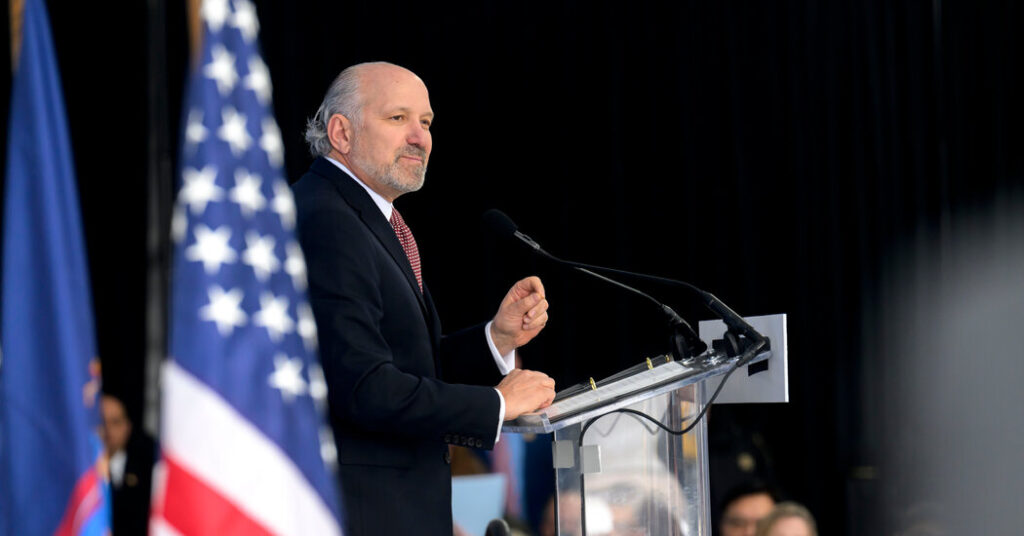
Howard Lutnick, the secretary of commerce, said in a statement that the company’s project was essential to “restoring U.S. critical mineral independence.” The investment “ensures our supply chains are resilient and no longer reliant on foreign nations,” he said.
On Monday, the company also announced that it had raised $1.5 billion through a consortium of private investors. For that transaction, Cantor Fitzgerald, a Wall Street firm formerly headed by Mr. Lutnick, acted as the lead placement agent, the company said.
The overlap between the Trump administration and Cantor Fitzgerald has recently been under scrutiny by Democratic lawmakers and others, after revelations by The New York Times that the Wall Street firm profited off several projects that Mr. Lutnick promoted in his official role as commerce secretary. Mr. Lutnick has divested from Cantor Fitzgerald, but the firm is now led by two of his sons.
Robert Weisman, the co-president of Public Citizen, a government ethics watchdog group that has been critical of the Trump administration, described the ties as concerning.
“The fact that the deal is brokered by the Wall Street firm formerly run by the Commerce Secretary — and now headed by his sons — is reason to worry that the public interest is being subordinated, yet again, to the profit seeking of Trump cronies,” he said.
A commerce department official said that the CHIPS office worked directly with USA Rare Earth on the government deal, with no involvement from Cantor Fitzgerald. Cantor Fitzgerald declined to comment.
The Trump administration has now announced deals to take equity stakes in at least 10 private companies, in an unusual strategy for a Republican administration.
Most of the deals involve the metals and mining sector, which the government has been trying to build up to ensure strategic independence from China. But the administration has also taken stake, or the option to acquire it, in the chipmaker Intel, the nuclear firm Westinghouse and U.S. Steel.
While critics say the practice risks distorting the private market, the Trump administration has argued that the deals give American taxpayers more benefits when companies succeed.
The funding announced on Monday is expected to support two projects, a mine anticipated to begin commercial production in Texas in 2028, and a manufacturing project in Oklahoma. USA Rare Earths would be the only company in the United States that would mine minerals containing rare earths, extract rare earth oxides, convert them to metals and turn that into the feedstock for magnets, the Commerce Department said.
Ana Swanson covers trade and international economics for The Times and is based in Washington. She has been a journalist for more than a decade.
The post Trump Administration Takes Another Stake in Rare Earth Sector appeared first on New York Times.