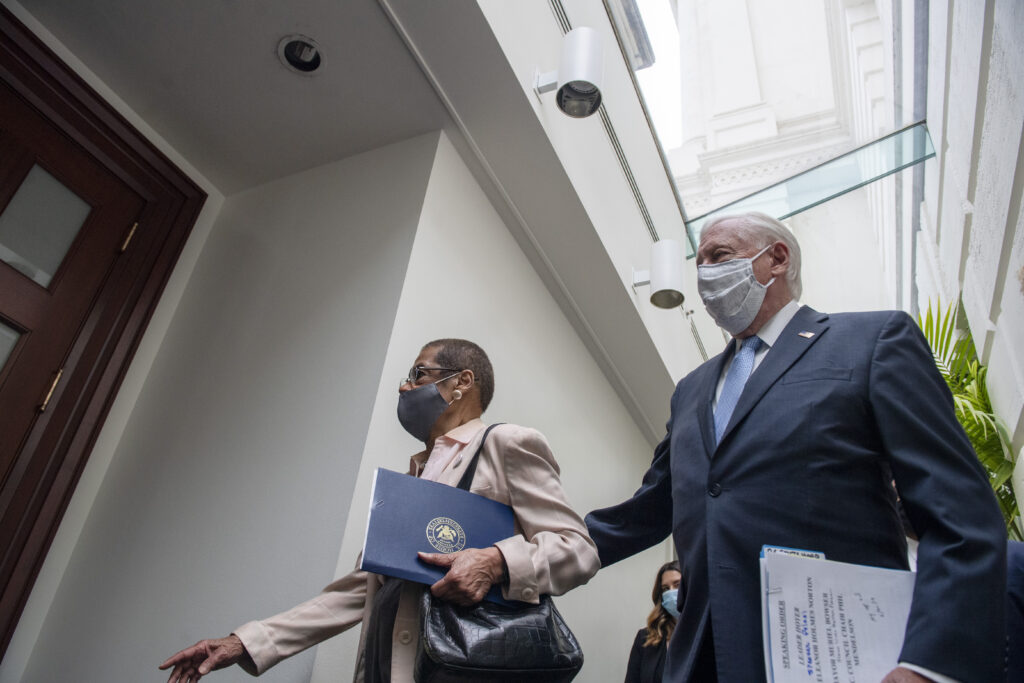
Eleanor Holmes Norton, 88, quietly filed paperwork Sunday to end her campaign for a 19th term as D.C.’s delegate to Congress. She did so after months of insisting she planned to persist, despite mounting evidence that she was in no shape to do so. It’s a sad ending to a life of public service, but similar stories have become too common.
Norton is part of a gerontocracy that has struggled to hand over the keys to power. President Joe Biden’s stubborn determination to seek a second term in his 80s, and the quiet acquiescence of Democratic Party leaders despite their knowing he was slipping behind closed doors, paved the way for Donald Trump’s return to power.
As much as anything else, that has led to a clamoring for generational change among the Democratic rank and file. Former House Majority Leader Steny H. Hoyer, who has represented Maryland in Congress since 1981, announced earlier this month that he will not seek reelection this fall. Last Friday, the 86-year-old endorsed his 31-year-old former campaign manager to replace him in the House.
The changing of the guard is good news for the region. The leading candidates in the Democratic primary to succeed Norton are D.C. Council members Brooke Pinto, 33, and Robert C. White Jr., 43.
There’s been an unusual amount of turnover recently across the local congressional delegations. Last year, Sen. Angela Alsobrooks (D-Maryland), in her 50s, succeeded Ben Cardin, in his 80s. After Rep. Gerry Connolly (D-Virginia) died at 75 in office last May, his 43-year-old former chief of staff James Walkinshaw won the special election to replace him.
There are 18 octogenarians in the House and six in the Senate, along with nonagenarian Chuck Grassley (R-Iowa). The 92-year-old has declined to rule out running for reelection in 2028.
Some people like Warren Buffett are able to perform effectively deep into old age, though even the Oracle of Omaha recently retired at 95.
Last week, as a prelude to his long-shot 2028 presidential campaign, former Chicago mayor Rahm Emanuel proposed instituting a mandatory retirement age of 75 for the president, the legislative branch and judges. Emanuel, 66, acknowledged it would even apply to him. He says he would step down rather than finish a potential second term in the White House.
Since age caps would require a constitutional amendment, they seem unlikely to ever take effect. But it’s notable that someone with Emanuel’s keen political instincts sees an upside in pushing for it anyway.
If aging politicians won’t take the hint and step aside gracefully, it’s on voters to reject the gerontocracy.
The post D.C. is about to get some needed generational change appeared first on Washington Post.