One year after two seemingly routine flights above Washington, D.C., ended in a deadly midair collision, some efforts to make the airspace significantly safer have faltered.
Since the crash, the Federal Aviation Administration, which controls the airspace, has asked airlines to modify their schedules to reduce the number of flights per hour at Ronald Reagan National Airport until the facility can handle a more normal tempo. The agency has also closed the air route that an Army helicopter was traversing when it collided with a passenger jet.
But control tower staffing is not much higher than it was at the time of the crash, according to F.A.A. figures. And morale within the tower remains low, according to two people who have spent time there recently, raising concerns about readiness.
Other steps that crash victims’ families had hoped would help protect fliers in the Washington skies seem to be languishing amid congressional inaction.
An air safety bill that recently passed the Senate faces opposition in the House, threatening its viability. And despite years of concerns by the F.A.A. and some lawmakers about congestion in the airspace around National Airport, there has been no meaningful discussion of permanently removing flight routes in and out of the airport to reduce the load.
The collision occurred Jan. 29, 2025, when an Army Black Hawk flew into American Airlines Flight 5342, which was on its way to land at National Airport from Wichita, Kan. Everyone aboard both aircraft died.
In December, the U.S. government admitted liability for the collision. As part of a civil suit brought by the family of one of the victims, the Justice Department said that the Army pilots flying a Black Hawk helicopter that night failed to maintain separation from the jet. Officials also acknowledged that the controller did not provide proper instructions, but denied that the lapse was the cause of the crash for the purpose of monetary damages.
An F.A.A. spokeswoman, Hannah Walden, said that the agency has taken steps to increase safety since the tragedy.
Since Sean Duffy was confirmed as transportation secretary, “he and the F.A.A. have taken decisive steps to correct past failures, strengthen accountability, and modernize” the national airspace, Ms. Walden said.
“We are acting proactively to mitigate risks,” she added.
On Tuesday, the National Transportation Safety Board, the independent government agency that has been investigating the crash, will share its findings on the cause of the collision and the circumstances around it.
The N.T.S.B. will also share recommendations for ways to improve safety.
The safety board fast-tracked its report to help bring closure to a frightening and impactful aviation crash, the nation’s deadliest in 24 years. The Army said it will work with the board to support “lasting improvements” in aviation safety, and the F.A.A. said it will “diligently consider” the board’s additional advice.
But to some who lost loved ones in the crash, the fixes that have been made since last January have been too gradual, and too reactive, to be satisfying.
Doug Lane, a Barrington, R.I., man who lost his wife, Christine, and 16-year-old son, Spencer, in the plane crash, said in an interview that, in his view, the F.A.A. has not been proactive about its own role as a safety agent. It instead looks to Congress for direction, he said, when crises happen.
“I’m kind of willing to forgive for things that happened before Jan. 29, 2025,” he said. “But I think the way that people react after that means a lot to me. And I’ve really gotten the sense that they have made no effort to learn from this.”
Understaffing, Grief and an Assault
The National Airport tower had been a troubled workplace before the crash, struggling with chronic understaffing and safety lapses.
Since then, conditions have improved at the tower, said two people who have spent time there recently who were not authorized to speak publicly, but morale has still not bounced back.
Ms. Walden said the F.A.A. conducts “regular wellness checks” at the facility to talk to the team there and listen to “any concerns.”
Currently, the tower employs 22 of the 30 controllers it is approved for, according to the F.A.A., an improvement over the 19 controllers it had at the time of the collision, but not by much. The F.A.A. noted that controllers there are currently working with eight trainees.
But before staffing got to its current levels, there was a wave of departures.
Some controllers who were working on Jan. 29 went on leave immediately, people who were familiar with the matter told The New York Times at the time.
Others, including senior managers, were relocated to different facilities in the aftermath of the crash, N.T.S.B. hearings revealed. The senior-most position in the tower, air traffic manager, has been occupied by three people within the past year. Still other management positions have gone unfilled, at times.
James Jarvis, an F.A.A. contractor who worked in the tower for years until his retirement in October, said he was bothered by the fact that certain management jobs had remained vacant in recent years and that others were occupied by people who had no knowledge of Washington’s skies, a sign that the agency has not always prioritized the facility.
“The F.A.A. and the public consider D.C.A. a gem,” said Mr. Jarvis, using a shorthand for the D.C. airport. “We have not treated it like a gem.”
Perhaps unsurprisingly, some controllers struggled psychologically in the aftermath of the crash, according to N.T.S.B. officials and others who spent time in the tower.
In the weeks and months after Jan. 29, N.T.S.B. investigators who were interviewing controllers sometimes found them highly distressed, said Jennifer Homendy, the N.T.S.B. chair. Some cried during conversations. One was spotted sleeping at their workstation, she said in an interview.
About two months after the crash, two investigators who had gone to the tower to conduct additional interviews were made aware of an altercation that had just occurred: one controller had punched another controller after a verbal argument that had grown heated, Ms. Homendy said. The aggressor was arrested by airport police, according to a Virginia court summons.
By that point, “our air traffic control team was really concerned about the well-being of the controllers in the tower,” Ms. Homendy said. She called the acting administrator at the F.A.A. as well as the president of the National Air Traffic Controllers Association and contacts on Capitol Hill to ask for help.
The F.A.A. declined to comment on the altercation or the call from Ms. Homendy. The agency noted that it has brought in four controllers from other sites to augment staffing.
A Popular Airport
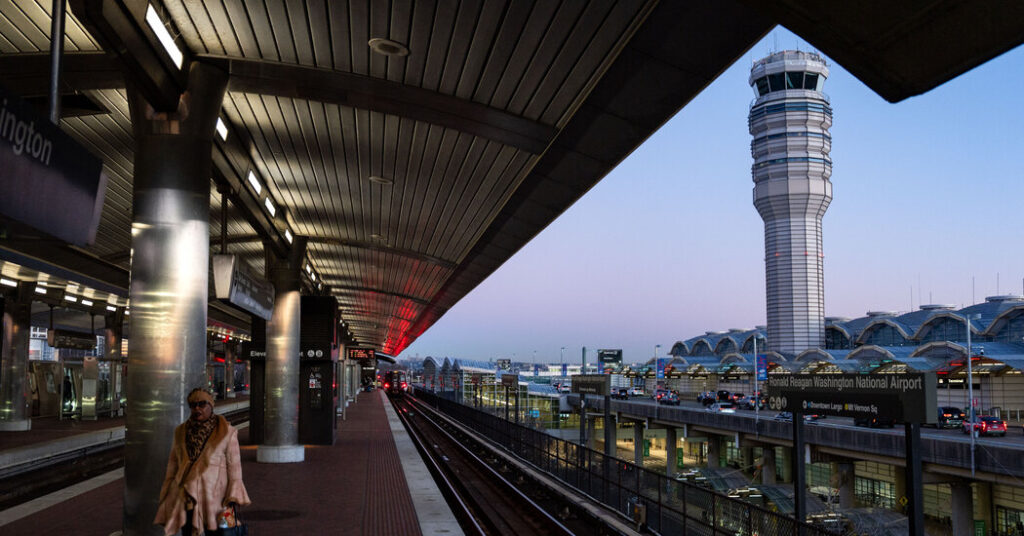
Reagan National Airport has in some ways been a victim of its own popularity.
Decades ago, it was established as the short-haul complement to the nearby Dulles International Airport, whose sprawling footprint and longer runways could more easily accommodate longer-haul flights.
But National Airport’s convenient location made it irresistible to many Washingtonians, including elected officials, who travel in and out often.
In recent decades, a series of congressional waivers have allowed airlines to add new and longer routes to the airport’s roster, adding to controller workload and to airspace congestion. In 2024, five new round-trip routes were added despite F.A.A. concerns about the strains those flights could add.
Last January’s midair collision came on the heels of a banner year for travel. National Airport set a record for the number of commercial passengers handled. The tower’s controllers had also been busy handling frequent military, medical evacuation and local law enforcement helicopters that passed through, often on very short notice.
In the aftermath of the crash, the F.A.A. initially reduced the number of hourly flights into National Airport from 36 to 26, but the number is now back up to 30. It also reduced helicopter traffic.
Figures kept by the Metropolitan Washington Airports Authority, which operates National Airport and Dulles, show that between January and October of 2024, 21.9 million passengers traveled through National Airport.
During the same period in 2025, the figure was 20.9 million, a 4.6 percent drop.
Still, family members of the crash victims say they know of no significant efforts on Capitol Hill to permanently reduce flights, even though many believe that airport congestion remains a problem.
Some lawmakers agree.
“I remain extremely concerned by the amount of air traffic in and out of D.C.A.,” said Senator Tim Kaine, the Virginia Democrat, in an emailed statement. “This is some of the most complex and crowded airspace in the country, and every additional flight that is crammed into it stretches an already overburdened runway and air traffic control work force.”
Mr. Kaine said he wants to work on removing routes from National Airport as soon as the N.T.S.B. and Army release their investigative findings.
Closing, and Reopening, a Loophole
Some victims’ families and N.T.S.B. officials say one of the most frustrating policy debates since the crash has been the back-and-forth over a cockpit system that allows aircraft to broadcast their locations and whether those should be mandatory to be used on military training flights.
That broadcasting system, which is a fixture on all commercial planes and the majority of military helicopters, provides real-time information to other pilots and controllers on an aircraft’s location in the skies, allowing others to track and avoid hitting it. But the Army, citing the need for confidentiality in case it is flying to secure locations, has long had a waiver on the system’s use, including for training flights, the type of flight that was occurring on Jan. 29.
In the aftermath of the crash, the F.A.A. ruled that the Army must use the system, even for training flights. But the mandate was unwound late last year in the annual defense spending bill.
The Senate last month passed an aviation safety bill that would revert to requiring the broadcasting system be turned on, along with a passel of other new aviation-safety measures that would secure skies in Washington and elsewhere.
But Representative Sam Graves, the Missouri Republican who leads the House Transportation and Infrastructure Committee, has called the bill “emotional” and has said he won’t support it as written, effectively relegating it to a back burner.
On Monday, he said in a statement to The Times that he was waiting to see the N.T.S.B. findings before “considering the best way forward.”
N.T.S.B. officials and relatives of people who died in the collision have bemoaned the setbacks.
In a text to The Times, Sheri Lilley, the stepmother of Sam Lilley, the first officer of the American Airlines flight, noted that the N.T.S.B. began recommending the broadcast system be activated 17 years ago.
“If those recommendations had been heeded at that time, this tragedy would not have happened,” she said.
Julie Tate, Kitty Bennett and Minho Kim contributed research.
Kate Kelly covers money, policy and influence for The Times.
The post A Year Past a Fatal Crash, Concerns About Safety at Reagan Airport Continue appeared first on New York Times.