Climate misinformation tends to proliferate around major weather events. On Friday, President Trump, a longtime climate skeptic, posted to social media, implying that the cold weather undermined the scientifically supported consensus that the planet is warming. (It is a claim he has made before.)
The science is clear. The world is warming because of the burning of fossil fuels, and that doesn’t mean there won’t still be some cold days.
Weather and climate are not the same thing, but they are related. In a broad sense, climate change encourages extreme weather events by altering the background conditions in the atmosphere. For example, as the atmosphere warms, it becomes capable of holding more moisture, and that moisture can then fall dramatically in the form of rain, sleet or snow.
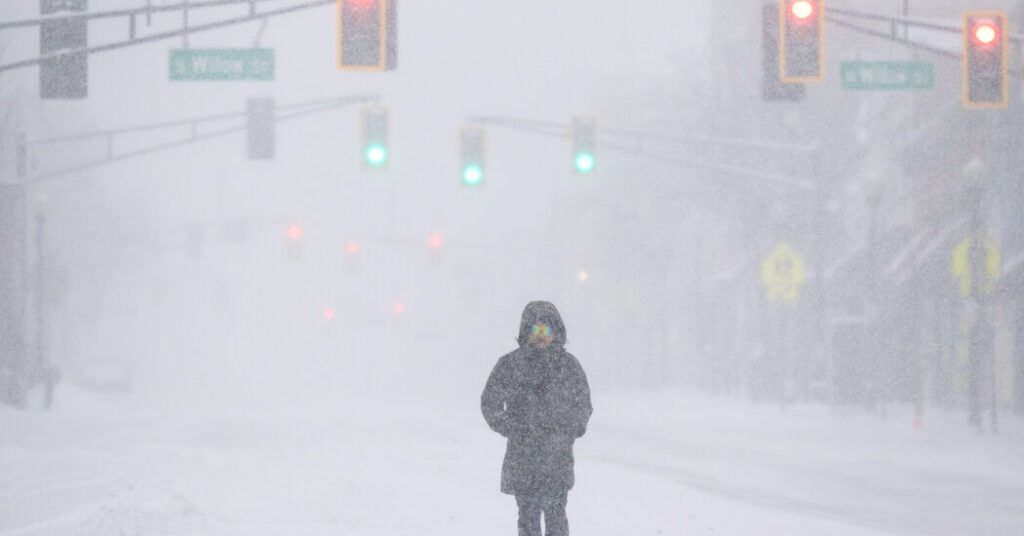
The frigid weather accompanying this week’s storm was driven by a polar jet stream, a fast-flowing air current high above the Earth that typically keeps cold air around the top of the world. There’s some evidence that the jet stream is weakening as the Arctic warms. And the Arctic is warming up nearly four times faster than the rest of the world.
But while it’s clear that the Arctic plays a large role in global weather patterns, scientists have not fully established a connection between changes in the jet stream and the warming there.
Renewable energy sources, like wind and solar, are sometimes a target of climate-related attacks at the time of severe weather as well. A typical claim is that they are at risk of falling short, contributing to blackouts. It’s a familiar line, and not necessarily the case. Following 2021’s winter storms in Texas, which knocked out more than 70 percent of the state’s electrical grid, Gov. Greg Abbott was among the politicians who blamed the state’s wind and solar sources for the lack of power. Peer-reviewed research has since found that the blackout was instead caused by freezing natural-gas pipelines and wellheads.
Some experts have found that renewable energy may actually be more reliable than fossil fuels during extreme weather events. A 2024 study of hundreds of cities and thousands of blackouts found that places with more renewables integrated into their grid were less vulnerable to blackouts.
Sachi Kitajima Mulkey covers climate and the environment for The Times.
The post How Does Climate Change Affect Winter Storms? appeared first on New York Times.