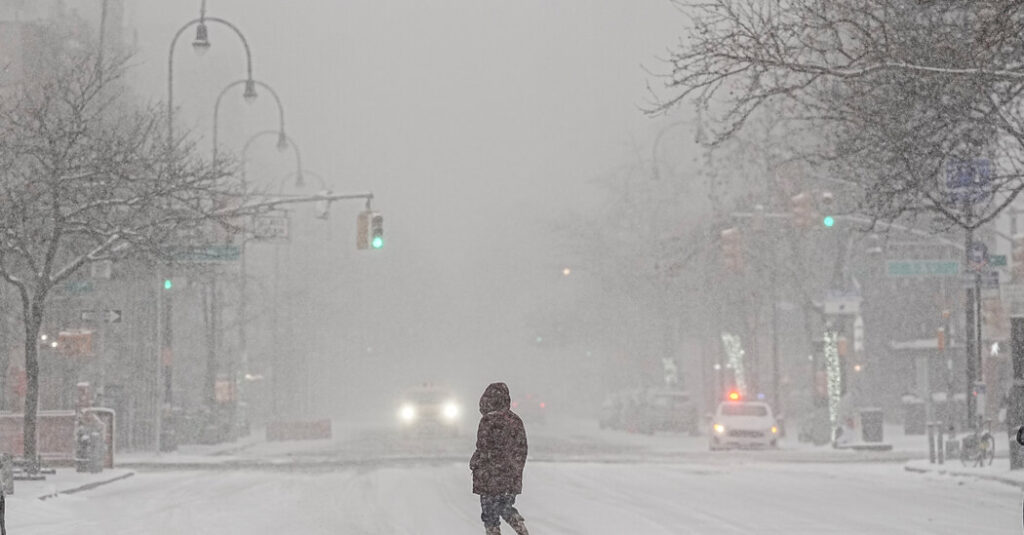
When the weekend’s winter storm bore down on New York City, residents were warned to stay inside to protect themselves from the dangerously cold conditions.
But doing so has been far from easy for the thousands of people who live on city streets and in the subway and parks.
Between Friday evening and Monday afternoon, eight people were found dead outside or later died at a hospital, officials said. They had not yet determined how the eight had died by Monday and said they were still investigating whether the people were homeless.
Mayor Zohran Mamdani said some of them had “interactions with the shelter system” in the past, but did not provide specifics.
The city is now continuing a desperate operation to get people inside, especially as temperatures are expected to be below freezing all week.
Andrew Chappotin, 41, said he slept in a tent on Thursday night near 18th Street in Manhattan, swaddled by more than 30 cardboard boxes, several mylar blankets, sleeping bags, two layers of pants and a T-shirt, tank top, long-sleeve shirt, hooded sweatshirt and coat. He also had four different types of gloves, he said, all part of a diligent preparation for the oncoming weather.
Still, he said, it wasn’t enough to feel warm. So he moved on Friday into the subway station at 50th Street and Eighth Avenue.
“I’ve been close to freezing to death, I’m pretty sure,” said Mr. Chappotin, who also advocates for the homeless with the Safety Net Activists at the Urban Justice Center. “It freezes you to where your brain stops working.”
Eventually, he joined his sister in her one-bedroom apartment in Brooklyn, where she lives with her husband and two children. He plans to go back outside on Tuesday, saying that he felt he had overstayed his welcome.
City officials said they would continue through the week to try to help people like Mr. Chappotin.
“Just because the storm has passed does not mean that the danger to homeless New Yorkers has passed,” Mr. Mamdani said on Monday. “Outreach teams are only intensifying their efforts today to connect vulnerable New Yorkers to shelter.”
Some 400 outreach workers raced to connect with those they knew might be outdoors on Monday: people discharged from hospitals or jails, in between apartments, struggling with mental illness or who were afraid to stay in city shelters.
The city opened 10 additional drop-in “warming centers” at schools for people in need. As of Monday, more than 200 people had been brought into shelters from the streets, said Dora Pekec, a spokeswoman for City Hall.
The storm, and the city’s response, underscores the difficulties of New York City’s housing woes. The city has a “right to shelter” law, meaning it must provide shelter to people who do not have a place to live.
In recent years, homelessness has reached record levels in the shelter system. Still, many people do sleep outdoors or in other public places.
More than 4,500 people were found to be homeless and not in shelters during a point-in-time count last January, the third year in a row the number has been over 4,000. The number is, according to many experts, an undercount.
Ms. Pekec said that New Yorkers could find warmth inside 126 shelters, more than 50 hospitals and the warming centers. The city is encouraging people to call 311 if they see people outside who need help.
Most people contacted by an outreach worker accept help, city officials said. But they said they also could bring people into shelters involuntarily if they were in danger; at least three people had been taken into a shelter or a hospital during the storm, officials said.
“An individual who is not appropriately dressed, who is wet, who is unable to acknowledge that they that there are the real dangers — that is the kind of instance, particularly in this weather, where we will where we’ll take somebody at the hospital,” Molly Wasow Park, the commissioner of the Department of Social Services, said at a news conference on Monday.
At the Urban Assembly School for Law and Justice, a high school in Brooklyn that is hosting a warming center, two people sheltered in a canteen-like hall on Monday afternoon.
Blue-and-steel cafeteria tables were stacked all around. One woman slept on a mat near the windows with a jacket draped over her. An officer with the city’s Department of Homeless Services stood in one corner.
The other person seeking warmth in the hall was Andrew Taylor, a 46-year-old homeless man. A person who he assumed worked at the center had found him outside nearby on Sunday night and asked him to come in, he said.
Dressed in a patterned woolen hooded sweatshirt and an orange beanie, he has remained at the center since. “I like it here,” Mr. Taylor said.
He said he has been dealing with homelessness for a “long, long time,” and planned to stay at the center for as long as it remained open. City officials said they would be open through at least Monday evening.
David Giffen, the executive director of the Coalition for the Homeless, said the pattern repeats every year, when about one dozen people die in the cold.
“When these individuals have gone years, and have had every one of these systems failing them again and again and again, and not giving them what they actually need, you end up with people still outside in this cold,” he said.
Mr. Giffen said the real problem was the city’s lack of housing.
“We wouldn’t have so many people lying out on subway platforms and exposed to elements,” he said.
Oishika Neogi contributed reporting.
Mihir Zaveri covers housing in the New York City region for The Times.
The post New York City Races to Help Homeless People as Temperatures Plunge appeared first on New York Times.