After Alabama state troopers and county deputies brutally attacked civil rights demonstrators trying to march to Montgomery from Selma in 1965, the Justice Department ordered F.B.I. agents to investigate. While no federal charges were brought, the evidence they gathered helped establish and preserve for history the misdeeds of the state and local police.
That investigation helped establish a model. Especially since the civil rights movement, the federal government has helped ensure the credibility of investigations into high-profile incidents of brutality and misconduct by police officers, stepping in if the local authorities appear unwilling or unable to do a credible job in holding law enforcement officials to account.
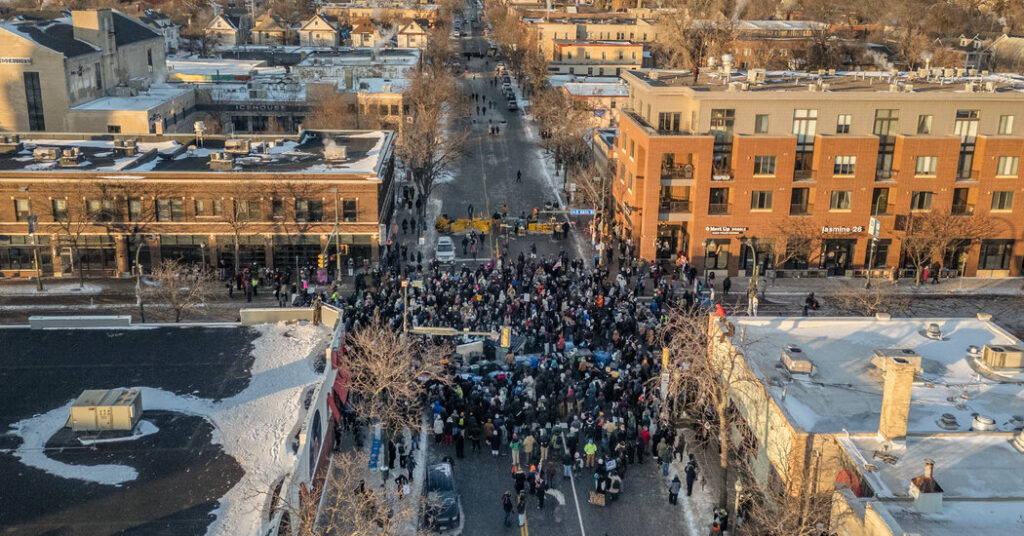
But since federal agents have descended on Minneapolis, the Trump administration has inverted that traditional dynamic in the killings of two people, Renee Good and Alex Pretti, at the hands of immigration enforcement agents. The F.B.I. does not appear to be investigating the sequence of events, even as federal officials have rushed to portray the shootings as justified. The local police are the ones trying to make real inquiries.
“Our office has jurisdiction to review this matter for potential criminal conduct by the federal agents involved and we will do so,” Mary Moriarty, the attorney for Hennepin County, said over the weekend, in connection with filing a lawsuit to try to prevent any destruction of evidence about the killing of Mr. Pretti.
That is a sharp role reversal from the usual pattern in which the federal government has backstopped dubious behavior by state and local law enforcement officials.
Homicide is normally a matter for the local police, which could then yield state criminal charges. But a post-Civil War statute, originally enacted to help combat violence by state and local officials in the South against formerly enslaved people, makes it a federal offense for anyone “under color of law” to willfully deprive people of their rights.
During the civil rights movement, the Justice Department began using that law to go after egregious violations of civil rights. In more recent decades, there have been a series of high-profile cases in which federal officials used it to investigate — and sometimes bring charges — when there was public doubt about the work of state investigators and prosecutors.
In 1992, after four officials from the Los Angeles Police Department were acquitted in state court over the videotaped beating of Rodney King, Justice Department prosecutors brought federal civil rights charges against them. Two were convicted in 1993 and two were acquitted.
In 2020, after the police killing of George Floyd in Minneapolis set off protests nationwide, both state and federal officials investigated what had happened. The police officer, Derek Chauvin, was convicted of murder in state court in 2021, but the Justice Department also indicted him on federal civil rights charges, to which he eventually pleaded guilty.
Federal investigations of the local police in high-profile cases have not always resulted in charges, but they can at least help provide a more independent look at what happened.
In 2014, a police officer in Ferguson, Mo., shot and killed Michael Brown amid claims that he had been surrendering at the time, leading to protests and rioting. A state grand jury declined to indict the officer, leading the Justice Department to conduct its own investigation. But it concluded in 2015 that the evidence showed Mr. Brown had not been surrendering and that the officer had fired in self-defense.
Another federal law also empowers the Justice Department to investigate state and local police agencies for any “pattern and practice” of discriminatory policies, and to file civil rights lawsuits to impose rules and reforms. In the Ferguson matter, for example, even as the department cleared the officer of wrongdoing in the shooting of Mr. Brown, it also found that the local police had a pattern and practice of unlawful conduct toward local residents.
It is much rarer, however, for state and local prosecutors to try to bring charges against federal law enforcement officials for a shooting as part of their official responsibilities. One reason is volume: There are far fewer federal agents who use force in their work than the local police patrolling the streets, and federal agents also tend to receive more training.
Federal agents can open assessments when there are questions about local police shootings, but they do not routinely do so. In the same way, the local police tend to defer to federal agencies to handle internal reviews of shooting incidents. On occasion, however, the local officials investigate what happened independently, and sometimes their findings diverge from federal reviews.
One example involved a March 2002 incident in which an F.B.I. agent shot an innocent Maryland man in the head after mistaking him for a bank robbery suspect. The bureau paid $1.3 million to settle a lawsuit, but internally considered the shooting to have complied with its procedures.
A police detective from Anne Arundel County, Md., however, prepared an independent report about the episode, and it raised subtle but important differences to the F.B.I.’s narrative of what happened in ways that made the F.B.I. agent’s actions look less reasonable. Still, a grand jury declined to indict the agent.
Indeed, bringing charges over any findings of misconduct is much harder. Federal officials can ask to have those cases removed to federal court and then invoke immunity.
An 1890 Supreme Court case says federal officials are immune from state charges when acting within their authority. To overcome such an invocation, prosecutors face the steep task of proving that an officer intentionally went too far.
A rare example came after an F.B.I. sniper killed Vicki Weaver, the wife of a white supremacist militia leader, amid a standoff at Ruby Ridge, Idaho, in 1992. A federal review found the shooting unjustified. The government paid her family a civil settlement.
In 1997, just before the five-year statute of limitations was set to expire, a local prosecutor filed a manslaughter charge against the agent. It was removed to federal court, and a district court judge threw out the charge, but an appeals court reinstated it. At that point, however, the local prosecutor’s office — which had changed leadership in the interim — dropped the case, saying it was unlikely that the offense could be proved beyond a reasonable doubt.
For now, in Minneapolis, it remains to be seen whether the local and state officials will succeed even in conducting a serious investigation into what happened, let alone any attempt at charges. Usually, state and federal investigators cooperate and share access to crime scenes and witnesses, but the Trump administration has declined to share evidence.
“For decades, in terms of investigation and cooperation, while there hasn’t always been the best cooperation there has always been some,” said Geoffrey P. Alpert, a criminology professor at the University of South Carolina who studies critical incidents with police. “Now we’re seeing not only no cooperation, but contamination. That’s new territory.”
Charlie Savage writes about national security and legal policy for The Times.
The post Killings in Minneapolis Invert Usual Dynamic Over Policing the Police appeared first on New York Times.