Many of the snazziest decorations in the animal kingdom are charm offensives, put on by creatures trying to mate.
While some of these adornments, like a peacock’s tail feathers or a moose’s antlers, are obvious even to humans, others can be perceived only with sensory capabilities that we don’t have.
A new study, published on Monday in the Proceedings of the National Academy of Sciences, offers the first evidence of one such display: cuttlefish dazzling potential sexual partners by creating a pattern on their skin, based on the orientation of light waves and invisible to the human eye.
When humans (and most other mammals) see light, we can’t discriminate between waves of light that are bobbing up and down vertically as they travel and waves of light weaving horizontally, from side to side. But lots of animals, including some fish, insects and soft-bodied sea creatures like cuttlefish, can perceive the orientation of light waves’ oscillations as those beams move through air or water. If light passes through a filter that blocks some of those orientations, the light is said to be “polarized.”
Since we can’t perceive the orientation of light waves, “it’s really difficult to know exactly what polarized light looks like to an animal that can see it,” said Arata Nakayama, an author of the study and a research fellow at the National Taiwan Normal University. As far as researchers can tell, polarization adds contrast or texture to what an animal sees, which can help make objects stand out more clearly against their surroundings.
For 30 years, scientists have known that cuttlefish, which are related to squids and octopuses, can see the orientation of light waves, and that parts of a cuttlefish’s body can reflect polarized light. For his doctorate at the University of Tokyo, Dr. Nakayama investigated whether polarized light is incorporated in cuttlefish mating displays.
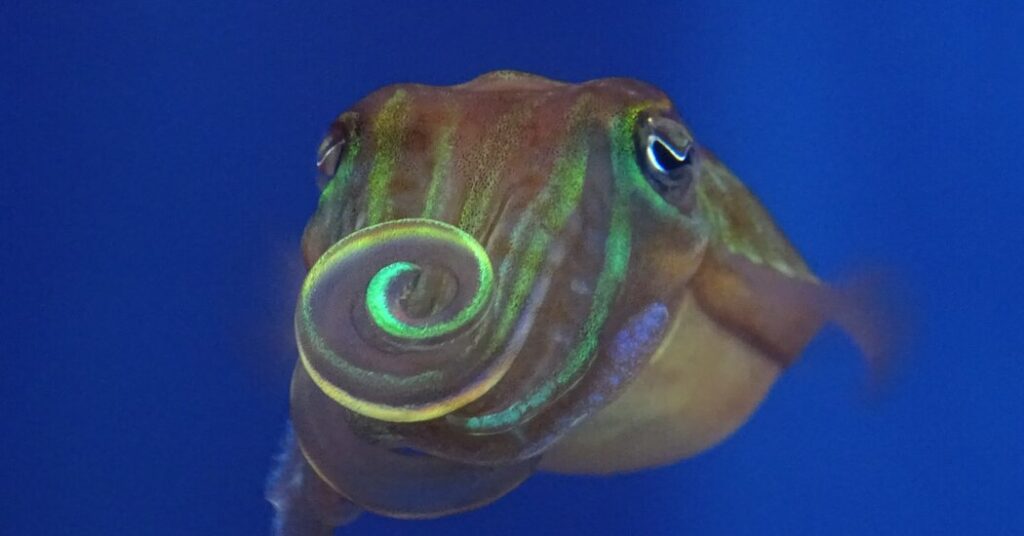
Male cuttlefish have a specialized pair of extra-long arms that they unfurl and extend in front of them during courtship. In the basement of the Asamushi Aquarium, Dr. Nakayama observed cuttlefish in a tank, in hopes of catching this mating display on camera. After more than a month of “sitting in front of the tank all day, every day,” Dr. Nakayama finally got a clear picture of a male cuttlefish’s extended arms.
To the naked eye, both extended arms had dark and light stripes, but the specialized camera revealed another, “hidden,” pattern, of vertically polarized light oscillating up and down and horizontally polarized light oscillating from side to side.
“When I saw the polarization pattern on my laptop, I was incredibly excited and also confused, because it didn’t look like any polarization pattern previously reported in animals,” Dr. Nakayama said. “That was honestly one of the most unforgettable moments in my life.”
Further observations of the cuttlefish, along with examinations of tissues in their arms, helped explain how they produce this strange pattern. During the courtship display, the male cuttlefish shrinks the pigment cells in the skin of its arms, exposing the reflective cells beneath them. These cells polarize light so that it’s oriented horizontally.
But from the vantage point of the female, who is typically positioned a few inches beneath the male during its display, some of this horizontally oriented light passes through the transparent muscles in the extended arms, causing its orientation to rotate to vertical.
Since this polarization pattern is seen only in flirtatious males, it could be that it evolved as an eye-catching mating display. “This is just opening the door to a very novel, very different way to manipulate light for an animal signal,” said Roger Hanlon, a senior scientist at the Marine Biological Laboratory in Woods Hole, Mass., who was not involved with the study. Dr. Hanlon said the paper could “stimulate the bio-inspired engineering of new classes of materials,” with potential military applications in underwater signaling for ships and submarines.
For Dr. Nakayama, the project’s importance lies in the insight it gives into how animals’ sensory capabilities work in tandem with their communication. “Different species have different ways of standing out, and studying those differences helps us understand evolution itself,” he said.
The post A New Way to Flirt: Dazzle Potential Mates With Patterns Invisible to Humans appeared first on New York Times.