One of my first memories of celebrating New Year’s was in Caracas, Venezuela, on a family visit. That trip is a flicker of scenes, as most early memories are. A packed church, a grove of fruit trees, a busy city with mountains in the background, impossible-looking birds with rainbow feathers.
The Venezuela I perceived was one of abundance, even without knowing I was standing on top of the world’s largest proven oil reserves. Oil production at that time was well over 2.5 million barrels a day, and poverty was falling as the popular president Hugo Chávez distributed profits from the nationalized energy industry to the poor.
That was before the inevitable costs of Chávez’s socialist movement caught up with its spending. As the economy started to slow down over the next decade and deadly lawlessness increased, my cousins sought the safety of an education abroad. Relatives started spending more time outside the country they loved than in it. Many left altogether.
They were, in retrospect, the lucky ones. A large deficit, rampant corruption and plummeting oil production contributed to hyperinflation that sent the economy into a spiral and roughly 8 million Venezuelans into refugee status. A land of abundance was starving.
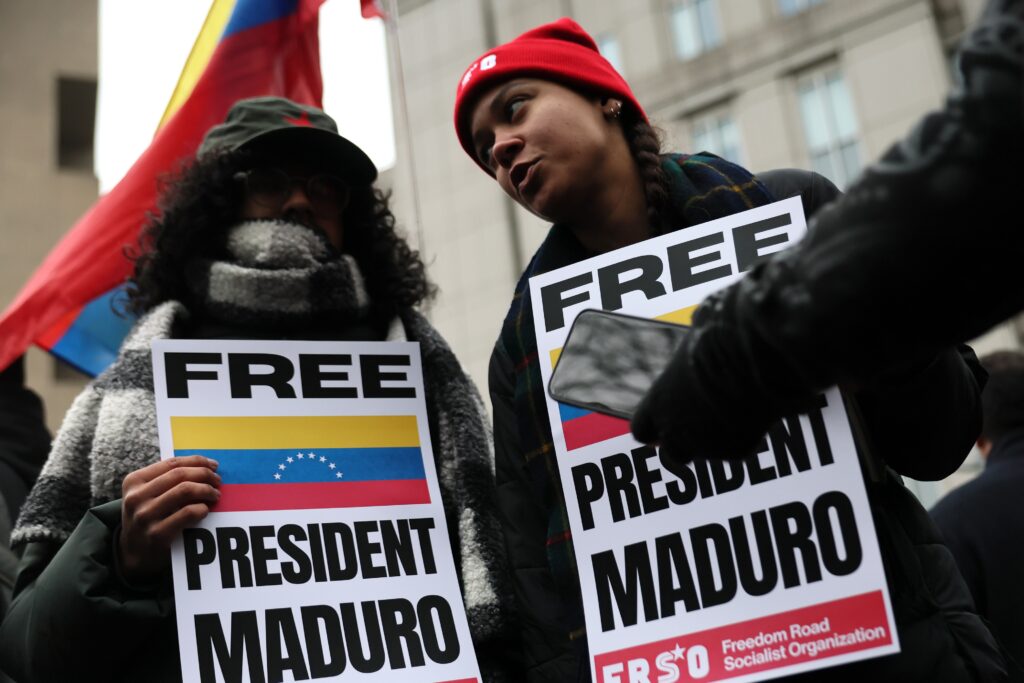
Even on top of a seemingly unlimited source of wealth, the socialist regime drove the nation’s economy into the ground. But today, as socialism’s popularity is surging with young Americans, a new narrative is emerging about Venezuela’s decline: that it wasn’t driven by flawed ideology but by American intervention. In the aftermath of Nicolás Maduro’s capture, socialist protesters in New York City assured me that Chavismo could succeed if only given the chance.
At a protest in Times Square the day after Maduro’s capture, Andre Easton, a congressional candidate from the Bronx, told me that “if we truly want to see the improved lives for the people of Venezuela, the people of Cuba and all other nations under U.S. sanctions, we have to call for an end to those criminal sanctions.” Two days later, at Maduro’s arraignment in Lower Manhattan, young socialists praised Maduro and blamed Venezuela’s economic hardships on Western intervention. One young man told me Maduro’s regime was “doing the best that they can” despite “U.S. involvement trying to destabilize the country for decades.”
But the timelines of these young would-be revolutionaries are wrong. It’s true that American sanctions put pressure on Venezuela’s economy, but only after it was already spiraling because of socialist policies.
From 2005 to 2017, the U.S. imposed narrowly targeted sanctions on individuals and entities involved in terrorism, drug trafficking and antidemocratic activity. The U.S. cut off commercial arms transactions with Venezuela in 2006 after determining the regime was “not cooperating fully” with U.S. counterterrorism efforts.
Sanctions with broader macroeconomic implications didn’t start until 2017 when the first Trump administration cut off the Venezuelan government — including the state oil company PDVSA — from accessing U.S. financial markets. In 2018 and 2019, the Trump administration ratcheted up the pressure on the Maduro regime with a variety of sanctions, including blocking purchases of Venezuelan debt and freezing the Maduro government’s assets in the U.S.
These broader sanctions weren’t a generic effort to stick it to a socialist regime — they were a response to the corruption, humanitarian crimes and economic decay that already flowed from it.
The irony of Chavismo is that it succeeded for as long as it did only thanks to capitalism. After a series of market liberalizations, oil production was at over 3 million barrels a day around 1998, the year Chávez was elected. Oil prices remained high throughout Chávez’s rule, making it easy for the socialist president to plunder PDVSA, to fund generous social services that temporarily helped slash poverty. He remained so popular that in 2009 his coalitionwon a referendum to eliminate term limits.
In the background, Chávez was enacting economic policies that put the oil industry on track for a crash. After strikes in the early 2000s, hereplaced many industry experts with regime loyalists. In 2007, he changed the agreements with multinational companies to favor PDVSA, in some cases expropriating assets altogether. While Chávez shelled out cheap oil to his Caribbean comrades and padded his cronies’ pockets at home, he was driving PDVSA’s cash flow away from critical reinvestment.
The bottom fell out shortly after Maduro took office in 2013 upon Chávez’s death. Global oil pricestanked in 2014, and GDP started to plummet. In 2015, according to some measures, Venezuela’s household poverty rate soared to over 70 percent, and hyperinflation took off in 2016, months before the Trump administration’s sanctions took effect. Oil production fell from over 2.4 million barrels a day in 2014 to just shy of a million in 2025.
Young American socialists believe that the Venezuela of my childhood could have succeeded: a place where unlimited wealth could indefinitely back a generous welfare system. But that period was an illusion, propped up by high oil prices. Chavismo was on track to fail, with or without U.S. sanctions.
As socialism continues to gain popularity among my generation, it’s important to debunk its biggest lies about Venezuela. This latest crop of revolutionaries believes that they can get it right this time. If that’s true, then why are they making so many excuses?
The post Young Americans should know the truth about Venezuela’s decline appeared first on Washington Post.