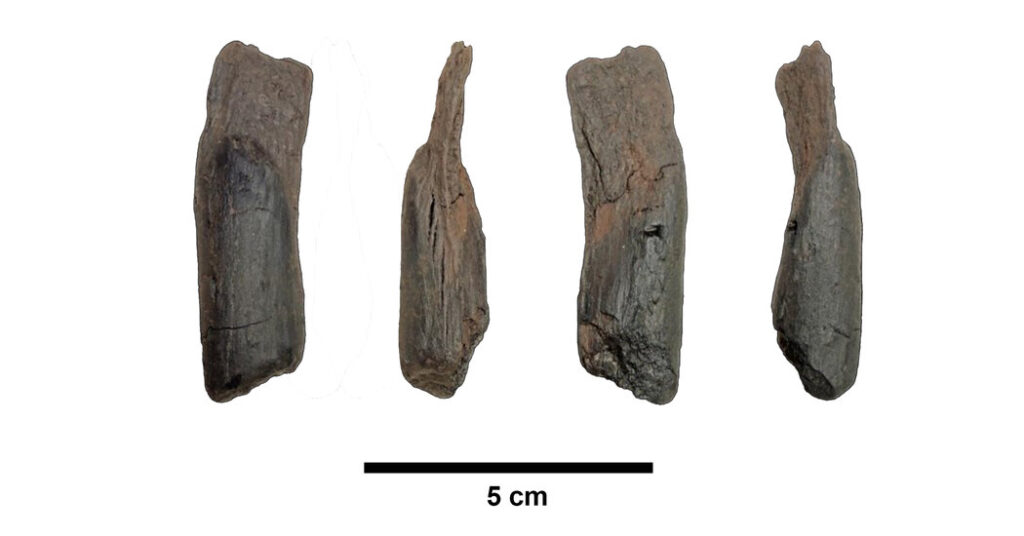
Early hominins in Europe were creating tools from raw materials hundreds of thousands of years before Homo sapiens arrived there, two new studies indicate, pushing back the established time for such activity. The evidence includes a 500,000-year-old hammer made of elephant or mammoth bone, excavated in southern England, and 430,000-year-old wooden tools found in southern Greece — the earliest wooden tools on record.
The findings suggest that early humans possessed sophisticated technological skills, the researchers said. Katerina Harvati, a paleoanthropologist at the University of Tübingen in Germany and a lead author of the wooden-tool paper, which was published on Monday in the journal PNAS, said the discoveries provided insight into the prehistoric origins of human intelligence.
Silvia Bello, a paleoanthropologist at London’s Natural History Museum and an author on the elephant-bone study, which was published last week in Science Advances, concurred.
The artifacts in both studies, recovered from coal-mine sites, were probably produced by early Neanderthals or a preceding species, Homo heidelbergensis. Homo sapiens emerged in Africa more than 300,000 years ago, and the oldest evidence of them in Europe is a 210,000-year-old fossil unearthed in Greece. By the time Homo sapiens established themselves in Britain 40,000 years ago, other hominins had already lived there for nearly a million years.
Sticks and stones
Because archaeology is in a perpetual state of rewriting its own history, the oldest record of any development is often temporary. The oldest known evidence of early humans intentionally crafting wood for structural purposes was found in 2019 at Kalambo Falls in Zambia and dates back 476,000 years. It consists of two carved, interlocking bushwillow logs that seem to have formed part of a dwelling or platform. “Organic artifacts, especially those derived from plants, are a lot more fragile and harder to find than those made from stone,” Dr. Havarti said.
The relics in the new wooden-tools paper were excavated from a deep layer at the Marathousa 1 site, a former lakeshore mine in the Megalopolis basin in Greece. They date back to the Middle Pleistocene age, which lasted from roughly 478,000 to 424,000 years ago. At the site, archaeologists discovered the partial skeleton of a straight-tusked elephant; the remains of turtles, birds, rodents and hippopotamuses; and stone tools used for butchering. Among the dozens of wood fragments embedded in the debris, two — a worked alder shard for digging and a carved poplar or willow twig — had been used as tools.
“We found marks from chopping and carving on both objects, clear signs that humans had shaped them,” said Annemieke Milks, an archaeologist at the University of Reading in England and a lead author of the study, who conducted microscopic analysis and CT scans of the items.
The digging stick was found among the elephant bones. Might it have been used to chop and carve meat from the carrion?
“I’ve never tried to cut up an elephant carcass, so I don’t know,” Dr. Havarti said. “I assume it’s not so easy, but I mean, I guess it’s possible.”
Elephantine tools
There is no older or more comprehensive assemblage of carved, sharpened elephant-bone tools than the collection uncovered over the last decade in the Olduvai Gorge in Tanzania, which dates back 1.5 million years. Previously, European elephant-bone tools were thought to be limited to the warmer south and to have appeared within the last 450,000 years. But an hammer made of elephant or mammoth bone, discovered at the Boxgrove site in West Sussex in England during the 1990s and only recently identified, overturns that assumption.
The setting is rich in flint, bone and antler fossils, but this was the first tool of elephantine bone discovered there. Deformities on its surface indicate that it was created and used while fresh, leaving researchers to speculate on whether the ancient elephant was hunted or scavenged.
Dr. Bello said the tool, four inches long and triangular, was used for knapping, the process of breaking off flakes from a stone to create tools like hand axes. Researchers found distinctive notches and marks on the bone fragment. “The hammer has been struck against stone, repeatedly,” Dr. Bello said. “The small pieces of flint found embedded in the bone confirm that it was used for this specialized purpose.”
Citing the maxim that an absence of evidence is not evidence of absence, Dr. Bello suggested that the apparent scarcity of early tools resulted from poor preservation or difficulties in identification. Thomas Terberger, an expert in ancient artifact analysis at the Lower Saxony State Office for Cultural Heritage in Hannover, Germany, agreed. “Further proof may be found in as-yet undiscovered sites or existing museum collections,” he said.
Dr. Terberger noted that the new studies highlighted the diversity of raw materials that prehistoric people used for toolmaking. “Flint was more common, but bone and wood were probably more valuable for our ancient ancestors,” he said. “Imagine how many tools you can make from a single large bone of an elephant.”
The post 430,000-Year-Old Wooden Tools Are the Oldest Ever Found appeared first on New York Times.