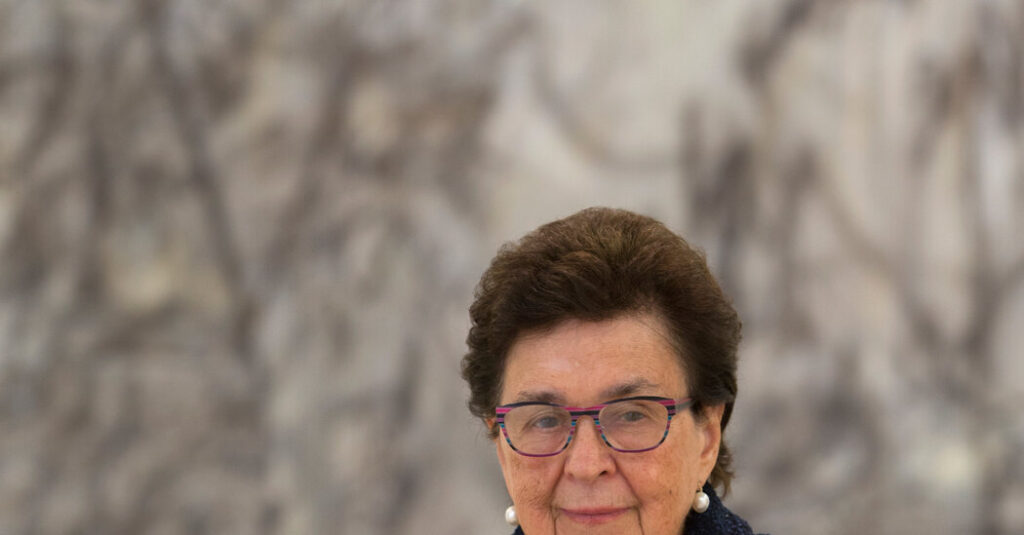
Marian Goodman’s New York galleries always felt like museums. Their subtle, often intellectually demanding work, understated presentations and an elegant casualness about the physical condition of the walls and floors made commercial concerns seem very much out of mind. Of course they weren’t really. Goodman, who died in Los Angeles on Thursday at the age of 97, was a ferocious steward of all aspects of her artists’ careers, including getting them paid. And though she was never much interested in the kind of global metastasis favored by her blue-chip peers, she did leave behind an organization that showed more than 50 artists, many of them household names, across spaces in New York, Los Angeles and Paris.
Goodman was able to do this, in part, by following her own eclectic, avant-garde interests. She was unusually attuned to the world outside New York, famously starting out with the Belgian artist Marcel Broodthaers, and bringing the German artists Joseph Beuys and Blinky Palermo to Manhattan — followed by Anselm Kiefer and Gerhard Richter. The Mexican artist Gabriel Orozco was surprised, when he first met her more than three decades ago, to learn how much she knew about Latin America, and today her gallery’s roster is thoroughly international.
More important, her artists say, she never lost sight of why she, and they, fell in love with art in the first place. Asked to share their memories, they all emphasized Goodman’s unusual devotion to conversation, to ideas, to the creative process — and to them.
“There was a kind of deep respect for her,” the painter Julie Mehretu said, “but what you also felt was that everyone felt deeply respected by her, all of the artists that worked with her. That was a very unique dynamic.”
Though Goodman had retired from her galleries’ day-to-day operations, her death hit her artists profoundly. Many told me they were devastated or, like the photographer Thomas Struth, shared funny anecdotes with tears in their eyes.
These are edited excerpts from conversations with eight artists who have shown with Goodman, and with Christophe Cherix, the director of the Museum of Modern Art.
Christophe Cherix first encountered Marian Goodman’s gallery when she was selling multiple editions by artists like Robert Smithson and Andy Warhol. In 2016, he co-curated a retrospective of her artist Broodthaers at MoMA.
What I thought was always striking was the fact that she had this sense of awe, this sense of wonder, for practices that for many seemed very dry, very difficult, very intellectual. Marian approached them in a very humane way.
Julie Mehretu, a MacArthur award-winning painter whose intricately layered abstract paintings meld history and politics, joined the Goodman gallery in 2013.
When she was committed, she was committed. She was really behind the work. When I was approached by SFMoMA [San Francisco Museum of Modern Art] to do the paintings for their atrium, they came to me with a proposal. She told me, “You can’t spend a year of your life, a year and a half of your life, making these paintings and not be sure they’re going to want them.” She figured out what amount of time it would take me to do, and we went back to the director and made it clear that if they were going to ask me to do this commission, they needed to make a commitment to purchase the paintings and display them for a certain amount of time.
And after she did that — which took her a year and a half; I had given up — she calls me and says, “They’re going to do it.” I couldn’t believe it. Because she put a serious price tag on it. She wanted it to be equitable, in terms of the amount of time and labor and love that would go into it. And then — this is what’s really remarkable — at the end, she asks me in the most gentle way in her office, “I really want you to get the lion’s share of this, but do you mind if we take 10 percent for having negotiated it?”
William Kentridge, a South African polymath of drawing and film, left the gallery a couple of years ago but showed with Goodman for more than two decades.
After Documenta [a world summit of contemporary art in Kassel, Germany] in 1997, I had a letter from Marian saying would I join the gallery. I’d never heard of her, I was in Johannesburg. But I asked about and people said, “Are you crazy? People would give their eye teeth to be in that gallery!” And that started a 25-year connection to Marian.
Everything she did was for her artists. She fought like a tiger for them. For some she was a tough person, and quite abrasive. But it was always absolutely on behalf of the artists. She was a master of getting people to shift positions and turning a no into a yes.
Also, coming from South Africa — the question of racial politics and the Apartheid struggle in South Africa were very close to her because of her nephew Andrew Goodman’s connection to the Civil Rights movement. She understood the world I was coming from and its questions. But she was also completely committed to what it was once transformed into art, and she had a deep understanding of the relationship between image making, which has its own laws and logic and history, and the broader ethical or political questions it can illuminate.
Anri Sala, an Albanian artist who lives in Berlin and works primarily in video, met Goodman in 2001 and joined the gallery in 2004.
As an artist, you do not make really a separation between creating and living; in my ongoing conversation with her, there was the same feeling, that there’s no separation between art as work and ideas as lived experience. When I discussed an idea that was driving me, I never had the feeling that it was business. Everything that mattered belonged to the same continuous space.
Oh, I wish I was born 10 years earlier, so that we would have more of this continuous time!
Gabriel Orozco, the Mexican artist, a veteran of several Venice Biennales, works in drawing, painting, sculpture and installation. He joined the gallery in 1994.
She was very much aware of many things around the world — and at the same time, a very truly super New Yorker. You can say that she was the classic [New York] lady, tough and intelligent and well-prepared, and with a good heart.
When I was invited to the Venice Biennale in 1993, I told her I was going to show an empty shoe box. And she told me, “Well, well, good — you still have time to think of something else.” And then at the end she came to the opening in Venice — she loved to go to Venice — and I displayed my empty shoe box with the lid underneath. And she was smiling … I think she started to like me a lot because I was doing those things. And I started to just have a great relationship with her.
Thomas Struth, the German artist known for his large-scale photographs, joined the gallery in 1990.
For many years she used to rent an apartment in Venice during the summer, and people she liked a lot, she invited. So I was there for maybe two or three years. And one year we said, “Oh, wouldn’t it be great to have a boat ourselves?” And so we made some phone calls, and it didn’t work out and we thought, “Ah, it was a stupid idea, what were we thinking?” And the next year we came, and she said, “Thomas, I have a boat, and you have to drive it!” And she insisted on buying me a gondolier’s T-shirt.
She had this very particular sense of humor that I suspect was maybe not so present for the general public, but she could be really funny.
Steve McQueen, a filmmaker and Turner Prize-winning artist born in London, joined the gallery in 1997 as, in his own words, a “cocky young kid” of 26.
I’ve been working with Marian for 30 years. It’s just one of those things where, she saw me. And when someone sees you, you illuminate. Possibilities and ideas come about. And I don’t think I’ve ever spoken to Marian about art, ever. We spoke about life and stuff. I was a 26-year-old kid. I imagine maybe people thought she was mad. But she’s one of those people who just saw people, and that’s what makes her exceptional. You see the track record. It’s not a fluke.
What was beautiful about Marian is, it was always about conversations. We used to go for long walks in Central Park and I would ask her things, how she’s lived, because she’s been around the block a couple of times — more than a couple of times. It was beautiful. Just two people having a chat.
It’s her bravery which allowed her to succeed. And again, this is a woman in an environment where there weren’t a lot of women doing what she did. She was 5-foot-1. She had to put on a lot of armor, and I imagine there were some times when it was difficult to take it off. But she would die for artists. She was a warrior.
Tacita Dean, who was born in England and produces monumental paintings, joined the gallery in 1998.
I don’t know who exactly recommended me, because Marian worked through recommendations. She trusted her artists to know who were the interesting artists.
I kind of got closer to her when I moved to L.A., which was over 10 years ago now, when I had a Getty residency. And she at that point was kind of interested in L.A. more, because of her son Michael. I used to see a lot of her then. Prior to that it was very much that you were in awe of Marian. I can’t really explain it, because she was very quiet. She was a bit inscrutable, really. But she was a complete powerhouse. She used to make all these museum directors lose their swagger a bit.
kentriNairy Baghramian, an Iranian-born, Berlin-based sculptor whose work often makes more or less oblique reference to the human body, joined the gallery in 2016.
When Marian passed away, all my friends and family called me, and I said, “Actually it’s a loss for the culture.” Thinking of the world we live in, “What will happen to the artists?”
It was a beautiful closeness, but at the same time a distance that created freedom. It was more about how we could create a dialogue about art, and a project, which is the exhibition — and taking the audience as seriously as possible.
I remember for my first show, “Dwindle Down,” I brought a lot of works to New York, glass works, but every day during installation I would remove one. And the gallery people [who needed art to sell] were getting crazy, like, every wall counts! But Marian said, “Let her do it.” It was never just about filling the space.
Tavares Strachan, a Bahamian-born artist who uses neon, ceramic, stone and other mediums to touch on displacement, loss and aeronautics, joined the gallery in 2020.
One of the first things I thought when I got the call was how much she’s changed my life. I think the biggest takeaway from Marian and her legacy is the gentle nature of her force. She was able to do magnificent things in the most humble way.
Just being seen — I’m not the first artist that’s going to tell you that. Being seen in that way adds a layer of confidence to everything that you’re trying to do. You start to understand the nature of the collaboration between an artist and a gallerist. It’s not a frivolous relationship.
The post Art Stars Remember the Legendary Steward Marian Goodman appeared first on New York Times.