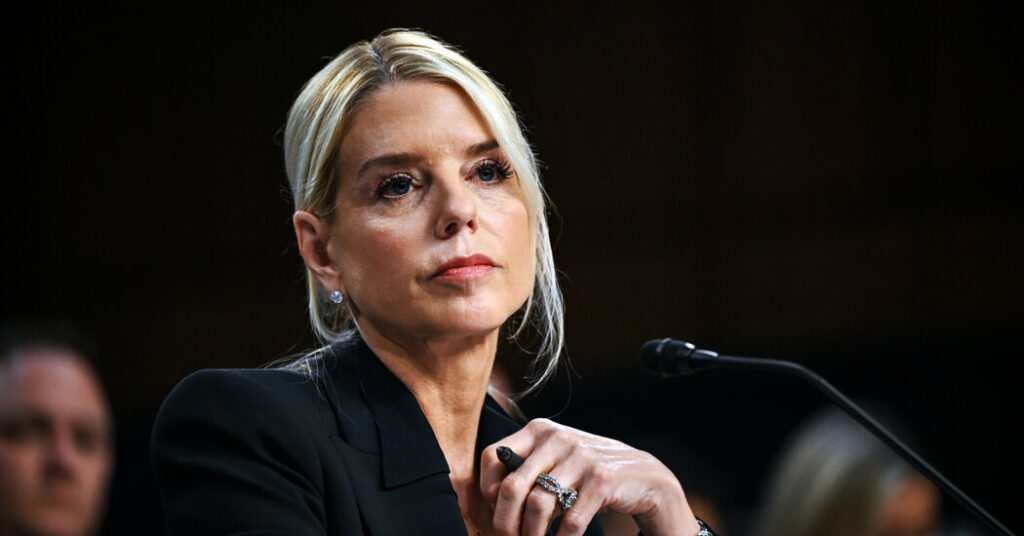
After federal immigration agents shot and killed an American citizen in Minneapolis for the second time this month, Attorney General Pam Bondi sent a letter to Gov. Tim Walz of Minnesota that outlined what she described as three “simple steps” to “bring back law and order.”
Her final step, however, seemed to have little to do with immigration or the state’s fraud scandal, the stated reasons for the federal government’s presence in Minnesota.
“Third, allow the Civil Rights Division of the Department of Justice to access voter rolls to confirm that Minnesota’s voter registration practices comply with federal law,” she wrote. Minnesota’s secretary of state, Steve Simon, a Democrat, swiftly rejected the demand, calling it an “outrageous attempt to coerce Minnesota into giving the federal government private data on millions of U.S. citizens in violation of state and federal law.”
Ms. Bondi’s request was part of a nearly yearlong fight in which the Trump administration has sought voters’ private data from states across the country. Numerous states, including Minnesota, have not complied, and the Justice Department has sued them.
Here’s a look at what is happening and the concerns over privacy and elections that have arisen:
What, exactly, are these voter rolls?
Nearly every state has a public version of its voter roll that includes basic information like first and last names. Some of these rolls include addresses.
But the complete, unredacted voter file includes personal identifying information, like driver’s license numbers and Social Security numbers. This list is kept private and is maintained by top election officials in each state.
Traditionally, no one can obtain it through public records requests — not even the Justice Department.
Why does the Justice Department want these files?
Ms. Bondi has said that the Trump administration is trying to keep elections secure. But President Trump and his allies — who tried to overturn the 2020 election and continue to deny its legitimacy — have long pushed unsubstantiated claims about undocumented immigrants voting illegally.
And last year, the Justice Department began to try to build the largest set of national voter roll data it has ever collected, raising concerns that the data could be used to cast doubt on future election results.
Is this a normal request?
No, it’s highly unusual.
The Justice Department has taken aggressive steps in the past to try to root out voter fraud, including during former President George W. Bush’s administration. But the idea of the federal government obtaining states’ private voter information was long seen as an overreach, because the Constitution dictates that elections are run mainly by individual states, not the administration in Washington.
How many states have complied?
At least 11, all of them at least partly run by Republicans, according to data from the Brennan Center for Justice, a voting rights and democracy group. Some other states, largely Republican-led ones, have provided their voter data to a separate but related program in the Department of Homeland Security.
But roughly half of the country’s states, most of them led by Democrats, have rejected the requests. The Justice Department has sued at least 24 states and territories, including Minnesota, to force them to turn over their voter data.
Why have states refused?
Some states, including Minnesota, have laws that prevent the transfer of private information. Others have expressed worries about how the Justice Department will keep the enormous troves of private information secure.
But for many election officials and voting rights experts, the main concern is that the Justice Department’s effort is led by Trump allies who long falsely denied that former President Joseph R. Biden Jr. won the 2020 election.
“These data can be manipulated to support false claims about ineligible voting and justify efforts to thwart free and fair elections,” Wendy Weiser, who directs the Democracy Program at the Brennan Center, wrote on social media.
The Minnesota secretary of state, Mr. Simon, said this possibility was on his mind.
“Though I’m not necessarily predicting direct federal interference with elections, I am planning for it,” he said in an interview, “and it would be irresponsible to not do that.”
Do states have a right to withhold the data?
This is still being litigated, but some legal experts have pointed to the Constitution’s language that the “times, places and manner” of elections are governed by the states, and that only Congress — not the president — can make or change election laws.
This month, a federal judge in California dismissed the Justice Department’s lawsuit against California seeking to obtain its full voter roll.
“The taking of democracy does not occur in one fell swoop; it is chipped away piece-by-piece until there is nothing left,” wrote Judge David O. Carter, an appointee of former President Bill Clinton. “The erosion of privacy and rolling back of voting rights is a decision for open and public debate within the legislative branch, not the executive.”
Are there any other concerns?
Election officials also say that any national voter roll within the Justice Department would probably be rife with errors because each state’s voter file is updated every day, changing as voters move away or die.
“If any state were to provide a voter list, and the list against which the federal government or anyone else is checking it is out of date, you’re going to have a lot of falsely identified ineligible voters,” Mr. Simon said.
Nick Corasaniti is a Times reporter covering national politics, with a focus on voting and elections.
The post Why Is the Trump Administration Demanding Minnesota’s Voter Rolls? appeared first on New York Times.