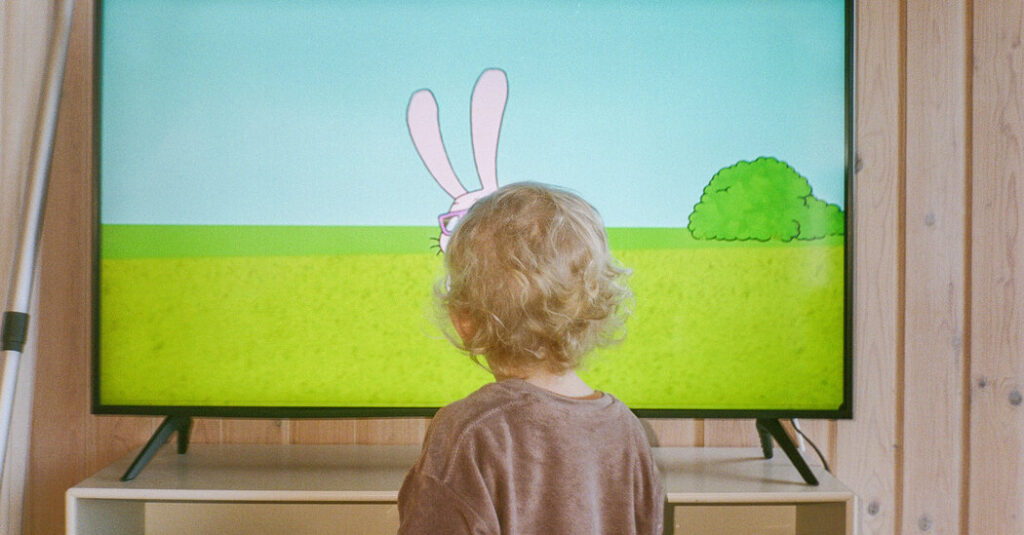
It was the middle of the afternoon, and my son, as he often does, wanted to watch “Paw Patrol.”
“‘Pups Save a Humsquatch’?” he pleaded, rattling off episode titles. “No, ‘Pups Save the Bears.’ No, ‘Pups and the Stinky Bubble Trouble’!”
I hesitated, the first sign of defeat. We’d settled into a virtuous no-TV-on-school-nights routine, but it wasn’t a school night, and my husband and I had already done everything there was to do with a 6-year-old on a below-freezing Chicago Saturday — made pancakes, drawn pictures, counted and written numbers up to 100, read stories, played hide-and-seek (which became tickle-and-run), practiced piano, gone to Sky Zone, eaten chicken and rice, played computer games at the library, transformed an errant cardboard box into a tube for our dog, pulled out his new kids’ cookbook and cooked up chocolate pudding on the stove. What more was there?
TV. There was TV.
Deep down, parents know that plopping your young child in front of the TV feels bad. Of course, there are even more malevolent screens lurking. In an age of YouTube Kids and artificial intelligence chatbots and when a 2025 Pew survey showed that among parents of children 12 and under, more than half reported daily YouTube consumption, worrying about the cartoons my kindergartner streams may sound quaint. But my son is, for now, too young for the perils of the internet and adequately distracted by streaming shows, which doesn’t make me feel any better about leaning on them to keep him occupied.
Summoning memories of my own kindergarten viewing habits (ahem, “Jem and the Holograms”) doesn’t alleviate my sense of failure. Nor does the knowledge that I can point to only one acquaintance, in my entire lifetime, who grew up without TV. (Other than having a next-level capacity for research, she turned out pretty normal, as writers go.) Flipping on “Paw Patrol” — or “Rubble and Crew” or “Spidey and His Amazing Friends” or “Daniel Tiger’s Neighborhood” or whatever series happens to have captured my son’s imagination at the moment — feels like a cop-out and a personal defeat. So when my son settled on “Pups Save the Kitty Rescue Crew,” I asked him to scoot over on the couch. “That’s right,” I thought, making myself comfortable. “This year, Mom’s watching TV with you.”
This is the way that I’ve found to battle my guilt and drown out that worrying-mom voice in my head: I sit down and watch TV with my kid. And not educational shows or PBS. We watch the ones he wants to watch. Thanks to streaming, modern children don’t need to subsist on a diet of whatever happens to be on at the moment. (R.I.P. to those “Brady Bunch” reruns and episodes of “Family Feud” that I grew up on.) Kids can choose to watch what they want to watch when they want to watch, as much as their parents will allow.
On this day, as on so many days, the choice in our house was “Paw Patrol.” Sitting beside my son, I struggled to keep my mind on the show, as the squirmy-voiced Mayor Humdinger tried to thwart the intrepid band of do-gooder dogs and supplant them with his Kitty Rescue Crew. I itched to reach for a magazine from that stack of New Yorkers teetering on the coffee table. My phone and all my unanswered emails beckoned. Dinner needed to be prepped or at least ordered. Yet I stayed glued next to my son as he stayed glued to the TV.
All my preparenting programming taught me that TV equals bad. When I was a kid, my mom taped an article with the headline “TV Kills Brain Cells” to the inside of a kitchen cabinet as a message to us all. Later, when I’d read “Amusing Ourselves to Death” by Neil Postman, I dutifully avoided consuming passive content for fear that it would catalyze an unshakable sloth or, at best, ruin my vocabulary.
I can’t imagine saying to my son that TV kills brain cells, but I do think it — or fear it. Our language might have shifted (today we talk about rotting), but the notion endures that watching too much TV and other visual content is detrimental for kids or at least has a whiff of moral failing. It’s an offshoot of the logic that childhood should be programmed to the hilt and that you’re sabotaging your prodigy’s future by not equipping him or her with prepubescent fluency in Mandarin or a firm handle on quadratic equations.
In these moments of self-doubt, in lieu of parenting books or mommy blogs, I like to turn to the writing of artists who are also parents. In her 1982 memoir, “Daybook: The Journal of an Artist,” the sculptor Anne Truitt reflects on visiting the Saihoji Temple’s garden in Kyoto with her children. On its paths, she recalls, they would “play games with scale, wandering in the multifoliate greens clinging to the soft mounds of earth as if in great primeval forests that tangled and roared over our heads” — a description that made me feel guilty for letting our membership to the botanic garden lapse. But it was something else that Ms. Truitt wrote that convinced me of the value of watching “Paw Patrol” with my son: Her experiments with scale, she wrote, drew her “attention to the intervals between events, to what is happening when ‘nothing’ is happening.”
Watching TV with my son has, for us, become that time when “nothing” is happening. What’s valuable about those minutes is how much space they leave for spontaneous connection. When my son and I watch TV together, we build a shared language together. In the end, it doesn’t matter if it’s TV that other parents deem actually good or TV that makes us a little dumber because it’s not really about what we watch. It’s about how watching together lets us bond with each other — and teaches me about my son.
Watching “Paw Patrol,” I learned about him — what prompts him to grow serious, like when Daring Danny X did something not just daring but dangerous, and what delights him to the point of uproarious joy, which, as it turns out, was Mayor Humdinger using the word “dearie.”
“Dearie” elicited howls of laughter so body-rocking that my son nearly flung himself off the couch. My tired parental guilt was no match for his glee. I was too busy laughing along with him.
The other day, midshow, he reached absently for my hair while we watched together and, half whispering, said to me, “Mom, what do you want to be when you grow up?”
I thought about how this interaction might not have happened if I’d been standing at the kitchen counter answering emails, if my son hadn’t invited me to sit next to him on the couch (as he started to do once I showed up for “Paw Patrol”), if I’d left him to play with his Spidey and his Amazing Friends Lego pirate ship in his room. Letting nothing happen, in front of the TV, made our closeness possible.
“A writer,” I said. “How about you?”
“Construction worker,” he said.
We kept watching, snuggled together, and I trusted that, yes, dearie, we were building something lasting.
JoAnna Novak is the author of, most recently, “Domestirexia: Poems” and other books, and she writes How to Watch TV With Your Kid, a newsletter about culture and parenting.
The Times is committed to publishing a diversity of letters to the editor. We’d like to hear what you think about this or any of our articles. Here are some tips. And here’s our email: [email protected].
Follow the New York Times Opinion section on Facebook, Instagram, TikTok, Bluesky, WhatsApp and Threads.
The post I Let My Kid Watch Bad TV. In Fact, I Watch It, Too. appeared first on New York Times.