Late last month, a woman posted a photograph on social media of a purple hat she had knitted, while a black-and-white dog lounged on the carpet a few feet away. The cozy scene was accompanied by a single sentence: “This hat is an hour behind schedule thanks to influencer retards.”
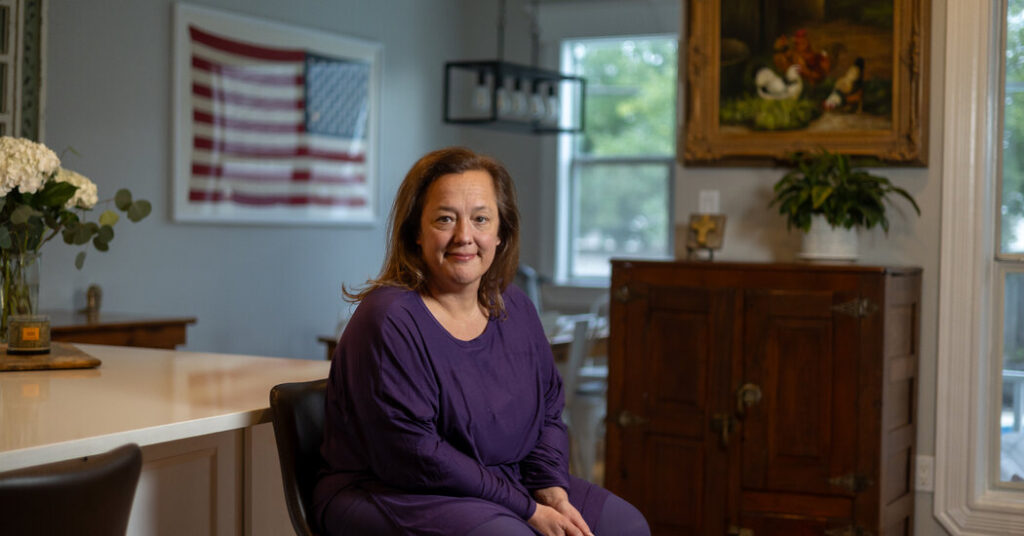
The proud knitter, Harmeet K. Dhillon, is also the assistant attorney general overseeing the Justice Department’s Civil Rights Division. Her purview includes protecting the rights of people with intellectual disabilities by ensuring compliance with the Americans With Disabilities Act.
For decades now, the “R-word” has been regarded as a slur against people with intellectual disabilities — a word to be avoided. Yet it has had a striking resurgence, in part because people in high-profile positions of power and influence have chosen to resurrect it, often with an air of defiance.
“The word ‘retarded’ is back,” the popular podcaster Joe Rogan declared in April, describing its return as “one of the great culture victories.” He did not respond to requests for elaboration, but there is abundant evidence to support his muscular declaration.
In the past three months, the musician Kid Rock donned a face mask while appearing on a program streaming on Fox Nation and said he was dressing up as a “retard” for Halloween. (He was also wearing a Jesus trucker cap.) The Fox News personality Greg Gutfeld coupled the word with a schoolyard taunt to mock mayors who oppose President Trump, and Elon Musk used it on his social media platform to insult a critic. The word has recently been uttered on the podcasts of the white nationalist Nick Fuentes and the right-wing commentators Derek Hunter, Steven Crowder and Tim Pool.
The use of a hurtful word still considered taboo is emblematic of the provocative language that courses through the manosphere sector of social media these days — almost gleefully transgressive language often adopted in messaging from the White House. Diplomacy is out and mockery in, whether by displaying plaques that insult former presidents, depicting Mr. Trump spraying excrement on protesters from a military jet — or using the “R-word” to question the intelligence of a political opponent, as Mr. Trump did in a Truth Social post on Thanksgiving Day, in which he called Minnesota’s Democratic governor, Tim Walz, “seriously retarded.”
When asked later whether he stood by that statement, Mr. Trump said, “Absolutely,” because he thought there was something wrong with the governor. For her part, Ms. Dhillon did not answer questions about her use of the word.
The word’s proliferation has alarmed many advocates and people with disabilities who thought it had long since been removed from circulation.
“The drumbeat and use of this word has been like nothing I’ve seen in a very long time,” said Katy Neas, the chief executive of the Arc of the United States, a disability rights organization. She called its use by the Justice Department’s civil rights chief “simply mind-blowing.”
The word’s return raises an obvious question: Why?
Why decide to resurrect a term well known to offend a community that has been historically marginalized, so much so that its usage prompted public-awareness campaigns and wholesale changes to nomenclature?
“I think there’s a perception of power, of ‘I am powerful, therefore I can use this language; I am powerful, and therefore I can diminish others,’” Ms. Neas said. She added: “It’s language used by bullies to bully.”
To Amy Hewitt, the director of the Institute on Community Integration at the University of Minnesota, the word’s return reflects a divisiveness defining the United States of 2026, in which a sizable part of the population believes that “many people are a drain on our society, on our progress, on what makes us great.” She pointed in particular to the Trump administration’s dismantling of diversity, equity and inclusion efforts.
“It’s not just about race and ethnicity, it’s also about disability,” she said. “This is why the R-word is completely acceptable to them. It’s ‘us versus them.’”
Use of the word has skyrocketed on X, Mr. Musk’s social media platform. In 2020, it appeared on the platform, then known as Twitter, just over 2,000 times a day, according to a recent study by two Montclair State University researchers. That number is now over 46,000 times a day — a more than 2,000 percent increase.
The researchers, Bond Benton, a communications professor, and Daniela Peterka-Benton, a justice studies professor, said the word’s use rose after Mr. Musk bought the platform in late 2022, and then spiked when he included it in an X post in January 2025.
But this Musk-induced growth was a blip when compared with what followed in the week after Mr. Trump’s disparagement of Mr. Walz in late November. Use of the word increased by more than 200 percent, with more than 1.1 million posts on X employing the word. Most of them, the study’s authors noted, conveyed enthusiastic endorsement of the term’s apparent restoration.
“Musk influences a lot of people, especially in the manosphere, so we had a hunch that the platform was going to have more use of the term,” Dr. Benton said. “Then when Trump used it, it was like a nuclear bomb.”
Defenders of the word’s use say that it is intended in part to clap back at political correctness, “wokeness” and perceived infringements of the right to free speech.
“There are so many words in the English language that have been driven out of use because we’ve been told that they’re politically incorrect,” Mark Meckler, a right-wing activist and self-described “free speech warrior,” said in his podcast last month. “Well, that’s just cultural Marxism.”
“So this has now come back into common use, and I’m actually glad it has, because it just shows we’ve been recapturing language from the woke left,” said Mr. Meckler, who, in adding that he did not mean to insult “mentally handicapped” people, used another term that disability advocates say is outdated.
Those who defend the word’s use often contend that it is meant as a synonym for “stupid” or “slow,” and not as a reference to people with intellectual disabilities.
“It’s not really like anybody wants to make fun of people who are slow, when it comes to brain development,” the conservative commentator Megyn Kelly said on her podcast last month. “It’s that they’re sick and tired of being told what they can and cannot say.”
“No one’s trying to actually say something negative about that community,” Ms. Kelly added. “They’re trying to say something about the person they’re targeting — that they’re kind of slow.”
But many people with intellectual disabilities and their advocates consider this distinction to be disingenuous, if not a complete cop-out. The word, they say, continues to wound.
Helena Donato-Sapp, 16, of Long Beach, Calif., is a junior in high school with several learning disabilities. Last semester, while walking through campus at lunchtime, she heard a classmate call a friend the R-word, and was taken aback by a word she associates with shame.
“It makes me feel bad and confused that people still use it,” she said.
The terminology for people with intellectual disabilities has evolved over generations, with words like “idiot,” “imbecile,” “feebleminded” and “moron” having their moment before being phased out for reasons of imprecision or hurtfulness, or both.
What united them, though, was an implied sense of otherness that, among other effects, gave oxygen to the pseudoscience of eugenics in the early 20th century.
By the 1950s, “mental retardation” had become the socially acceptable medical term of choice, but it, too, devolved into a pejorative. The phrase became part of what linguistics experts refer to as a “euphemism treadmill,” in which a word that begins as acceptable develops into a slur through negative use, leading to eventual replacement.
As people with intellectual disabilities began more and more to speak up for themselves, they made their dislike of the R-word clear. The consensus was “that it’s mean, hurtful, harassing,” Dr. Hewitt said. “It’s personally offensive.”
Rejection of the term gradually took hold. In 1992, for example, the Association for Retarded Citizens of the United States changed its name to what it is called today: the Arc of the United States.
Ms. Neas, its chief executive, said that advocates, including those with intellectual disabilities, argued that words mattered. “The words had to be fully inclusive, and not in any way include language that separates or denigrates people,” she said.
At the 2009 Special Olympics in Idaho, youth advocates — galvanized in part by repeated use of the word in the film “Tropic Thunder” — sparked a global movement called Spread the Word to End the Word. Disability advocates called out anyone who used the word, including President Barack Obama’s chief of staff, Rahm Emanuel, who subsequently apologized and agreed to sign a pledge to end the use of the word.
Perhaps the most significant rejection of the term came in 2010, when Mr. Obama signed “Rosa’s Law” — named after a young girl with Down syndrome — replacing “mental retardation” with “intellectual disability” in federal legislation and policies.
Among those present for the signing ceremony was Jill Eglé, a disability advocate who, a year earlier, had been a driving force in having the word eliminated at the state level in Virginia. The cause was personal; as a child growing up in Virginia, she had been declared “mildly mentally retarded.”
“I had a hard time because I was made fun of, laughed at,” Ms. Eglé, 49, recalled. “I didn’t have a boyfriend, always ridiculed and always, you know, just was the odd one out. No boy ever asked me to the prom and stuff.”
“They all called me retarded, and I tried to be nice, but it wasn’t the way it should be,” she said. “And it was hurtful.”
Over the next decade, the sustained efforts to remove the word from the vocabulary seemed to succeed, with students and teachers reporting a marked decline in its use. By 2019, the Special Olympics considered the matter settled, and began shifting the focus of its public awareness campaign to a larger message of inclusivity.
“I really felt like we had made so much progress,” said Andrea Cahn, vice president of Unified Champion Schools, the Special Olympics umbrella program that oversaw the campaign. “The use of the word really seemed to have been diminished.”
Then it came back.
Special Olympics saw a spike in alerts from athletes and people with intellectual disabilities about an increased use of the word. Ms. Cahn said the thrust of many messages was: “Can you do something? Can you make them stop?”
Advocates say it isn’t surprising that the word is being heard more frequently. “You’ve got the president of the United States using that word,” Dr. Hewitt said. “So why are we surprised?”
Nicole LeBlanc, 40, of Silver Spring, Md., an advocate who has autism and an intellectual disability, said she had noticed how the word had returned as a common, everyday insult. Hearing it, she said, she feels the sting of stigma — even when it isn’t directed at her or another person with a disability.
“It makes me want to run, hide and curl up into a ball,” she said.
Kitty Bennett contributed research.
Dan Barry is a longtime reporter and columnist, having written both the “This Land” and “About New York” columns. The author of several books, he writes on myriad topics, including New York City, sports, culture and the nation.
The post The ‘R-Word’ Returns, Dismaying Those Who Fought to Oust It appeared first on New York Times.