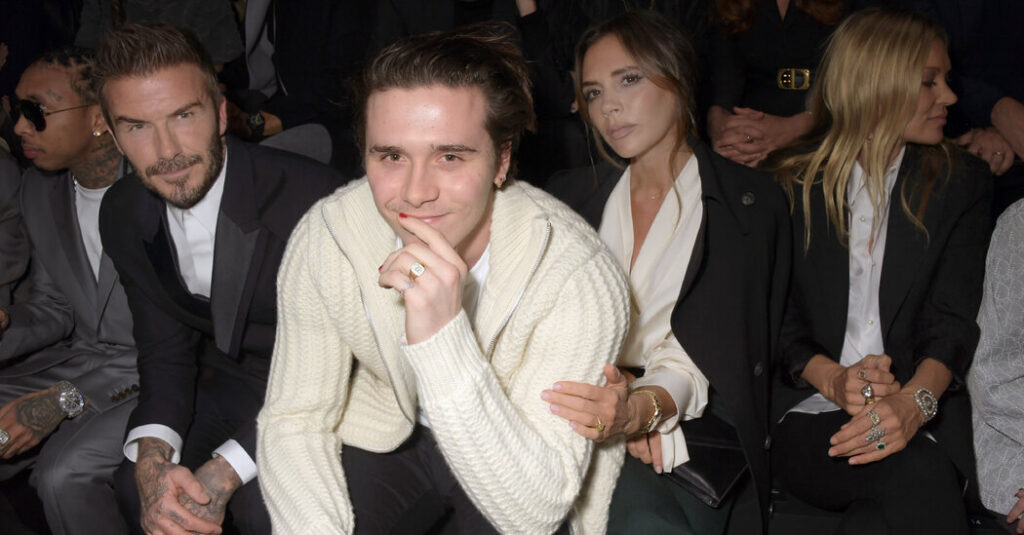
Brooklyn Beckham left a few things out when he publicly cut ties with his famous family this week, but it took the internet just a few hours to concoct fake evidence to fill in the blanks.
The eldest son of David Beckham, a former British soccer star, and Victoria Beckham, a fashion designer and former Spice Girl, blasted his parents in a series of Instagram Stories on Monday night. A key accusation: that the power duo had repeatedly tried to sabotage Brooklyn’s relationship with his wife, Nicola Peltz, the daughter of the billionaire investor Nelson Peltz.
Social media users were enthralled by the drama, an age-old response to the spectacle of public discord in the ranks of the rich and beautiful. This time, though, the audience didn’t wait for verified evidence to be released or leaked. Instead, people took control of the narrative by using artificial intelligence to imagine what might have happened behind closed doors.
Brooklyn claimed, for example, that his mother “danced very inappropriately” with him at his wedding in 2022 — a situation that has not been publicly corroborated by authentic footage from the event. Into the void came a slew of realistic A.I. clips purporting to show Victoria shimmying, leaping, flailing, gyrating and recreating movie scenes from “Saturday Night Fever” and “Pulp Fiction” at the wedding.
The A.I. videos and images offered an entertaining and plausible — though phony — glimpse into the Beckhams’ personal lives. Many people, their curiosity sated, did not seem to care that the content was fake. Users left comments sprinkled with laughing emojis, like “they keep getting better and better” and “the first acceptable use of A.I. I’ve ever seen.”
The Beckhams did not respond to requests for comment. Brooklyn and Nicola admired people’s creativity, according to a person close to the couple, who was speaking anonymously because of the sensitivity of the situation. But the couple felt that A.I. renderings could not capture the reality of how poorly they say they were treated by Brooklyn’s family, the person said.
“There are people who are hungry for a particular kind of content, and if you can create that content for them, they will eat it up,” said Kristian J. Hammond, a computer science professor and A.I. expert at Northwestern University. “Here’s a moment where, if you want to believe it, you will, and those are the moments where we have to resist.”
With A.I. becoming increasingly accessible, famous people are irresistible — and easy — targets.
Often, a celebrity gets the digital treatment without his or her consent. Social media users are turning to tools with names like Nano Banana Pro to generate convincing selfies with Hollywood stars (think Leonardo DiCaprio and Kate Winslet on the “Titanic” set, or at a party with three recent “Spider-Man” actors).
The resulting content is not always harmless. Such technology has also been used to undress famous people or to place them in sexual situations. After the conservative activist Charlie Kirk was assassinated, A.I.-generated musical tributes from artists with avowedly different political views — among them Adele, Eminem and Lady Gaga — surfaced on YouTube, according to the Poynter Institute.
To many people who have been breathlessly following the Beckham feud, it is clear that the A.I. images of the family are not real (though social media users have filled comment sections with surprise at how convincing the content seems). The internet has devoured the posts, with some racking up hundreds of thousands of views. In the absence of actual footage, the A.I. renderings of Victoria and Brooklyn could become the default images of the dance, experts say.
A Scottish digital artist known professionally as Hey Reilly used a mix of A.I. programs and Photoshop to create a series of Beckham images that has been liked more than 1.5 million times on Instagram. He wrote in an email that visualizing the wedding was “just a fundamentally funny idea” and noted that much of his work is “very obviously ridiculous.”
“If someone thinks the aim is to fool people, they’re missing the point entirely,” he wrote.
In the Beckhams’ case, A.I. can produce whatever juicy details the public demands, even if they are inaccurate. The synthetic versions of Victoria and Nicola, many of them clad in the actual dresses they wore to the nuptials, scratch the internet’s itch for answers, and allow people to move on to their next fixation.
Casey Fiesler, an associate professor of information science at the University of Colorado Boulder, described the A.I. dance posts as a sort of visual fan fiction, similar to the content that is created to bridge missing scenes in books and films, to illustrate courtroom sessions or even to depict historical events.
But Dr. Fiesler said she was concerned about people who did not care at all whether the content was real. Disinformation researchers and fact checkers have raised alarm in recent years over a growing state of disinterest in facts, especially in a world where the White House posts manipulated images of real people, and politicians declare that the emotional impact of images is more important than their authenticity.
“I worry that we can get to a kind of learned helplessness in this information ecosystem where it’s like, ‘I’m never going to be able to know whether anything’s real anymore, so why bother?’” Dr. Fiesler said.
“If that’s the case,” she added, “then there’s an argument that even small things or things that seem frivolous are just, over time, wearing us down.”
Tiffany Hsu reports on the information ecosystem, including foreign influence, political speech and disinformation
The post New Videos of the Beckham Feud Are Fake. Nobody Seems to Care. appeared first on New York Times.