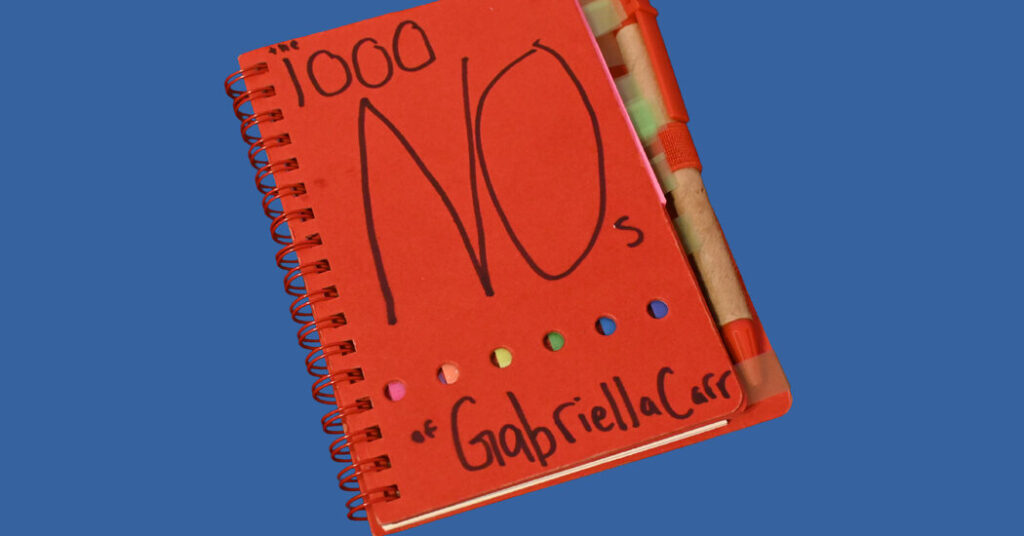
Gabriella Carr held up a small red spiral notebook with “The 1,000 Rejections of Gabriella Carr” written across the front. Her front-face camera inverted the phrase in the video she posted to her TikTok and Instagram accounts. On the pages of the notebook, the video creator and actress tracks brand influencer campaigns she’s applied for, roles she’s auditioned for, and fitness photo shoots she’s submitted herself for, all with the goal of putting herself out there enough to amass 1,000 no’s — and some unexpected yeses — to opportunities she seeks.
“I’m know I’m delusional, but you kind of have to be to chase your dreams,” she said in the video.
Now rejection spreadsheets are popping up across social media as microinfluencers follow Carr’s lead. TikTok user @theplanistobefamous is tracking job applications and Facebook Marketplace bargaining (he asks for things for free or low price). Others are negotiating the terms of their lease, asking strangers to style them, copping free subway swipes, or pitching themselves for toothpaste brand deals.
No rejection is too big or too small. Unlike most January challenges, which emphasize no days off or optimizing routines, the 1,000 Rejections Challenge welcomes defeat. Perfection-based challenges like 75 Hard are out. Tallying up losses is in.
Carr, 22, said she’s always been hard on herself when it comes to achieving her goals. She had turned her pandemic hobby of making videos into her full-time focus but by last year was facing a breaking point. Auditions for acting jobs had gone nowhere and she was losing followers. She decided she’d finish out the year trying to make it work, but wanted a way of keeping herself accountable.
She reasoned that the defeats were what made her want to quit, and thought, “What if I face this rejection?” She landed on a count of 1,000 — big enough to prevent her from completing the mission quickly, like if she’d gone with 100, and bold enough to keep her interested. “If I truly failed by the end of this 1,000 no’s, then I felt like it was OK to leave and walk away,” Carr said.
She explained the gambit to her followers in September 2025 and thought she’d be done in four months. She’s gotten 86 no’s (and 17 yeses), to date, and has landed a pageant title, some small acting roles, and even, to her shock, been approved for a Dutch passport.
The bigger win is Carr says she feels stronger and more hopeful about her future than before. “I was kind of a mess,” she said. Now, she’s realized how quickly things can change for the better. Carr said her Instagram follower count has risen from around 17,000 to more than 82,000, as people pursue their own rejections and fill her comments with the kind of earnest optimism that’s rare in social media.
“My daughter shared your account with me and if inspired me to apply for my dream job! I haven’t heard back yet but, yes or no, it felt good to be so daring!” read one such comment. “I need to get an internship for spring, and I’m so scared,” read another.
Because the challenge is so simple — grab a notebook and start tracking — anyone can try. It’s personal by nature; it requires people to map out their own goals, during a month when people are focused on resolutions. Videos and lists spreading across social media, while riddled with rejections, eventually include some victories. For those following along at home, the thrill of seeing people win is worth the wait.
“There’s something about 1,000 — it’s audacious, it’s delusional,” said Gabby Beckford, a former engineer who transitioned into making content full-time five years ago. Inspired by Carr’s reframing of rejection, Beckford announced on LinkedIn that she was hopping on the trend for 2026. “Accept that you’ll be rejected, move on, and keep doing it,” Beckford said.
Persistence can pay off in more ways than one. According to Lynn Lyons, a psychotherapist and author of books such as “The Anxiety Audit: Seven Sneaky Ways Anxiety Takes Hold and How to Escape Them,” an intolerance for the discomfort that comes with risk can increase anxiety.
Lyons warned against all-or-nothing goals, which she says aren’t all that effective. “If we set these resolutions that are like, ‘I’m not going to do this,’ or ‘I’m only going to do this,’ you lose the power of adjustment,” she said. Avoiding rejection, Lyons said, has the potential for isolation.
With loneliness on the rise (in 2023, the surgeon general issued a report on the “Healing Effects of Social Connection and Community”), Lyons said that young people, who have grown up online, were particularly affected. “Being afraid of rejection, or avoiding rejection, means that you are limiting the possibility of connection,” Lyons said. “You can’t have one without the other.”
Carr may be turning every slammed door into content, but her process is still a vulnerable one. She said the sudden attention from the 1,000 Rejections project had been “scary.” Yes, she knew people would see her videos online, but before it took off she still felt like she was part of the background in people’s feeds. Carr said she feels pressure now that makes her “triple examine” her work. “I don’t want to let these people down,” Carr said. She typically films her videos from the intimate space of her generously pink bedroom, which viewers have come to identify with her content. “You can piece together my whole bedroom,” she said. “My whole bedroom is online, weird.”
Though 1,000 Rejections has brought on new challenges, it’s also made it easier for Carr to accept letdowns. “It still hurts sometimes,” she said. “I try not to take it as personally.”
The post For This Influencer, Rejection Is the New Perfection appeared first on New York Times.