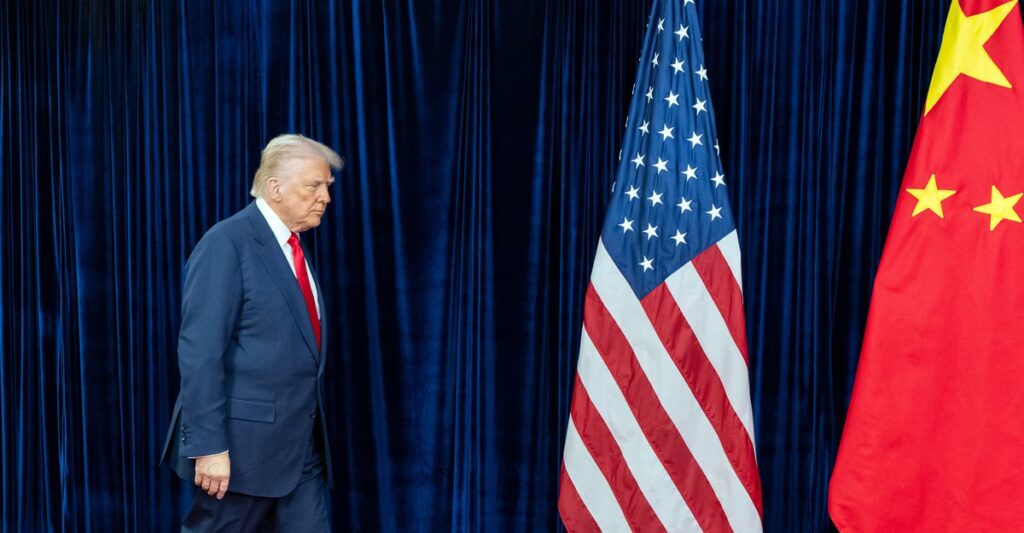
As President Trump has charged into a conflict with American allies over Greenland in recent weeks, he has also been pursuing an unlikely new friend: Communist China. Even for a politician known for erratic policy shifts, this swap—of longtime democratic partners that have sacrificed much for America’s benefit in exchange for an authoritarian regime intent on undermining it—is bizarre. It also highlights the risks that Trump’s personalized form of diplomacy presents to American national security and the balance of global power.
Although a hard line on China was a centerpiece of Trump’s first term, he has gone soft in his second. The president has removed nearly all of the tariffs that he imposed on Chinese imports last year, and he has loosened controls on the sale of advanced American semiconductors to China—over the objections of national-security experts—on the condition that Nvidia coughs up a cut of its sales to the U.S. government. Trump also hailed his October 2025 summit with China’s leader, Xi Jinping, as a meeting of the “G2,” or “Group of 2,” a flattering nod to the idea that the United States and China are the two most powerful countries in the world.
Trump has also lately seemed to take Beijing’s side regarding Taiwan, which China continues to claim as its own. The Trump administration has scaled down its interactions with Taiwan’s government, and in November, the president reportedly asked Japanese Prime Minister Sanae Takaichi to not escalate a dispute with Beijing over comments she had made about China’s threat to Taiwan. That conversation took place shortly after Trump had spoken with Xi, who reinforced Beijing’s position on Taiwan.
[Read: ‘Some foreign influence will be hard to reverse’]
Even the most well-connected China experts in Washington are left guessing about what Trump hopes to achieve by placating Xi. One possibility is that Trump’s pivot is a strategic feint to secure a truce in a trade war that has revealed significant American vulnerabilities. Given China’s dominance of rare earth materials, which are vital to advanced manufacturing, Xi’s restrictions on exports in response to Trump’s tariffs had harmed U.S. industries. In negotiations with Washington, Xi pledged to restart supplies and temporarily suspend some of China’s export controls on these metals, but he could easily resume these measures if tensions escalate again.
Trump may be appeasing Xi to buy some time as he seeks alternative sources of rare earths—in Greenland and elsewhere. But considering that securing these commodities could take years of U.S. investment, Trump may be pacifying Xi for longer than he expected.
Trump’s approach to China may have changed with his political calculations. His earlier attacks shored up his appeal with blue-collar voters who had been hurt by international trade and the export of manufacturing jobs overseas. Trump entered office in 2017 vowing to right the injustices caused by liberal globalists. Now he seems to think that he has more to gain from cozying up to China. At his meeting with Xi in October, Trump secured a crackdown on China’s exports of the chemicals used to make illicit fentanyl, and a promise that China would buy significant quantities of soybean imports from American farmers—a key Republican constituency.
Trump’s softer touch seems to have won Beijing’s consent for an arrangement to keep TikTok operating in the U.S.—allowing him to fulfill a political promise. The deal, finalized this month with ByteDance, the Chinese internet company that owns TikTok, hands control of the U.S. operation to a consortium of investors that includes Larry Ellison of Oracle, a Trump ally. Xi further rewarded Trump’s shift in tone by inviting him to visit Beijing in April, appealing to the U.S. president’s penchant for high-profile diplomatic summits.
Trump has also always had a thing for autocrats. He has praised Xi as “highly respected”—a description he has also used for Hungarian Prime Minister Viktor Orbán, Russian President Vladimir Putin, and others. Trump’s diplomacy is often guided by his preference for strongmen over more trustworthy, democratically elected allies. And like any schoolyard bully, Trump prefers to pick on countries that can’t fight back. Yet Xi’s potent response to Trump’s trade war has shown that the Chinese leader can fight back—and will.
Despite his fiery rhetoric in his first term, Trump spent a great deal of time negotiating a trade pact with Beijing, which both sides signed in 2020. This time around, Trump seems to have gone rogue. A rare issue on which Republicans and Democrats agree is that China presents a real threat to the United States—economically, militarily, and otherwise. But Trump has been reluctant to press China on issues of urgent national interest. Although he imposed extra tariffs on India last year to curb the country’s purchase of Russian oil, which helps fund Putin’s war in Ukraine, he has largely given a pass to China, the biggest consumer of Russian crude. Earlier this month, the president green-lighted a bill imposing tariffs on countries that buy Russian oil, but the White House has insisted that the legislation grants Trump some latitude in how he applies these sanctions.
Anyone hoping to ascribe a grand strategy to these moves must reckon with the inconsistency of Trump’s approach to China. Following its capture of Venezuelan President Nicolás Maduro, his administration has reportedly pressured Venezuela to expel advisers from China. This, together with Trump’s threats to Greenland, seem to be part of a larger effort to push Beijing out of the Western Hemisphere. Such unpredictability drives home just how personal—and erratic—foreign policy has become under Trump. In a recent analysis of the administration’s new National Security Strategy, a group of Brookings Institution scholars noted just “how much U.S. foreign policy now hinges on one mercurial leader.”
[From the March 2026 issue: America vs. the world]
With this, China and the U.S. have something in common. In Beijing, Xi has centralized policy making in his own hands—and to a greater extent than Trump can ever hope for, given China’s authoritarian political system. Whereas Trump is a flip-flopper, Xi has proved relentlessly committed to a fixed agenda. Nearly everything he does is meant to expand China’s global power and advance its technological and industrial dominance. Although Trump’s desire for Greenland is ostensibly about reducing China’s influence in the Arctic, the president’s conflict with NATO allies must delight Xi because it precludes international coordination to contain China.
Some in China see Trump’s softening as a great opportunity for Xi to press for more concessions. Da Wei, the director of the Center for International Security and Strategy at Tsinghua University, in Beijing, recently suggested in Foreign Affairs that the U.S.-China relationship was at an “inflection point,” making this an opportune moment to further reduce tensions and move “toward a more normal relationship.” To help things along, he recommended that the U.S. curb its “politically provocative” naval missions near China. Although he didn’t say so explicitly, he likely meant operations in the South China Sea, which is officially international waters, but Beijing claims it as its own. Da also counseled Trump to declare U.S. opposition to Taiwanese independence—which would mark a radical change in U.S. policy. Both steps, if Trump were to take them, would be cause for alarm among American allies. In return, Da wrote, China should scale back military exercises around Taiwan and “increase cross-strait exchanges”—neither of which are really concessions to Washington.
China has a strong incentive to push for these compromises now, given how Trump’s fickle nature could suddenly shut the window of opportunity. Beijing is also well aware that American democracy is inherently prone to flip-flops and that the hard-line Washington consensus on China is likely to return with the next election. At this point, only one thing is certain: In what has become a contest between two men, victory will go to the leader who operates strategically and with discipline, not erratically and on impulse.
The post Why Is Trump Cozying Up to China? appeared first on The Atlantic.