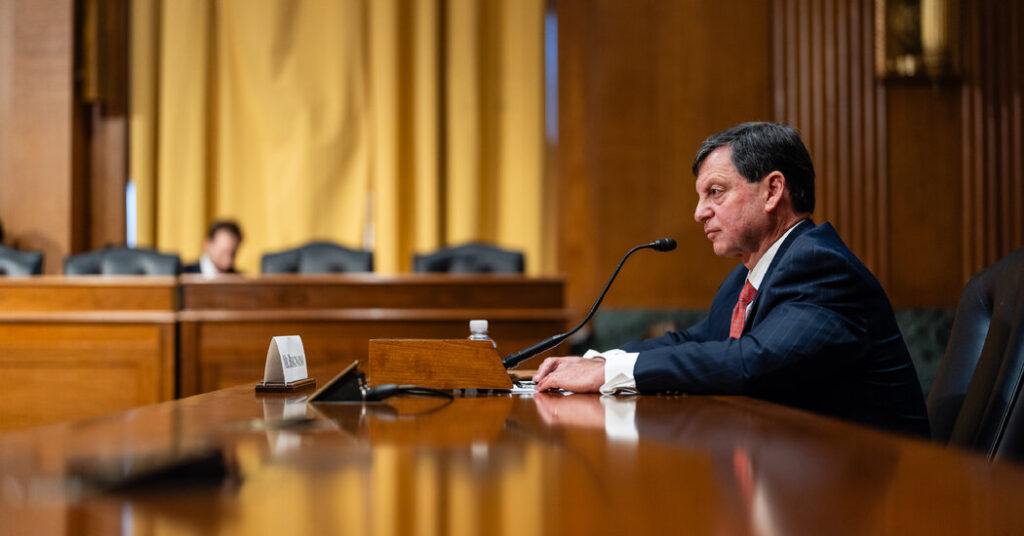
The gathering of former leaders of the Internal Revenue Service this past fall was not meant to be anything special.
They had come to a private room in a Washington steakhouse to meet with the newest steward of the agency and discuss the challenges of running one of the most pilloried, and yet essential, parts of the federal government.
For all its apparent mundanity, much about the meeting was atypical. For starters, the target for the group’s wisdom, Frank Bisignano, was not the commissioner of the I.R.S. He was its chief executive officer, a newly created role that Treasury Secretary Scott Bessent had asked him to fill in addition to his duties as the Senate-confirmed commissioner of the Social Security Administration.
Then there was the state of the I.R.S. Before Mr. Bisignano agreed to run it part time last October, the I.R.S. had spun through a chaotic carousel of seven leaders in 2025. Roughly 25,000 I.R.S. employees, a quarter of the work force, had left under President Trump. Congress was pursuing deep cuts to the I.R.S. budget, just weeks after Republicans passed into law a slew of complex new tax cuts that the agency would be responsible for administering.
But just the fact that Mr. Bisignano had called for the dinner encouraged the group of former I.R.S. commissioners, who had served in both Republican and Democratic administrations. After months of turmoil at the I.R.S., the opportunity to trade notes with Mr. Bisignano, once one of the highest paid executives in the country, seemed refreshingly normal.
“We came away, every single one of us, thinking, ‘This guy is competent, he is for real,’” Fred Goldberg, who led the I.R.S. under President George H.W. Bush, said at a recent tax conference. “He understands what needs to be done.”
At the top of Mr. Bisignano’s list is having a smooth tax filing season. The annual tax season is always a critical period for the I.R.S. More than 140 million tax returns — many simple, some complicated — pour into the agency.
Many Americans expect a refund, and they want it quickly. For poor Americans, their tax refund, padded by credits that return cash to people even if they did not owe any income tax, is often the single largest payment they receive in a year. Delays can mean skipped meals and missed bills. The margin for error is small.
This year’s filing season, which began on Monday, could be an even more formidable challenge than usual for the I.R.S. and Mr. Bisignano. Taxpayers may have difficulty parsing the fine print of the new tax cuts. Mr. Trump’s promise of “no tax on overtime,” for example, is in fact just a partial tax break that applies to a portion of certain federally mandated overtime wages. Rules like that could fuel a rush of additional questions for the I.R.S. during the 10-week filing season, which the agency will have to handle with its significantly smaller staff.
Mr. Bisignano, in an interview, said the I.R.S. was prepared.
“The job is to deliver the best results we have ever seen, and I haven’t seen anything in the way of executing that mission, with the technology crowd we have, with the operations crowd we have, with the legal staff we have,” he said.
Mr. Bisignano, the former chief executive of a payment processing company, will have to execute the filing season while also overseeing another large agency, the Social Security Administration. He works at the I.R.S. roughly two days a week, commuting from his home in New Jersey to Washington in his private plane, according to five people familiar with his schedule.
“I run two large organizations,” Mr. Bisignano said. “I don’t divide my time. On any given day, for example at 11:15 today, I will have an S.S.A. call, and at 12:30 I will have an I.R.S. call. They’re just two big divisions I run.”
Mr. Bisignano, a onetime lieutenant to Jamie Dimon, JPMorgan’s chief executive, has quickly won some fans at the I.R.S., where there’s respect for his experience at large financial services companies and relief at the stability he appears to bring to the agency. The last commissioner of the I.R.S., Billy Long, was a former Republican congressman who had never run a major organization. He lasted less than two months last year. (Mr. Long did not attend the gathering of former I.R.S. leaders, according to three people familiar with the meeting.)
The hope among some current and former I.R.S. officials is that Mr. Bisignano represents a shift away from the Trump administration’s attempted demolition of the federal government last year and toward a more functional and professional equilibrium.
Indeed, Republicans are now counting on the federal government’s successful operation to help deliver political wins. Mr. Trump has promised Americans record tax refunds this year as a result of his tax law, and the G.O.P. hopes the cash payments can buoy Americans’ views of the economy before this year’s midterm election.
“The administration needs to be very, very careful about what they’re promising about refunds because they don’t have the staffing to quickly resolve these issues and get people their refunds,” said Nina Olson, who previously led taxpayer advocacy efforts at the I.R.S. “There’s nothing worse than promising people something and then not giving it to them.”
Mr. Bessent, who is also the acting commissioner of the I.R.S., said in a statement that previous infusions of workers and money to the agency had made it “a bloated, inefficient and technologically unprepared entity that wasn’t serving the American people.”
“Under my leadership, along with Frank Bisignano, we are bringing this organization into the 21st century while providing greater collections, customer service and privacy,” Mr. Bessent said.
Even if Mr. Bisignano can deliver a painless tax filing season, the outlook for the I.R.S. remains uncertain. Democrats have questioned the legality of Mr. Bisignano’s leadership of the I.R.S. without Senate confirmation. Mr. Trump has continued to shake things up, most recently in November, when he at the last minute pulled his nominee for I.R.S. chief counsel.
“I’m here for the foreseeable future, and the support of both the president and the secretary has made it possible to execute in both the jobs,” Mr. Bisignano said.
‘Mr. Fix It’
When Mr. Bisignano was first approached about leading the Social Security Administration in 2024, he told lawmakers that he had to Google basic details about the position. While his father had spent his career working for the federal government, Mr. Bisignano dedicated his professional life to the private sector, where he earned a reputation as a “Mr. Fix-It.”
As the chief administrative officer of Citigroup, Mr. Bisignano led the relocation of 16,000 staff members from Lower Manhattan on Sept. 11, 2001. Mr. Bisignano has said his work near ground zero that day later gave him throat cancer, changing the sound of his voice. He went on to JPMorgan, rising to become its co-chief operating officer, before leaving to run First Data, a payments company then owned by the private equity giant KKR.
Mr. Bisignano led an aggressive turnaround of KKR’s investment in First Data, with a public offering in 2015. The company was later merged with another payments firm, Fiserv, which Mr. Bisignano then led as chief executive officer until joining the Trump administration.
In May, Senate Republicans confirmed Mr. Bisignano to run Social Security, where he inherited an agency in disarray. Elon Musk, the architect of the so-called Department of Government Efficiency, had spent the first few months of the Trump administration fanning falsehoods about widespread fraud in Social Security, a line of criticism that Mr. Trump adopted. The agency lost much of its staff, and, at one point, the interim chief threatened to shut down key operations during a legal standoff over DOGE access to the agency’s records.
Soon after starting at Social Security, Mr. Bisignano told The New York Times that the agency would be “a fact-based, rule-based organization that can count.” So far, he has had a comparatively calm tenure. He shifted resources toward reducing call wait times and made sure the agency’s website was up and running 24/7, rather than regularly going dark for service.
Under him, the Social Security Administration has also taken down some public metrics of its performance. Current and former agency staff members warn that focusing a smaller work force on reducing phone wait times could create backlogs in other areas, eventually causing a new set of problems.
Mr. Bisignano said the agency, with better technology systems, would be able to do more with less. “Head count is not the only metric to look at when you run these businesses with a technological presence,” he said.
At the same time, Mr. Bisignano’s reputation on Wall Street has been dented.
In an earnings call last October, Mr. Bisignano’s replacement at Fiserv, Mike Lyons, said that the company had not invested enough in long-term growth under Mr. Bisignano and that it would not meet its previous financial forecasts. That prompted a plunge in a stock that had been dropping for much of the year; Fiserv’s stock is down nearly 70 percent over the last year.
“There’s a temptation to underinvest,” said Brett Horn, an analyst at Morningstar. “You can pull back on spending, margins go up and everybody’s happy. But eventually that hits growth.”
Under Pressure
Perhaps Mr. Bisignano’s first accomplishment at the I.R.S. has been beginning this year’s filing season on the normal timeline. Mr. Long, the previous commissioner, suggested over the summer that filing season could start several weeks late. Mr. Trump fired him soon after.
Just days before filing season, Mr. Bisignano announced a reorganization of the agency’s leadership, one that redirected more people to report to him directly, according to a memo he sent to I.R.S. staff that was viewed by The Times. He will directly oversee all of the agency’s compliance work, an unusual arrangement, splitting the portfolio with Jarod Koopman, a longtime I.R.S. special agent who has been simultaneously assigned to lead the agency’s criminal division.
Mr. Bisignano replaced the retiring I.R.S. criminal chief with Mr. Koopman instead of Gary Shapley, the I.R.S. agent who became a minor celebrity among conservatives after he testified publicly that the criminal investigation into Hunter Biden’s taxes had been slow walked.
Mr. Shapley, who was briefly the acting I.R.S. commissioner in the spring, repeatedly told colleagues that he would be the I.R.S. criminal chief starting in 2026, answering questions about his plans for the job in an interview with CBS News in November. While Mr. Shapley told CBS that he would be apolitical, current and former I.R.S. officials worried that Mr. Shapley intended to change internal I.R.S. procedures to more easily pursue investigations of liberal individuals and organizations.
Mr. Shapley will serve as the deputy chief of criminal investigations and remain on the senior leadership staff.
“The recent reorganization was decided by the C.E.O., but was discussed with the team, and we are all on board to continue to improve the I.R.S. experience for all Americans,” Mr. Shapley said in a statement.
Still, the criminal investigations group has been pulled into the Trump administration’s broader political agenda. Some of its agents, typically focused on complex financial crimes, have had to spend time patrolling the streets in Washington, D.C., and Memphis alongside other federal law enforcement agencies as part of Mr. Trump’s crackdown on crime.
That diversion could eventually blunt the agency’s ability to pursue investigations into tax crimes, part of a broader anticipated enforcement drop-off at the I.R.S. caused by the staffing losses and budget cuts. But any decline in revenue caused by weaker I.R.S. enforcement would marginally widen the deficit over years. A mess during the tax filing season would be an immediate problem.
“There’s a huge amount at stake here,” Terry Lemons, the former I.R.S. communications chief who now works at Frost Law, said of filing season. “If you’re a leader of the I.R.S., this is the one area where you cannot fail.”
Andrew Duehren covers tax policy for The Times from Washington.
The post Trump Hobbled the I.R.S. This C.E.O. Now Has to Make It Work. appeared first on New York Times.