Negotiations around President Trump’s demand for U.S. ownership of Greenland have left officials from Denmark, Greenland and many other countries feeling confused and overwhelmed.
President Emmanuel Macron of France texted President Trump to say, “I do not understand what you are doing on Greenland.”
Indeed, for many people in the United States and abroad, Mr. Trump’s foreign policy seems incoherent, even irrational.
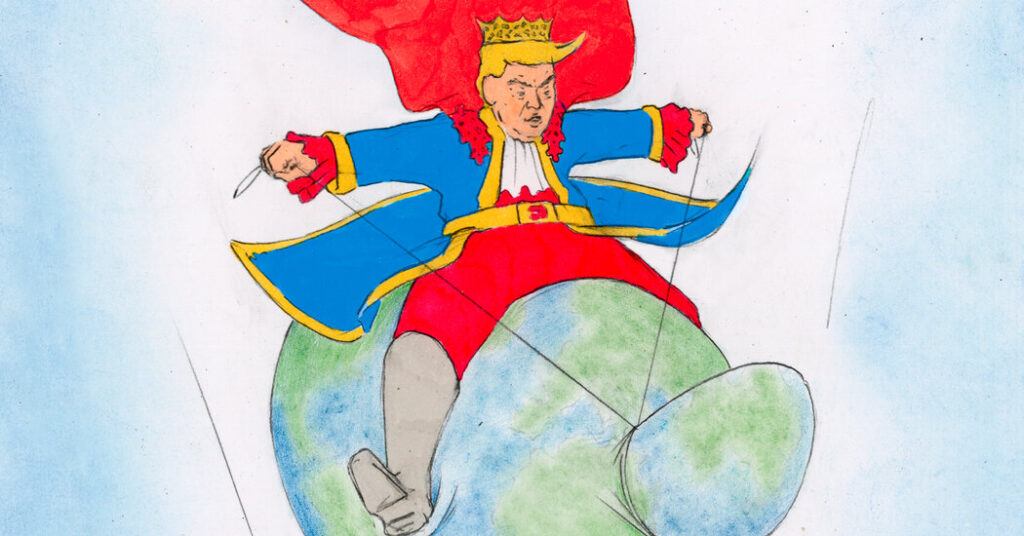
But that is because people are looking at it through the wrong historical lens. Mr. Trump’s approach is not just chaos or, as many people have commented, an updated version of 19th-century great-power competition. He is pursuing something more out of the 16th-century, what we call neoroyalist international politics.
Foreign policy has become a tool to channel money and status to Mr. Trump and his closest associates. National interests are eclipsed by those of elites. Rather than compete with rivals, Mr. Trump is willing to collude with them in order to advance his court’s parochial interests.
And if other countries do not act quickly to check Mr. Trump’s impulses, they are likely to enable a global order based on extraction and dominance.
For decades, the United States has championed a rules-based international order. Mr. Trump has wasted little time taking a wrecking ball to it and was typically blunt in declaring, “I don’t need international law.”
To interpret Mr. Trump’s approach, the administration and pundits have been quick to turn back the clock to 19th-century models of international affairs. The purported Donroe Doctrine (aping the Monroe Doctrine of 1823) aims to secure a sphere of influence in the Western Hemisphere to counter the influence of Russia and China. We are back to a world, the president’s deputy chief of staff, Stephen Miller, said, that is “governed by strength, that is governed by force, that is governed by power. ”
But what we are seeing is not great-power competition in any traditional sense. Instead of securing the region from narcotrafficking, Mr. Trump went after one autocrat in Venezuela and pardoned a former Honduran president who said he wanted to “stuff the drugs up the gringos’ noses.” Mr. Trump claims that taking over Greenland is “psychologically needed,” even though the United States already has a military presence on the island and an open invitation to expand its bases. And he has struck deals with great-power rivals that undermine U.S. influence, reportedly promising Vladimir Putin territorial gains in Ukraine and approving Nvidia’s bid to sell its high-end semiconductor chips to China.
Today, America’s foreign policy establishment has morphed from a set of staid bureaucracies into a royal family, such as the Tudors or Hapsburgs. Foreign policy is molded in the hands of the court clique — a small, exclusive network. Some are in Mr. Trump’s cabinet, like Marco Rubio, who is simultaneously the secretary of state, interim national security adviser, acting chief archivist and perhaps viceroy of Venezuela.
Mr. Trump’s clique also centers on his family members and individuals who donated to his 2024 campaign (like Elon Musk and Paul Singer, the billionaire founder and co-chief executive of the hedge fund Elliott Investment Management). Ukraine peace negotiations continue to be led by Mr. Trump’s fellow real estate magnate Steve Witkoff and Mr. Trump’s son-in-law Jared Kushner.
While Mr. Trump boasts that the Venezuela intervention will increase American prosperity, there is actually little promise of national benefit. Instead, the gains appear to be flowing to Mr. Trump and his insiders. Amber Energy, an affiliate of Mr. Singer’s hedge-fund company, won an auction for Citgo, the U.S. subsidiary of the Venezuelan state-owned oil company, a few months ago and is now strategically positioned to play a key role in refining and distributing that oil. As a down payment, Mr. Trump announced that up to 50 million barrels would be sold and that “that money will be controlled by me.” The first sale was routed through the company of another megadonor, leading Senator Chris Murphy to conclude, “Trump took Venezuela’s oil at gunpoint and gave it to one of his biggest campaign donors.” Fifty million barrels is a mere two and a half days’ worth of domestic consumption, but it would be well more than what Mr. Trump spent on his 2024 election campaign — a pot of patronage rather than a national investment.
Mr. Trump’s trade policy follows a similar script. While not delivering a rebirth in U.S. manufacturing jobs, tariffs have served as a ready-made tool to get countries and companies to tithe. South Korea and Japan have collectively pledged hundreds of billions in investment funds operated under opaque governance rules. Vietnam fast-tracked the approval of a $1.5 billion Trump family golf course at the same time that it sought to reduce its tariff rate.
Private companies, too, pay the king a benevolence. Apple’s chief executive, Tim Cook, delivered a gold-based plaque and a donation to Mr. Trump’s planned ballroom. And the spoils system has paid off for members of the Trump family, with their personal wealth reportedly increasing by at least $4 billion since the election.
Looked at through a neoroyalist lens, the irrational becomes rational. The shift in U.S. semiconductor policy can be read as an effort by Mr. Trump and his insiders to place themselves at the center of huge sums of economic activity. For roughly a decade, U.S. policy sought to limit the sale of advanced chips to countries or companies that might leak U.S. technology to China. This made a ready pool of players willing to pay tribute to get that access, particularly in the Middle East.
A few months after coming to office, Mr. Trump traveled to the United Arab Emirates, reversing U.S. policy and arranging a preliminary deal that would open up the flow of half a million Nvidia chips to that country. The unprecedented deal steamrolled security concerns surrounding ties between the Emirati company G42 and the Chinese Communist Party. Shortly before the finalized deal was announced, Emirati-backed investors plowed $2 billion into World Liberty Financial, a cryptocurrency start-up founded by the Trump and Witkoff families.
As with all royal houses, the goal is not only money but also status. Mr. Trump seems to think that perceptions of power mean actual power. Some have quickly adapted to the game. It is not random that when he arrived for his state visit to South Korea, the government gave him a golden crown or that King Charles of Britain offered a royal visit draped in pageantry and tech titans.
This status game is far from costless. Just ask India’s prime minister, Narendra Modi. In 2025, as trade talks dragged on between India and the United States and after he refused to credit Mr. Trump for playing a key role in a cease-fire between India and Pakistan and nominate Mr. Trump for the Nobel Peace Prize, India was slapped with unprecedented tariffs. Greenland follows a similar logic. Mr. Trump’s various threats and interest in a Nobel have loomed over his demands about the semiautonomous island.
The reaction of most of the world to Mr. Trump’s neoroyalism had been muted. Last week at Davos, Mr. Trump’s threats finally prompted European leaders to openly rebuke his claims to Greenland. Yet Europe has said little about the U.S. intervention in Venezuela. Even on Ukraine, leaders like Mr. Macron and Germany’s Friedrich Merz seem more inclined to flatter than outright oppose him. Mr. Macron might claim that Europe “prefers respect to bullies,” but he also went as far as to defend Mr. Trump’s demand for Ukraine’s minerals, seeing it as a way to buy United States support for Kyiv.
Perhaps everyone hopes that it is fine if Mr. Trump wants to style himself as a Hapsburg emperor, as long as the world eventually returns to the rules-based normal. This is a dangerous bet. A group of Swiss billionaires took a gold bar and a Rolex desk clock to the Oval Office. Then Switzerland got some tariff relief, but at what cost? And what about next time? The more foreign public and private leaders appease Mr. Trump, the more those behaviors become the norm of international politics.
To resist neo-royalism the first step is to “name the reality,” as Canadian Prime Minister Mark Carney warned at Davos. He noted that those who “compete with each other to be the most accommodating. This is not sovereignty. It’s the performance of sovereignty while accepting subordination.”
Mr. Carney is right. A neoroyalist world is not inevitable. Countries — including America’s closest partners — now need to offer a coherent alternative, mobilizing their own sizable collective resources to counter Mr. Trump and support a system based on fair rules and predictable diplomacy.
A potential deal between the European Union and the countries of the South American trade bloc Mercosur would be a good start, creating one of the largest free trade zones in the world and a bulwark against U.S. economic bullying. The European Union should continue to accelerate trade integration in Asia and Africa, offering a clear alternative to a system based on tithing and threats. And European nations must be willing to make a coordinated financial injection into their defense industries and reduce dependence on the United States.
Domestically, businesspeople must understand that the short-term payoff of patronage is less valuable than the long-term value of the stable rule of law. Major U.S. oil companies are not diving headfirst back into Venezuelan oil. Capital does not want to end up in the same position as an oligarch in Mr. Putin’s Russia, constantly fearing arbitrary punishment and open windows.
A neoroyalist world is not good for the United States, and it is not good for humanity. Its primary goal is extraction for the few rather than safety or prosperity for the many.
Stacie Goddard teaches political science at Wellesley College. Abraham L. Newman is a professor of international affairs at Georgetown and an author, with Henry Farrell, of “Underground Empire: How America Weaponized the World Economy.”
The Times is committed to publishing a diversity of letters to the editor. We’d like to hear what you think about this or any of our articles. Here are some tips. And here’s our email: [email protected].
Follow the New York Times Opinion section on Facebook, Instagram, TikTok, Bluesky, WhatsApp and Threads.
The post Trump’s Foreign Policy Is Stuck in the 16th Century appeared first on New York Times.