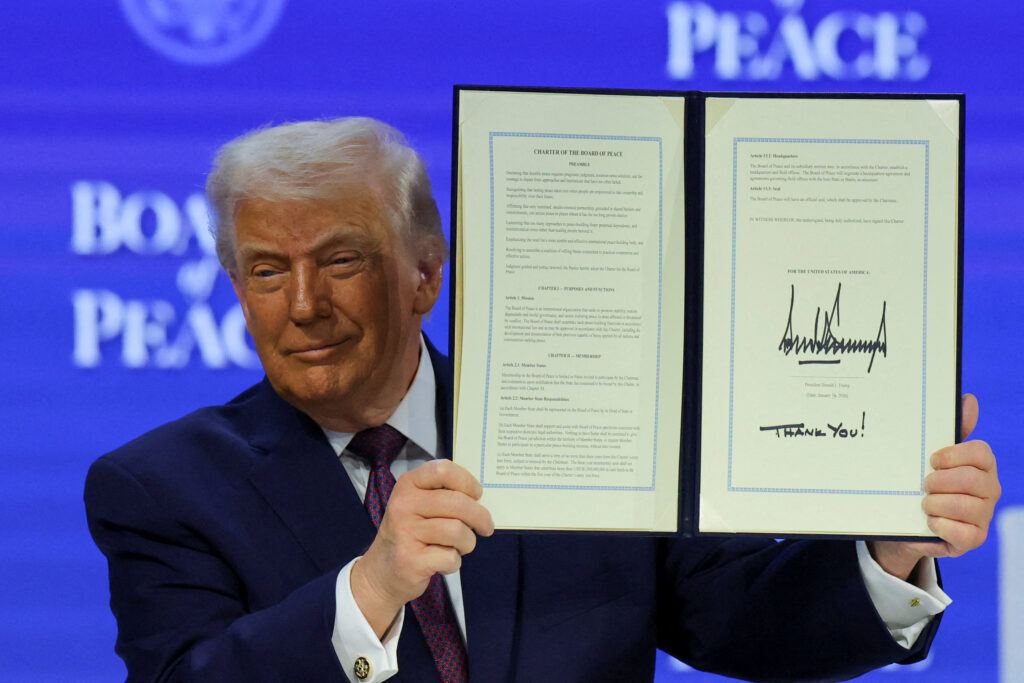
DAVOS, Switzerland — Up in the Alps, Secretary of State Marco Rubio served as his boss’s hype man. At a Thursday ceremony on the main stage of the World Economic Forum, the White House unveiled President Donald Trump’s “Board of Peace” — a grouping of countries aligned with some of Trump’s peace initiatives, chiefly now the project to reconstruct war-ravaged Gaza. Rubio cast the entity as an answer to a faltering international system.
“Oftentimes in international affairs, we often find ourselves at events where people are reading these scripted statements, these strongly worded letters that they put out, but no action, nothing happens,” Rubio said.
“This is a group of leaders that are about action,” he added, gesturing to 19 other leaders or ministers assembled onstage around Trump, “and the president of the United States is a president of action, of getting things done.”
There’s a lot uncertain and unclear about what the Board of Peace represents or may try to accomplish in the coming months, beyond the plans in place to administer postwar Gaza. Few of the U.S.’s most important Western allies considered joining it, while Trump has conspicuously extended invitations to dictatorships in Russia and Belarus. Both the board’s boosters and critics see it as a challenge to the existing international order, at a time when Trump appears increasingly convinced of the U.S.’s right to assert primacy in global affairs, from his defenestration of the regime in Venezuela to his desire to annex Greenland.
In an interview with CNN, Mary Robinson, a former president of Ireland as well as a former top-ranking U.N. official, described the entity as a “power grab by an individual who now has imperial ideas.”
Jonathan Schanzer, executive director of the Foundation for Defense of Democracies, a neoconservative think tank in Washington, cheered that “the jackals at the U.N. are watching nervously. If Trump succeeds, it will be a further sign of their failures.”
In Davos, the view was more nuanced. I spoke to two leaders whose governments had signed onto the Board of Peace. Both President Vjosa Osmani of Kosovo and Armenian President Vahagn Khachaturyan insisted that the board was a complement, not a challenge, to the U.N. system and also downplayed reports of the Trump administration extracting $1 billion commitments as a guarantee of membership.
Osmani said Kosovo had not been asked to pay into the board, and said her country’s participation was more about the power of its example. “We know what it means to be a country that needs a helping hand,” she told me, referring to the U.S.-led operations close to three decades ago that helped Kosovo break away from Serbia.
“Each and every one of us were refugees. We were IDPs. We lost loved ones, we lost our houses,” Osmani said. “We had to build our lives from scratch, and we were able to just because the democratic world stood by us. They opened their doors, they opened their hearts. So now it’s our turn to give back.”
Khachaturyan said membership in Trump’s entity was “not about millions of dollars or hundreds of millions of dollars, but more about an attitude, and it’s a possibility to help people in need.” He lamented that, around the world, “principles of coexistence are very often violated, and the United Nations is not often able to prevent those violations” but said the Board of Peace could help “enhance confidence” in the U.N. system.
Many prominent analysts do not share this assessment, and criticize Trump’s record of self-dealing. Trump “is a destroyer of institutions who wants to replace them with his own preferences, which inevitably benefit him personally,” political philosopher Francis Fukuyama wrote in the aftermath of the spectacle in Davos. “An institution is a rule or structure that is not dependent on a single individual, one that survives the departure of the institution’s creator.”
Phil Gordon, a former Biden and Obama administration official and foreign policy adviser to former vice president Kamala Harris, suggested that the Board of Peace was an extension of Trump’s political style. “He wants to be the man, the all-powerful leader who gets the respect of everybody and takes the resources that he deserves and controls them,” Gordon told me in Davos. “Anyone who thought he was an isolationist, because of ‘America First,’ is learning that that’s not it.”
The broader shift in global politics that Trump seems to have catalyzed — described variously as a drift toward an old-school “spheres of influence” vision of the world or an embrace of “might makes right” politics — has troubled those who still ascribe to the principles of a liberal order.
In an interview in Davos, Svetlana Tikhanovskaya, leader in exile of Belarus’s democratic opposition, warned that “a transactional approach in policy is rather dangerous” and that those heralding the collapse of the rules-based order may regret what it entails.
“Are we ready for the dictatorship of pragmatism to win this world?” she said. “I doubt, because it will be a world just of money, and this is not what our society, I hope, is striving for.”
Salah Ahmed Jama, Somalia’s deputy prime minister, pointed to what his nation and many others in the Global South are striving for.
“We are envisioning a world that is more stable than it is, a world that gives an equal opportunity to children, no matter where they are born and which geographic location they are in, and a world that does not snatch away the future from them,” he told me. “We have a lot of ambitions and dreams for our citizens, and much of what we can do for them as a government depends on the international order in which we live.”
Sign up to receive WorldView, a free, thrice-weekly email newsletter from the international desk of The Washington Post.
The post Looking for signs of Trump’s new world order after Davos appeared first on Washington Post.