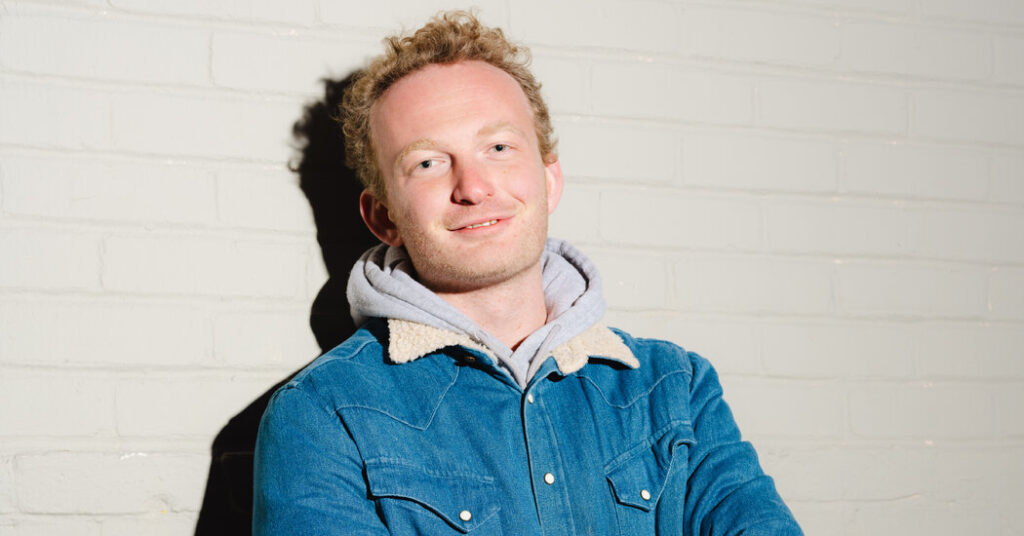
Morris Katz is a confident young man, but he did doubt himself last November, for a moment.
The 26-year-old media strategist, who helped orchestrate the greatest political upset of the decade, was sitting behind Zohran Mamdani, the mayor-elect of New York City, on a flight to a much-anticipated meeting with President Trump. Scrolling X, he came across a post by a New York Post journalist that cited an anonymous Democratic operative who chided Mr. Mamdani for bringing along Mr. Katz and Elle Bisgaard-Church, his 34-year-old campaign manager, rather than more seasoned aides.
“Susie Wiles and that gang of vipers are going to tear them to shreds,” the post read, referring to Mr. Trump’s formidable, 68-year-old chief of staff.
“Most of this stuff bounces off of me,” Mr. Katz recalled in an interview. “But I thought, ‘Oh God, maybe we are going to get eaten alive.’”
Instead, a national audience watched, stunned, as Mr. Mamdani and Mr. Trump hosted a news conference whose headline was its sheer affability. It went better than Mr. Katz — who had played Mr. Trump as the men practiced for the meeting, and who had rushed to Brooks Brothers to buy a replacement for the tie Mr. Mamdani had originally selected (“Not fancy enough,” Mr. Katz said) — could have possibly imagined.
Then again, so have most things in Mr. Katz’s short, charmed career. Like Mr. Mamdani, Mr. Katz is a child of the New York cultural elite, but is fluent in the anti-elite language of progressive populism. In addition to his role as one of Mr. Mamdani’s closest advisers, Mr. Katz has helped to select, mold and make ads for a crop of rough-hewed, gruff-voiced Democratic candidates throughout the country, including the Maine Senate hopeful Graham Platner. This makes Mr. Katz a kind of casting director for a future Democratic Party whose members wear Carhartt and aren’t afraid to say “hell” and “damn.”
“He has a vision in his head,” said David Axelrod, the media strategist who masterminded Barack Obama’s two presidential campaigns and has shared notes with Mr. Katz.
Not everyone in the party shares that vision, particularly those Democratic insiders who believe the regular cycles of American political opinion will soon restore them to power. But Mr. Katz’s proximity to the splashiest story in American politics has made him an in-demand image maker — a proximity perhaps best measured by election night photos that show Mr. Katz squeezed into a love seat beside Mr. Mamdani as the mayor’s wife, Rama Duwaji, looks on. At a time when politics is pop culture, this gives Mr. Katz privileged access to the biggest show around.
In a statement, Mr. Mamdani called Mr. Katz a “a close friend, and a fellow New Yorker who wasn’t smart enough to get into Stuyvesant” — a joking reference to the ultra-competitive Manhattan public high school with a microscopic acceptance rate, which neither man attended — adding that his adviser “possesses the combination of ruthlessness and principle that’s all too rare” in politics.
Mr. Katz’s success, along with his age and sharply worded ideas about what is wrong with Democrats and the people who try to elect them, has helped thrust him into a broader conversation about how Democrats can win back voters they lost in 2024. In seeking to rebrand the party, he professes an aversion to phonies so strong it would make Holden Caulfield blush.
“If you’ve wanted to be president since you were 5 years old, a large percentage of the electorate thinks you’re a loser,” Mr. Katz said. “There’s a ‘no more losers’ thing. It’s harsh, but it’s true.”
He also strives to meet younger voters where they are. Mr. Katz’s 24/7 shaping of Mr. Mamdani’s message across a daunting array of media — from cable news to TikTok — suggests a thoroughly modern strategist, equally at home making a 30-second ad as he is brainstorming social media stunts.
That said, Mr. Katz’s oft-repeated strategy for Mr. Mamdani was to “let Zohran cook”: Get out of the way, and let him do his thing against his disgraced, unpopular opponent, Andrew Cuomo. Mr. Katz rode a unicorn to a position of sudden influence within the party, following a trajectory of star strategists from decades past, like Mr. Axelrod or James Carville, or even Karl Rove.
But those men had decades of experience working for political campaigns before they achieved national prominence. Mr. Katz does not. What can he do with candidates who don’t cook, so to speak?
“Morris has an enormous belief in himself, a belief that he should be in that room and should be having these conversations,” said Tommy Vietor, who knows a bit about being a political wunderkind, having arrived on the national scene in 2009 as a 28-year-old assistant press secretary to President Obama.
Belief and confidence are not the first qualities that spring to mind when one thinks of the Democratic Party in 2026. But greatness — real or otherwise — is rarely achieved without them. Mr. Katz has the next nine months to show the party what he can do.
On Set
On a frigid Saturday in December, Mr. Katz sat in the living room of a well-appointed home on the west side of Des Moines. He was there to direct an ad for Nathan Sage, who is competing against several other Democrats in the primary for the Senate seat in Iowa currently held by the Republican Joni Ernst, who is retiring.
In a plain T-shirt, jeans, unlaced Timberland boots and a beanie — from which sprang short blond curls — Mr. Katz resembled less a slick political spin doctor than a production assistant on a Safdie brothers film. Jiggling his foot at the end of a crossed leg, he read lines off an iPhone from a script he had prepared.
“Iowans are tired of politicians with slicked back hair, fancy shirts and no backbone,” Mr. Katz said.
“Iowans are tired of politicians with slicked back hair, fancy shirts and no backbone,” Mr. Sage repeated.
“Angrier,” Mr. Katz said. “Like we’re about to get in a fight.”
Mr. Sage, a stocky, earnest former mechanic in the Marines, had no political background, and Mr. Katz was straining to make him act naturally in front of lights and a camera. Mr. Katz and his colleagues wanted to air the ad on Fox News to gin up excitement about their candidate among Republicans and independents. But first, they needed to get Mr. Sage to give viewers something to be excited about.
Mr. Katz encouraged Mr. Sage to discuss the people he had met on a recent tour of the state. Now Mr. Sage began to loosen up, relating the financial struggles of Iowans back to his own childhood. He started to cry.
“I grew up in a trailer park in Mason City,” he said. As Mr. Katz fed him lines, Mr. Sage’s sadness welled into anger.
“We have some of the highest cancer rates in the country,” Mr. Sage said as he talked about a state bill that would protect pesticide companies from personal injury lawsuits.
“Say it as if it’s an accusation, not a fact,” Mr. Katz said.
During a coffee break, Mr. Katz conferred with Charlie Hills and Rebecca Katz, his colleagues at the Fight Agency, a strategy firm. Ms. Katz, a veteran political operative who was the lead strategist on the successful Senate campaigns of John Fetterman and Ruben Gallego — and who is not related to Mr. Katz — worried that Mr. Sage seemed nervous. But there was good material, too.
“The moment where he’s getting choked up, we can do something with that,” Mr. Katz said.
“That could go viral,” Mr. Hills added.
If relatability is the benefit of running brawling candidates with limited experience, unpredictability is the risk. Mr. Fetterman, of course, badly disappointed many of his followers with his policy decisions once he was elected. (He has defended his stances by saying he would not subject himself to “purity tests.”)
And Mr. Platner, the Maine hopeful, made news after the disclosure that he had been tattooed with a Nazi symbol. (Mr. Platner, who said he did not understand the significance of the design, had the tattoo covered up.)
In the Iowa living room, Mr. Katz jokingly asked Mr. Sage if he had any Nazi tattoos.
“No,” Mr. Sage responded brightly, tugging up his sweatshirt sleeves to prove it.
For the second leg of filming, a group of volunteers for Mr. Sage gathered around a dining table, pretending to be a family in conversation with the candidate. Rather than a static shot, Mr. Katz wanted the camera to track Mr. Sage as he strode into the room, to capture what he called “organic texture.” Mr. Katz instructed the camera crew to set up a dolly, a time-consuming process.
“I hate your ambition,” Mr. Hills said.
“Me too,” Mr. Katz responded, with a laugh.
Getting Into Politics
Mr. Katz is the most recent in a family line of offbeat comers. His great-grandfather made a fortune in hosiery, and fabricated a family crest to prove that Jews could have one. (The young Katz has the crest, a stylized “K,” tattooed on his arm.) His grandfather, Harry Jay Katz, was a notorious Philadelphia raconteur and media fixture who once estimated to Philadelphia Magazine that he had slept with 4,000 women.
At 14, Mr. Katz gave a eulogy at his grandfather’s funeral. Dan Gross, formerly a gossip columnist for The Philadelphia Daily News, remembers the young man bringing down the synagogue with an anecdote about the Katz patriarch’s use of his adorable grandson to pick up attractive strangers.
“Morris has always had that confidence and surety,” said his father, David Bar Katz, a successful playwright and television producer whose credits include “Ray Donovan” and the 2022 remake of “American Gigolo.” Morris Katz’s mother is the children’s book author and publisher Julie Merberg.
Mr. Katz grew up in a creative milieu centered on his parents’ TriBeCa home, where he would stay up late around the kitchen table listening to his father’s close friends — including Philip Seymour Hoffman, who was Mr. Katz’s godfather — argue about the playwright Tennessee Williams and the avant-garde drama theorist Antonin Artaud.
Morris Katz attended the Beacon School, a prestigious public school in Hell’s Kitchen, where he was a Woody Allen-watching, Philip Roth-reading, Bob Dylan-listening occasional truant who dreamed of becoming a screenwriter. He wrote his first screenplay as a freshman.
“It was ‘Midnight in Paris’ meets ‘Inside Llewyn Davis’ meets ‘Kids,’” Mr. Katz said. “But more poorly written.”
He also fantasized about politics, writing pretend stump speeches and spending hours reading about the progressive leaders of yesteryear. As a student at Skidmore College, Mr. Katz started to take more seriously the idea of a political career, listening to “Pod Save America” and volunteering for the losing New York congressional campaign of Tedra Cobb. Initially, his father thought he was developing another career path to mine for material.
Mr. Katz’s senior year of college was remote because of the pandemic, and he used much of his time to work for Erica Smith, a North Carolina state senator running for U.S. Senate. He made his first ads for her. On the trail, Mr. Katz said, a funder told him that 21 sounded too young to have a significant role on a political campaign, and that he should tell people he was 23 — a college graduate.
Until last year, Mr. Katz continued to tell people he was two years older. It’s a misrepresentation that Ms. Katz, his colleague, likes to think of as a boyish fib.
“Only a 26-year-old would think 28 sounds really old,” she said.
Regardless, Mr. Katz’s work for Ms. Smith persuaded the strategist Tommy McDonald to hire him as deputy media director on John Fetterman’s successful 2022 Senate campaign against Dr. Mehmet Oz.
In October of that year, as Mr. Fetterman battled questions about his fitness for office after having a stroke, Mr. Katz wrote an ad, “Family Matters.” In it, Mr. Fetterman used his near-death experience to pivot to a message about the way government should help families spend more time together. It was a heart-string puller shaped by Mr. Katz’s fine antenna for pathos, honed since his childhood around the theater.
“Politics isn’t telling the story of a funding achievement,” Mr. Katz said. “It’s the person who is sighing at the end of their workday because they’ve already been defeated, or the person who can’t find love because the system doesn’t leave room for it.”
Mr. Fetterman set the aesthetic template for many of Mr. Katz’s candidates: a gruff white guy who looked as if he had just walked off a job site. From him springs Mr. Platner, introduced to the American public in a Katz-penned and directed ad wearing a hoodie and sunglasses, pulling oyster traps as a guitar solo blares; Mr. Sage, whose campaign announcement featured a tool cabinet and light profanity; and Dan Osborn, the Nebraska independent who came within six points of taking a safe Republican Senate seat in 2024, helped by memorable ads like one that featured him wielding a blowtorch.
These candidates share a willingness to name a villain, something Mr. Katz values highly. Think “the billionaire class,” “the Washington establishment” and multinational corporations — the stock targets of the wing of the progressive left that sees appeals to class, rather than to identity or abundance or resistance to Mr. Trump, as the path forward for Democratic politics.
Through these attacks, Mr. Katz is also trying to press a new picture of political masculinity, one that, he said, “isn’t about throwing trans kids under the bus.”
He added, “Being a man is saying ‘I’m not afraid to stand up to corporations and billionaires.’”
A New Insider
For Mr. Katz, the two months since Mr. Mamdani’s election have been surreal and overwhelming: “a presidential campaign meets ‘Beatlemania,’” as he called it.
For one thing, he’s not used to being recognized, as he was recently by a Williamsburg bartender, who saw his name on his credit card and offered heartfelt congratulations. For another, this wasn’t how he envisioned his political life. Mr. Katz imagined working on House races for years and then maybe for a presidential candidate, before finishing his career coming home to help elect a mayor.
Which is not to say he’ll be keeping his distance from Mr. Mamdani. He helped set up meetings with real estate bosses and Jewish leaders after the campaign to soften, if not overcome, these groups’ opposition, and he has advised the mayor from outside the administration on staffing and endorsements. He accompanied Mr. Mamdani to a recent meeting with Steven Spielberg at the director’s Central Park West home. And he has mixed in a bit of crisis communications, helping the mayor navigate controversies over old social media posts made by several appointees.
“Anything that is in his political footprint or media footprint, we want a deliberate, clear vision,” Mr. Katz said. “And I see myself as the person responsible for that.”
But it appears he won’t be joining the new administration, at least not yet. On the one hand, he could be passing up the opportunity to be the most important adviser in the most consequential city hall in the United States.
On the other, it’s a sign that Mr. Katz’s ambition for the Democratic Party — and himself — extends far beyond the five boroughs.
It’s a daunting remit for anyone, let alone a young man with all of Mr. Katz’s other responsibilities.
A self-described “adrenaline junkie,” Mr. Katz relies on superstrong nicotine pouches he orders from Europe to keep all of his plates in the air. According to his colleagues, he’s an accomplished multitasker, in the Gen-Z way that can look suspiciously similar to wasting time on the phone.
(“He’s a very good listener when he’s paying attention,” Ms. Katz said.)
He’s made the media rounds, raising eyebrows in some political group chats with his pronouncements about the state of the Democratic Party. “No one has a worse read on what electable means and less of a pulse on voters than the Democratic establishment in D.C.,” he said in an interview just after Mr. Mamdani’s victory.
This attitude has led other Democratic insiders to wonder if Mr. Katz is leveraging his connection to Mr. Mamdani to push his own brand — and his own hot-blooded candidates — at the expense of more established figures who can help the party build a durable majority.
Adam Jentleson, the former chief of staff to Mr. Fetterman and the founder of the Searchlight Institute, a new think tank, said that he was impressed by and liked Mr. Katz, but that he worried that Mr. Katz’s brash candidates might not survive the thermostatic push and pull of the midterm cycle.
“I want Morris to succeed,” Mr. Jentleson said, “but I wish he could live through the 2030 midterms and have his approach today informed by that experience.”
Mr. Jentleson and others on the center left aren’t sure that Mr. Katz’s economic populism will work in wide swaths of the country, and are skeptical of the idea that it’s possible to sidestep issues like immigration and climate change.
“You start with a highly selective image of populism that is tailored to an Upper West Sider’s political sensibilities,” Mr. Jentleson said. “It gets very awkward very fast in red and purple states.”
Mr. Katz remains undaunted by charges of callowness, arguing that transformative candidates like Mr. Mamdani can “restructure power” in a way that lets Democrats dream of national majorities so large that they can enact sweeping change.
Of course, when a young person excels in public life, it can never be a simple cause for celebration: The nature of precocious success must be contested. Is it the product of authentic greatness, too intense to wait its turn? Or else a flimsy imitation, waiting to be exposed?
“There are days I have intense impostor syndrome,” Mr. Katz said. “What will shake me out of it is, I’m on some call with other consultants, and I’m hearing what they’re saying, and it is so idiotic. At least I’m not a net negative on these campaigns.”
And it helps, too, to keep a sense of humor, which Mr. Katz has used to keep a little distance from the dizzying trajectory of his life.
Said the 26-year-old, only a few years removed from his screenwriting dreams: “I have a lot more material now.”
Joseph Bernstein is a Times reporter who writes feature stories for the Styles section.
The post He’s 26 and Ready to Fix the Democrats’ Strategy appeared first on New York Times.