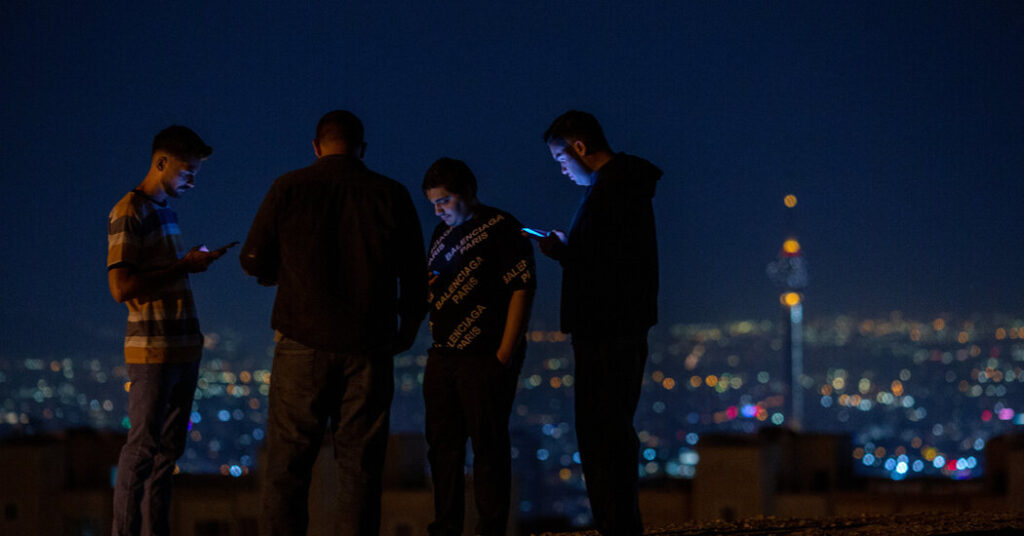
For more than 17 days, Iranians have withstood not only a brutal crackdown to quell nationwide protests, but also a near-total communications blackout. Now some Iranians, eager to reconnect with the world, are managing to gain sporadic but brief internet access.
Many Iranians have used the quick windows to send their first messages to loved ones to reassure them they are alive, relatives said. But the openings have also allowed Iranians to send more extensive messages and videos abroad, giving journalists and rights groups a widening view of the extent of the government crackdown and its toll.
Even the limited information being gleaned indicates that thousands more Iranians may have been killed than the estimated 5,200 previously reported, according to some human rights groups working to verify the numbers.
It remains unclear how some Iranians are managing to connect, even as monitoring of Iran’s internet indicates that the shutdown remains in place. Internet experts said the moments are probably related to the Iranian authorities’ efforts to lift the shutdown while also maintaining tight censorship filters.
“Every time I connect, it takes a year off my life,” Mahsa, a 39-year-old in Tehran, wrote in a message during a window of connectivity. “I prefer to turn a blind eye and remain in the dark and in this state of uncertainty and despair.”
Like many people in Iran, Mahsa asked that her full name be withheld for her safety. She was among more than a dozen people in Iran reached in recent days by New York Times journalists and who described being able to gain fleeting online access.
The demonstrations in Iran were initially set off in some cities in late December by worsening economic hardship and a currency crisis, but they quickly spread nationwide — and into direct calls to overthrow the Islamic Republic.
In response the authorities shut down Iran’s internet on Jan. 8 as security forces began a fierce campaign to suppress the protests. International calls have also been blocked, while domestic phone calls work reliably only until the evening, according to the few residents who managed to speak to The New York Times.
The blackout had made it nearly impossible for journalists and human rights groups, let alone Iranians themselves, to ascertain the scope of the violence.
The brief openings to the internet may slowly help change some of that.
The Washington-based Human Rights Activists News Agency said that as of Friday it had verified more than 5,000 deaths, and that it was seeking to verify more than 17,000 possible deaths in all as new information trickles out of Iran.
Internet censorship in the Islamic Republic is not new — the authorities have been blocking websites since 2005, including Facebook and Instagram. During previous anti-government protests, the authorities temporarily shut down the internet in restive areas. In June, during the 12-day war with Israel, it imposed a near-total shutdown.
But this blackout is the longest and most extensive.
The sporadic access for Iranians is creating “a twilight zone where users are neither online nor offline,” said Alp Toker, the director of the internet monitoring group NetBlocks.
The openings may be the result of people trying to access the internet as the authorities experiment with methods to “whitelist” users, said Amir Rashidi, a cybersecurity expert with Miaan, a digital rights group focused on Iran.
Whitelisting is what Iran’s internet activists call state efforts to essentially offer different levels of connectivity, based on people’s political loyalties or ability to pay for access, or their need for the internet — such as for businesses or academic institutions.
“At times, for a few minutes, parts of the network appear to be unfiltered, but this quickly reverts back to a full internet shutdown,” Mr. Rashidi said. “All of this points to an effort to aggressively expand whitelisting, ultimately moving toward a form of tiered or class-based internet access.”
The more authorities experiment with whitelisting, he added, “the more gaps and unintended pathways for connectivity will emerge.”
The current shutdown is costing Iran’s economy between $16 million to $24 million a day at the current exchange rate, according to Donya-ye Eqtesad, Iran’s most widely read financial newspaper.
According to the reformist newspaper Khabaronline, Majid Reza Hariri, the head of the Iran-China Chamber of Commerce, said that traders now receive internet access for 20 minutes a day under supervision, “which in no way meets the needs.”
State-affiliated news channels have reported that the return to internet connectivity first began with access to Google search and then expanded to Iran’s “domestic internet” — walled-off versions of social media and websites.
The scale and extent of what happened in Iran are not yet clear, even inside the country.
Yashar Soltani, a prominent investigative journalist in Tehran, posted on X that the scale of death was “a tragedy whose true dimensions are still shrouded in obscurity and censorship.”
He wrote, “The truth, even if they hide it, will not disappear.”
Kiana Hayeri and Pranav Baskar contributed reporting
The post Amid Two-Week Internet Blackout, Some Iranians Are Getting Back Online appeared first on New York Times.