Celine Gounder is a physician and epidemiologist and a senior fellow at KFF. She is also the editor at large for public health at KFF Health News and the host of the podcast “Epidemic.”
Bill Foege had been summoned to the U.S. Embassy in New Delhi. The American ambassador to India, Daniel Patrick Moynihan, was not happy.
“I have evidence here that you’re spreading smallpox rather than containing it!” Moynihan barked as Foege walked into his office.
A demanding Moynihan wanted to know who all those American epidemiologists gathered at the border with Nepal were. It was the 1970s, the height of the Cold War and international tensions were fraught. Nepal was a Communist hotbed, and the Indian government feared the doctors might be spying under the guise of public health work.
Foege explained. He and his colleagues had launched a door-to-door search for smallpox across India. Wherever they looked, they found smallpox case numbers were spiking.
Listening, Moynihan softened. Soon he was asking what he could do to help. Foege had helped him see that they had the first opportunity in history to eradicate a human disease. It all hinged on whether it could be achieved in India — a country of formidable challenges.
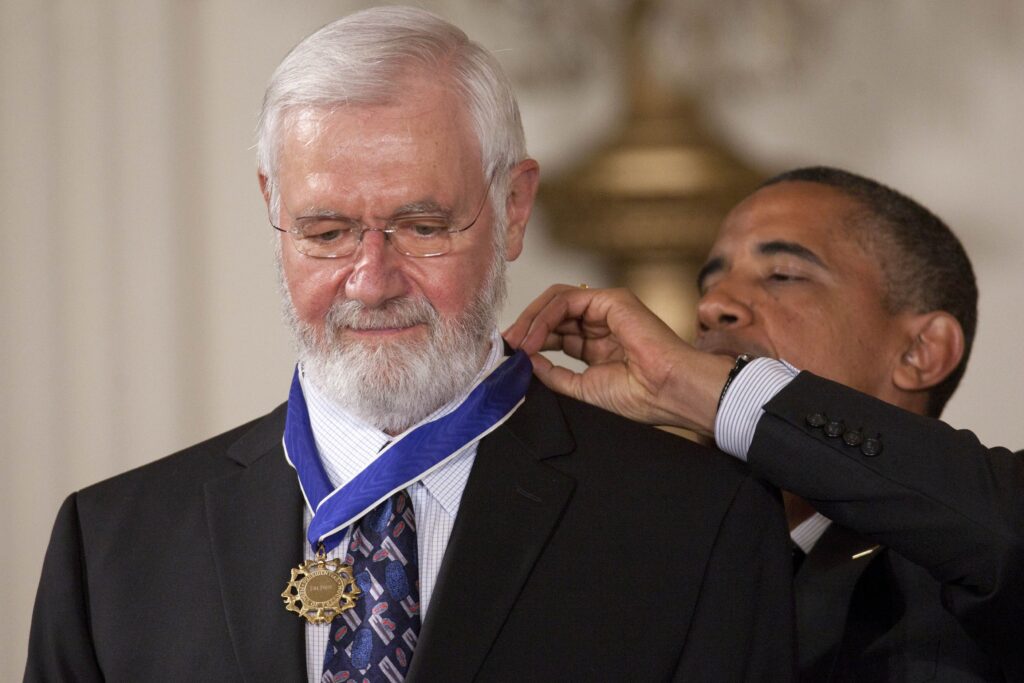
Foege, who died on Saturday at 89, went on to overcome those challenges and succeed in his quest to help wipe out smallpox not only in India but worldwide. His strategy of “surveillance-containment” — finding cases and isolating them, then vaccinating anyone who had come into contact with them — changed the course of public health history.
I interviewed Foege extensively in the years before his death for my podcast on eradicating smallpox. He was a mentor until the end, a visionary humanitarian and moral leader who inspired many careers in public health, including my own.
Foege’s connection to India dated back to his time as a physician with the Peace Corps in 1963. That was the first time he saw smallpox. “They were outcasts,” said Foege, recalling the patients. “I was struck immediately by something I had never read, and that was the smell. … It was similar to a dead body, that smell.”
Foege’s surveillance-containment strategy was not a novel one; a British Royal Commission had suggested it in the 1890s. But Foege rediscovered and employed it while working at a missionary hospital during a smallpox outbreak in eastern Nigeria in the late 1960s. Ordinarily, the response would have been a mass vaccination campaign, but there was not enough smallpox vaccine for everyone.
Asked to help, Foege radioed other missionaries in the region and sent runners to local villages to check for smallpox cases. He mapped the affected villages and sent them the bulk of the vaccine supply. And then he asked himself, “Where is it likely to spread? And the spread was likely to come through commerce.” Doctors used the rest of the supply to vaccinate people in the vicinity of three markets. The local outbreak disappeared.
Foege and his colleagues continued to search for smallpox cases in eastern Nigeria, vaccinating along the way. “In those first months of 1967, we were finding outbreak after outbreak,” he remembered. “But the federal government, seeing how successful we were, started to restrict our supply of vaccine,” saying they had to focus on other regions until they caught up with Foege’s team.
Desperate, Foege’s team headed to a vaccine warehouse in Lagos, a couple of hours to the west. While one person distracted the manager, another stole the smallpox vaccine. “We left … looking over our shoulder for that entire trip,” recalled Foege. They made it back, and by July 1967, the last outbreak in eastern Nigeria was under control.
Soon after, Foege joined the Centers for Disease Control and Prevention. Employing surveillance-containment, he and other CDC epidemiologists helped 20 countries in West Africa eliminate smallpox. Brazil and Indonesia also used the strategy and became smallpox-free. But India remained a problem. In 1973, Foege went back.
The smallpox program in India was focusing on mass vaccination, hoping to achieve herd immunity by immunizing 80 percent of the population. But with vaccinators revisiting the same places repeatedly, they fell far short of the goal.
Foege and his Indian counterparts, Drs. M.I.D. Sharma, Mahendra Dutta and Purshottam Diesh, were all surveillance-containment converts. And in August 1973, Prime Minister Indira Gandhi gave them the opening they needed to launch the All-India Searches. An army of 150,000 workers fanned out across the country, seeking out cases and marking homes with saffron-colored clay to indicate vaccination needs.
Then, India detonated its first nuclear device. As reporters streamed in to cover that event, they found another story: With expanded surveillance-containment, reported smallpox case numbers were spiking. “From their perspective, smallpox was out of control because you could see the numbers going up. They were going up because our surveillance was getting better,” Foege told me. “Suddenly, the newspaper articles come out saying here’s India working on nuclear weapons, and they can’t even control smallpox.”
India was embarrassed by the negative media. Political pressure to do something was intense. And that something was to revert to mass vaccination. Nine days after the nuclear-bomb test, Foege, Sharma and Dutta were in Bihar, the state with the most smallpox cases, for their monthly meeting with field staff. Bihar’s health minister arrived to inform the staff that they would be returning to mass vaccination.
A young Indian physician stood up and said, “I’m just a village man. And I don’t know much, but I do know when someone’s house caught on fire in my village, we all put water on that house. That’s surveillance-containment. We didn’t all put water on every other house; that’s mass vaccination.” The health minister was stunned. “I’ll give you one more month,” he said. A week later, reported cases had dropped: Surveillance-containment was working in Bihar, just as it had elsewhere.
The political pressure didn’t end. Karan Singh, the Indian Minister of Health and Family Welfare, likewise suggested a return to mass vaccination. Singh flew to Bihar to announce the change in strategy. Meeting him at the airport, Sharma and Dutta succeeded in changing his mind. “That’s how close we came I think to losing the program in India. And of course, if we lost it in India, we lost it every place,” said Foege.
Over his long career, Foege advanced public health on many other fronts, from scaling up childhood immunizations against measles and polio to fighting malnutrition, river blindness and lymphatic filariasis in refugee camps. For all his accomplishments, he had his regrets. “I should have learned more about politics. It’s the politicians who make the decisions,” he told me.
And yet, his ultimate legacy is one of inspiration — and optimism. “Bet on the optimists,” he said. “You need the optimist to say, ‘We’re going to try to do it.’”
The post Bill Foege’s optimism helped save the world from smallpox appeared first on Washington Post.