NUUK, Greenland — The notion that Denmark alone, or Europe together, could defend Greenland against an American force had become the source of relentless mockery within the White House. The Danish were dismissed as “irrelevant,” while Europe was portrayed as a shadow of its former self. If President Trump chose to take control of this Arctic island, the administration said, it would be his for the taking.
And yet, Europe did defend Greenland last week. Plans for a forceful economic response from the European Union spooked U.S. markets. Trump backed down from his years-long pursuit to take over the territory — and little Denmark succeeded, securing relief from an American pressure campaign that had challenged its basic sovereignty.
“We’ll get by with a little help from our friends,” Denmark’s prime minister, Mette Frederiksen, wrote in a guest book at Chequers on Thursday, referencing the Beatles lyric while visiting her British counterpart.
The specter of conflict has not disappeared. In Nuuk on Friday, after visiting with local leaders at a government office on the main boulevard of Greenland’s capital, Frederiksen embraced locals fearful of an imperialist United States. She declined to answer questions on whether tensions had been defused with Washington.
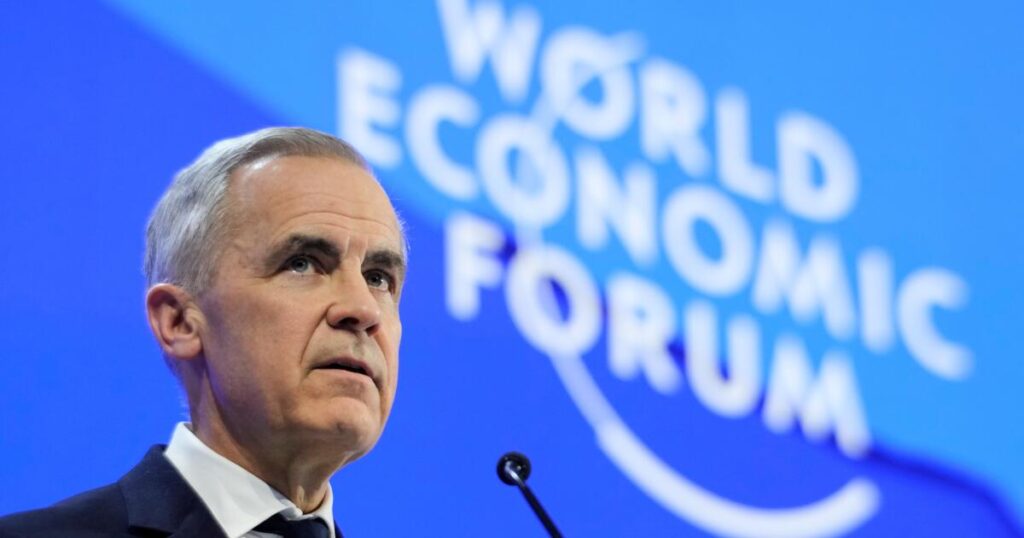
The Greenland crisis has proved to be an inflection point for U.S. allies, whose leaders, gathered last week in Davos, Switzerland, shed the pretense that all is well with Washington as they confront a new order. “The middle powers must act together,” said Mark Carney, Canada’s prime minister, in a speech widely shared in foreign capitals, “because if we’re not at the table, we’re on the menu.”
Within Europe, disagreements still persist on how to handle Trump on an interpersonal basis. German Chancellor Friedrich Merz and Italian Prime Minister Giorgia Meloni have bristled at French President Emmanuel Macron’s diplomatic dualities, standing up to Trump in public while courting him in private with obsequious texts.
But they all agreed that a firm stance against a U.S. ploy to seize Greenland was required to prevent disastrous escalation — even at risk of jeopardizing the NATO alliance itself.
Markets rallied after Trump reversed course, rebounding to previous highs. U.S. relations with its partners will take longer to recover, experts said.
“Trump’s retreat, and the skillful European handling of him, avoided an immediate crisis, but not the longer-term damage,” said Elliott Abrams, a veteran diplomat who served under Presidents Reagan and George W. Bush, as well as under Trump in his first term. “An unpredictable and unfriendly United States threatening to use force against a fellow NATO ally was unthinkable. Now it is thinkable — because it just happened.”
“Leaders of allies will be pondering this for the next three years and figuring out what works with Trump, whom he listens to, and how much of the problem is Trump,” Abrams added, “as opposed to deeper currents in American politics that will outlast him.”
Over the course of just a week, allied leaders who for the last year hadn’t dared criticize Trump began returning fire. “There’s no point in being soft anymore,” Belgium’s prime minister told the local press.
After Trump falsely said Thursday that North Atlantic Treaty Organization partners had “stayed a little back, off the front lines” in Afghanistan, despite losing more than 1,000 troops in the war there, Keir Starmer, the British prime minister, called his remarks “insulting and, frankly, appalling.”
Peter Kastor, chair of the history department at Washington University in St. Louis and an expert on the history of U.S. land acquisitions, said that Trump’s efforts to ram through a U.S. acquisition of Greenland were dramatic in the United States — but “traumatic in Europe.”
“The issue in this case is the consequences of this roller-coaster ride are so profound,” Kastor said. “Even if Trump does in fact establish a U.S. military presence, with little difference from what the United States is already entitled to do through prior treaty agreements, the damage to U.S.-European relations are real and potentially long-lasting.”
Carney’s speech in Davos struck with particular poignance among foreign leaders — including Trump, who went off-script in his own remarks to castigate the Canadian leader.
“When we only negotiate bilaterally with a hegemon, we negotiate from weakness. We accept what’s offered. We compete with each other to be the most accommodating,” Carney said. “This is not sovereignty. It’s the performance of sovereignty while accepting subordination.
“In a world of great power rivalry, the countries in between have a choice — compete with each other for favor, or to combine to create a third path with impact,” he added.
On Friday, Trump disinvited Carney from joining his “Board of Peace,” an organization that Trump founded primarily to assist in the reconstruction of the Gaza Strip. No European nation, other than Hungary, had agreed to join.
Permanent membership on the board required a $1-billion check. Canada declined, Carney explained in Davos, because he questioned where the money would go.
The post A playbook emerges to counter Trump as ‘middle powers’ unite appeared first on Los Angeles Times.