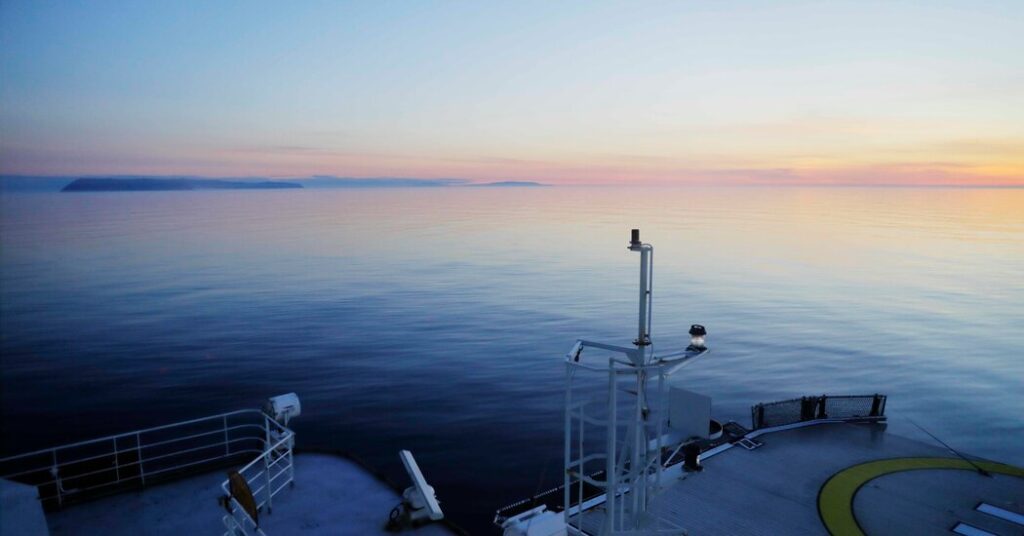
President Trump is right to be thinking about the Arctic. He is just focused on the wrong part. The area many Arctic strategists in America think needs immediate attention is not Greenland but the Bering Sea, about 3,000 miles away.
That is the part of the Western Hemisphere where Washington should be putting more of its energy to secure its military advantage. The Bering Strait is the choke point that links the Arctic and the Pacific Oceans, and more than 600 tankers cross the strait each year. Alaska’s Aleutian Islands jut into the waters near Russia’s far east like a finger wagging at Vladimir Putin and Xi Jinping, who leads the near-Arctic state to the south. Alaska’s fisheries, oil deposits and other critical minerals make the region a vital area of commerce and, yes, competition.
That explains why Chinese and Russian bombers were spotted off Alaska in 2024; why Chinese and Russian naval and coast guard vessel have held military exercises in the international waters in the Bering Sea, not off Greenland; and why Russia’s military has in recent years operated in proximity to American fishermen in the Bering Sea, not in Nuuk. Within a few decades, melting ice caps will further open up sea lanes and significantly reduce the time it takes to ship goods around the world. That will make the Bering Sea even more strategic, drawing even greater interest from Moscow and Beijing.
Mr. Trump has called for greater military capabilities in Alaska, which currently hosts America’s largest fleet of advanced fighter jets and missile defense architecture. Lawmakers have also discussed re-establishing a base in the Aleutian Islands, and joint military exercises have been ramped up in the region. This is not a call for the White House to militarize the Bering Strait, which could trigger a dangerous escalatory spiral or hasten a new arms race. But establishing a stronger U.S. military presence will be central to pre-empting, and certainly managing, any problems in the region. Effective defense and security require not only presence but also patience.
The Aleutian archipelago is no stranger to war. Dozens of Americans were killed during Japan’s 1942 attack on Dutch Harbor, a naval base on the Aleutian island Amaknak; the Japanese subsequently occupied the nearby islands Kiska and Attu. Alaska was unprepared for assault then, and not much seems to have changed.
Today the U.S. military does not have sufficient resources and experience across the North Pacific. The military currently has only a handful of icebreakers, though it plans to get more, and is believed to be woefully unprepared to fight a near-peer competitor in subzero conditions. Washington has slashed Arctic research, and our military capabilities in the region are best designed to respond to events like maritime emergencies and illegal fishing or involve strategic assets like submarines, unmanned systems and planes.
The problems that are most likely to occur in a clash with an adversary require a wide range of options. During the winter, you can walk across the ice from Alaska to Russia. All it takes is one maritime incident to go wrong or one illegal abduction of a fishing vessel to spark a standoff between two — or even three — nuclear powers.
Greenland, by contrast, is along a far less trafficked corridor. While Mr. Trump has said that China and Russia, which have commercial interests on the island, have significant naval assets operating along its coast, some experts say that there is no evidence to support this claim. Assigning Greenland so much significance — at the risk of serious damage to important trans-Atlantic relationships — does not make America safer. Our partnerships in the North Atlantic are serving us well. Now that Finland and Sweden have joined NATO, the northern flank of the alliance is more secure than ever.
This doesn’t mean we should ignore Greenland. The U.S. base there hosts a radar station that’s critical for surveilling what happens in space and for our nuclear early-warning systems. The island may also hold vast reserves of rare earths that are essential to a global economy dependent on semiconductors and chips.
But, as the White House’s new National Security Strategy recognizes, the United States cannot be everywhere at once. Danish and Greenlandic operators — for now, our military allies — are far more capable in handling the kind of threats expected above the Arctic Circle. We should let them.
In the meantime, by establishing a greater military presence in, say, Adak, an Aleutian Island that already has major infrastructure in place, the United States would gain considerable advantages both in the Arctic and in support of its interests in Asia, to say nothing of building deterrence. In Mr. Trump’s vision of a world divided by spheres of influence, Adak, Dutch Harbor and the rest of Alaska lie firmly in the Western Hemisphere. Any Russian or Chinese shows of force beyond routine military drills would undermine our dominance in this hemisphere.
Pouring military resources into Greenland would not put our military in a better position to defend our growing Arctic interests. But redirecting our efforts toward the actual threat area in the region — and strengthening our position on land that already belongs to America — almost certainly would.
Troy Bouffard is an assistant professor of Arctic security at the University of Alaska, Fairbanks, and the director of its Center for Arctic Security and Resilience. Lionel Beehner is a former research director of West Point’s Modern War Institute and a senior editorial director at Columbia’s School of International and Public Affairs.
The Times is committed to publishing a diversity of letters to the editor. We’d like to hear what you think about this or any of our articles. Here are some tips. And here’s our email: [email protected].
Follow the New York Times Opinion section on Facebook, Instagram, TikTok, Bluesky, WhatsApp and Threads.
The post Trump Is Right About the Arctic. He’s Wrong About Greenland. appeared first on New York Times.