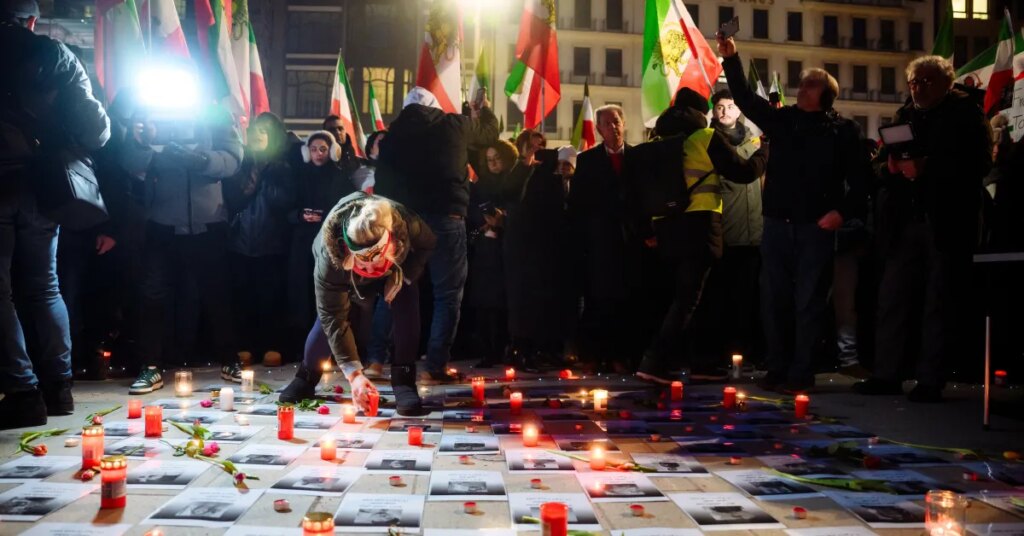
As many as 30,000 people could have been killed in the streets of Iran on Jan. 8 and 9 alone, two senior officials of the country’s Ministry of Health told TIME—indicating a dramatic surge in the death toll. So many people were slaughtered by Iranian security services on that Thursday and Friday, it overwhelmed the state’s capacity to dispose of the dead. Stocks of body bags were exhausted, the officials said, and eighteen-wheel semi-trailers replaced ambulances.
[time-brightcove not-tgx=”true”]
The government’s internal count of the dead, not previously revealed, far surpasses the toll of 3,117 announced on Jan. 21 by regime hardliners who report directly to Iran’s Supreme Leader Ali Khamenei. (Ministries report to the elected President.) The 30,000 figure is also far beyond tallies being compiled by activists methodically assigning names to the dead. As of Saturday, the U.S.-based Human Rights Activists News Agency said it had confirmed 5,459 deaths and is investigating 17,031 more.
TIME has been unable to independently verify these figures.
The Health Ministry’s two-day figure roughly aligns with a count gathered by physicians and first responders, and also shared with TIME. That surreptitious tally of deaths recorded by hospitals stood at 30,304 as of Friday, according to Dr. Amir Parasta, a German-Iranian eye surgeon who prepared a report of the data. Parasta said that number does not reflect protest-related deaths of people registered at military hospitals, whose bodies were taken directly to morgues, or that happened in locales the inquiry did not reach. Iran’s National Security Council has said protests took place in around 4,000 locations across the country.
“We are getting closer to reality,” Dr. Parasta said. “But I guess the real figures are still way higher.”
That appears to be the reality implicit in the government’s internal figure of more than 30,000 deaths in two days. A slaughter on that scale, in the space of 48 hours, had experts on mass killing groping for comparisons.
“Most spasms of killing are not from shootings,” said Les Roberts, a professor at Columbia University who specializes in the epidemiology of violent death. “In Aleppo [Syria] and in Fallujah [Iraq], when spasms of death this high have occurred over a few days, it involved mostly explosives with some shooting.”
The only parallel offered by online databases occurred in the Holocaust. On the outskirts of Kyiv on Sept. 29 and 30, 1941, Nazi death squads executed 33,000 Ukrainian Jews by gunshot in a ravine known as Babyn Yar.
In Iran, the killing fields extended across the country where, since Dec. 28, hundreds of thousands of citizens had assembled in the streets chanting first, for relief from an economy in freefall, and soon for the downfall of the Islamic regime. During the first week, security forces confronted some demonstrations, using mostly non-lethal force, but with officials also offering conciliatory language, the regime response was uncertain. That changed during the weekend commencing Jan. 8. Protests peaked, as opposition groups, including Reza Pahlavi, the exiled son of Iran’s former shah, urged people to join the throngs, and U.S. President Donald Trump repeated vows to protect them, though no help arrived.
Witnesses say millions were in the streets when authorities shut down the internet and all other communications with the outside world. Rooftop snipers and trucks mounted with heavy machine guns opened fire, according to eyewitnesses and cell phone footage. On Friday, Jan. 9, an official of the Islamic Revolutionary Guard Corps warned on state television to anyone venturing into the streets, “if … a bullet hits you, don’t complain.”
It took days for the reality to penetrate the internet blackout. Images of the bloodied bodies trickled out via illicit Starlink satellite internet connections. The task of counting the dead was hampered, however, because the authorities had also cut off lines of communications inside Iran. The first firm information came from a Tehran doctor who toldTIME that just six hospitals in the capital had recorded at least 217 protester deaths after Thursday’s assault. Health care workers in Iran estimated at least 16,500 protesters had been killed by Jan. 10, according to an earlier report by Dr. Parasta in Munich. Friday’s update built on that research, he said.
“I am genuinely impressed by how quickly this work was pulled together under extremely constrained and risky conditions,” said Paul B. Spiegel, a professor at the Johns Hopkins University International School of Health. Like Roberts, he expressed wariness of extrapolating from the figures provided by hospitals.
Roberts, who traveled into war zones to research civilian death rates in Iraq and the Democratic Republic of Congo, said, “the 30,000 verified deaths are almost certainly an underestimate.”
The emergence of the Ministry of Health numbers appears to confirm that—while underscoring the stakes for both Iranians and a regime that, in 1979, came to power when a sitting government was confronted by millions of people demanding its downfall.
On Friday, Jan. 9, Sahba Rashtian, an aspiring animation artist, joined friends on the streets in Isfahan, a city in central Iran famous for its beauty. “Before anyone started chanting,” a friend told TIME, “Sahba was seen collapsed on the ground. Her sister noticed blood on her hand.”
Sahba died on an operating table at a nearby hospital. She was 23.
“She always joked about her beautiful name,” her friend said. “She’d laugh and say, ‘Sahba means wine, and I am forbidden in the Islamic Republic.’”
At the burial, the friend said, religious rites were barred, and Rashtian’s father wore white.
“Congratulations,” he told mourners, according to the friend. “My daughter became a martyr on the path to freedom.”
The post Iran Protest Death Toll Could Top 30,000, According to Local Health Officials appeared first on TIME.