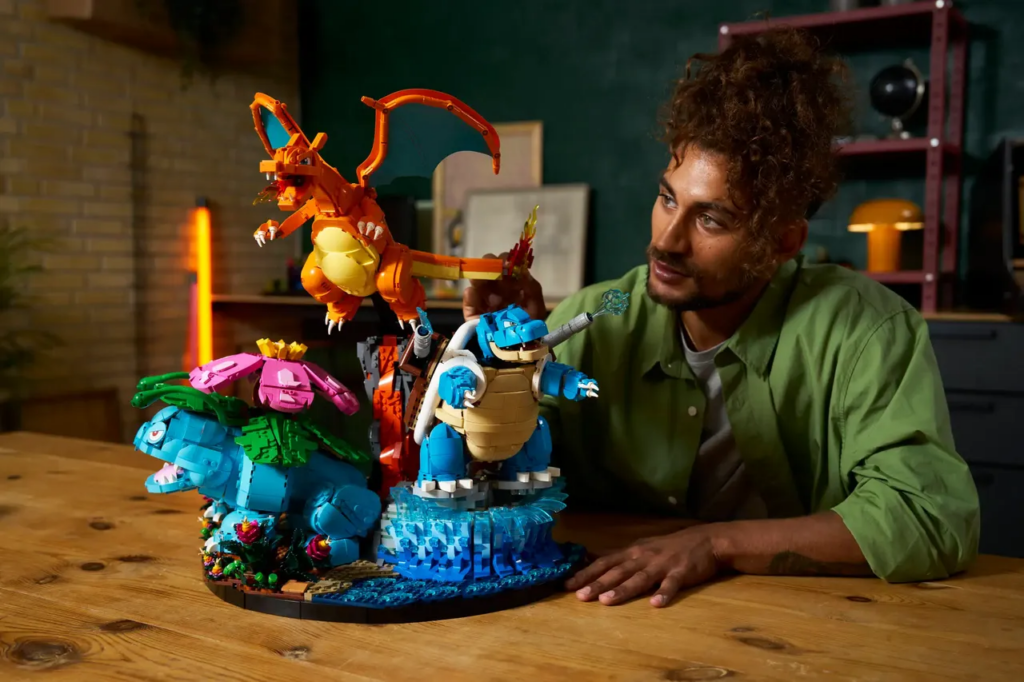
From the moment a pixelated Gengar and Nidorino faced off in the opening animation of the first Pokémon games on the original Game Boy back in 1996, the Pokémon franchise has been a perennial favorite of kids and adults alike. With 2026 marking Pokémon’s 30th anniversary, Lego’s first-ever collaboration with the enduringly popular monster-catching megahit is perfectly timed—a crossover of pop culture titans with just one problem: Anyone who isn’t an ultra-fan with cavernously deep pockets isn’t invited.
The recent announcement of a line of Lego Pokémon wasn’t a surprise—the Danish brick brand first revealed it had entered into a “multi-year partnership” with The Pokémon Company back in March 2025—but the makeup of the range itself was. Despite the mass appeal, Lego is launching with just three sets, and every single one is age-rated 18+. In short, it’s exclusively aimed at and priced for the “Adult Fan of Lego” (AFOL) market.
The most affordable set is Eevee, a 587-piece model for $60. Franchise mascot Pikachu takes up the mid-tier, price-wise, with the 2,050-piece Pikachu with Pokéball set, at an MSRP of $200. Lastly, the signature statement piece is a colossal three-in-one set of Venusaur, Charizard, and Blastoise—the final evolutions of the first game’s starter Pokémon—which clocks in at a massive 6,838 pieces for $650.
Beyond the steep prices, all three sets target nostalgic adults by drawing exclusively from the first-generation Pokémon games, and are designed for presentation over play—the assembled models result in display pieces with minimal articulation or posability. It all begs the question—are kids still welcome when it comes to Lego?
No Kids Allowed?
Lego being expensive or targeting adult collectors is nothing new—2025’s $1,000 Star Wars Death Star hit a lofty new price threshold, while the $400 USS Enterprise-D from Star Trek: The Next Generation—a 38-year-old show—now looks a bargain compared to Venusaur, Charizard, and Blastoise. Nor is it unusual for Lego’s collector sets to be shown off once built, rather than played with—look, but don’t touch.
However, Lego’s other collaborations with cross-generational charm typically offer something for everyone. The Super Mario range makes for a pertinent comparison here, based on another Nintendo property, with plenty of kid-friendly Mario Kart racers and larger playsets to contrast the collector-grade Mario and Kart or the replica Lego Game Boy. Yet Lego Pokémon has nothing at all for younger builders at launch, nor, at the time of writing, anything announced to reach that audience. Given Pokémon has such broad appeal across age ranges, Lego’s decision to exclusively chase the lucrative collector’s market is all the more striking—and some experts think it risks undermining the brand’s standing as being for everyone.
“Pokémon and Lego have multi-generational fanbases, yet there’s no explicit narrative about multigenerational play, which runs counter to Lego’s ethos,” says Katriina Heljakka, a senior researcher of toy and play cultures at the University of Turku in Finland. “The new sets emphasize novelty, collectability, and fandom, which aligns with AFOL preferences, but provide little substantive commentary on how people actually play together.”
Playing together is something Lego has been pushing for a while, with a selection of sets that are designed to be built collaboratively using the Lego Builder app’s “Build Together” feature. The family-targeted mode splits instructions into smaller parts, so multiple people can build their own sections, then combine for the final build. Yet of the announced Pokémon sets, it’s only the smallest, Eevee, that—per the announcement—“presents fans with the ability to build together with friends and family.” Another departure from Lego’s universal appeal.
Read More on LegoLego’s Smart Brick Gives the Iconic Analog Toy a New Digital BrainI Really, Really Want the 3,600-Piece Lego U.S.S. EnterpriseThe 14 Best Gifts for Lego Lovers
The result, says Heljakka, is that “licensed collectibles risk being perceived as display pieces for solitary play rather than as tools for shared play,” adding that the upcoming sets are “closed-object products that behave more like 3D jigsaw puzzles than platforms for co-play by building together.”
Priced Out
Further cementing the Lego Pokémon range as being for adults only is a pair of collectibles that money literally can’t buy. A 233-piece Mini Pokémon Center is only available through the Lego Insiders Club membership scheme, redeemable for 2,500 points accrued through other purchases made on Lego’s website or in its stores, while the Kanto Region Badge Collection, a 312-piece “Gift With Purchase” set recreating the eight gym badges players earned in Pokémon Red/Blue, was only available to those who preordered the priciest trio evolutions set directly from Lego.
The scarcity of that badge set in particular has worked in Lego’s favor—a desirable set produced in limited quantities, tied exclusively to the most expensive set in the line, propelled the $650 evolutions trio to sell out almost immediately in most territories. Professional Lego YouTuber Bamidele “JANGBRiCKS” calculated that it made Lego $30 million in just 24 hours.
Targeting adult collectors with high price, low quantity goods—let alone unbuyable exclusives—has an unfortunate knock-on effect, though: predatory scalpers. With stock snapped up in moments, resellers are already listing the Kanto badge set alone for upwards of $300 on eBay, long before it’s even in hand. Some have the Venusaur/Charizard/Blastoise set and the badges together for $1,500 or more. While Lego has confirmed that some stock of the GWP will be reserved for launch day, even legitimate adult fans wanting the piece for their collections won’t be guaranteed to secure a copy.
WIRED reached out to Lego to ask if it employed any strategies to mitigate scalpers; a Lego representative said, “Unfortunately, we’re unable to provide comment on this occasion.”
Adults Only
Some of these trends are side effects of the wider toy industry’s growth, largely coming from adults. Figures from market research group Circana found that toy sales in the US for the first half of 2025 were up for the first time since 2022, and that “adults continue to drive market growth in toys, with sales increasing by 18 percent for recipients aged 18 and older.”
There’s increasing awareness of the benefits of play for adults. Both the National Institute for Play in the US and the British Psychological Society have emphasized this importance, with the NIFP specifically highlighting that “engaging in playful activities helps adults cope with stress and enhances mood,” which appears to be reflected in the toy sales data. But with money on the table, it’s little surprise that both the primary and secondary markets have homed in on that demographic to the seemingly growing exclusion of kids.
Also notable was Circana’s finding that “every top growth property is connected to licensing, content, or movie releases in some form. Video game properties were dominant among the top 10 gainers, including Pokémon.” It’s not that Pokémon fans are uniquely easy marks—legacy brands from Masters of the Universe and Transformers to My Little Pony and Barbie have long targeted the collectors market—but the monetized nostalgia of that particular audience does go some way to explaining Pokémon Trading Card Game cards selling for ridiculous prices, or repeatedly being stolen due to their value to adult collectors.
Adult-driven growth in the toy sector goes back further, though, and Lego has long been paying attention to the trend. At its Lego Fan Media Days event in 2020, the company revealed its own research finding that the number of adults buying sets for themselves had quadrupled over the previous decade. The same year saw Lego launch its “Adults Welcome” campaign, directly targeting grown-up customers.
With so much money up for grabs with adult fans, it might be unsurprising that Lego has aimed Pokémon at them. “This mirrors a broader toyification of culture and an industry shift in which toys increasingly function as lifestyle objects or markers of fandom,” Heljakka says.
Your Pokémon Is Evolving
Perhaps the hints that Lego Pokémon would be adult-targeted were there all along. In that March 2025 licensing announcement, it was only “fans” that were mentioned, with the press release saying the sets would allow “fans to build beloved Pokémon in Lego brick form,” while Gaku Susai, chief product and experience officer at The Pokémon Company International, was quoted as saying it would “surprise and delight fans.”
So, is there any hope of younger Pokéfans, or even more casual adult collectors, getting their hands on some Lego Pocket Monsters in the future? Lego repeated that it was “unable to provide comment on this occasion,” but there are some hints. The FAQ on Lego’s landing page for the Pokémon range suggests it will expand, saying the “first three” sets are “display pieces aimed at adult collectors,” and that it is “always releasing new sets across all our themes.” Elsewhere, the dedicated Lego site Brick Fanatics lists more than a dozen unconfirmed sets expected to launch from summer 2026 onward.
Some of these suggest more play-focused sets, with several “versus” sets replicating Pokémon’s signature monster battles, and kits themed around a specific Pokémon’s evolutions. Whisper it, but these sound as though Lego might be taking a page from rival Mattel’s Mega brand (AKA Mega Bloks, AKA Mega Construx), which held the license for brick-built Pokémon from 2017 until 2025. While Mega has never managed to build the same cultural cache that Lego enjoys, its Pokémon range at least catered to kids and included a few collector’s editions for older fans.
The rumors for future Lego Pokémon also include at least two sets incorporating the manufacturer’s new Smart Play Brick technology, both centered on mascot Pikachu. One, a purported “Smart Play: Pikachu’s House,” even has a rumored price of $70. That’s in line with the confirmed pricing of the Smart Play Darth Vader’s TIE Fighter, but also noteworthy is that the entire Smart Play line is tailored toward all ages. If these Smart Play Pokémon sets do exist, it stands to reason they’d be similarly targeted—and could be the link between Pokémon fans young and old, packing in engaging new tech alongside, hopefully, some compelling Lego builds.
Bridging that divide, and ensuring Pokémon Lego is accessible to all, is essential if Lego wants to prove it’s not only interested in big-spending adult collectors. As Heljakka says, “Intergenerational play is one of the few remaining spaces where digital-native kids and analog-nostalgic adults can collaborate creatively without screens mediating the experience. Play can be slow, messy, and remain unfinished. It doesn’t need winners, judges, or mastery narratives to be meaningful—but building worlds together matters more than ever in the present day.”
The post The Lego Pokémon Line Shows Toys Are Only for Rich Adults Now appeared first on Wired.