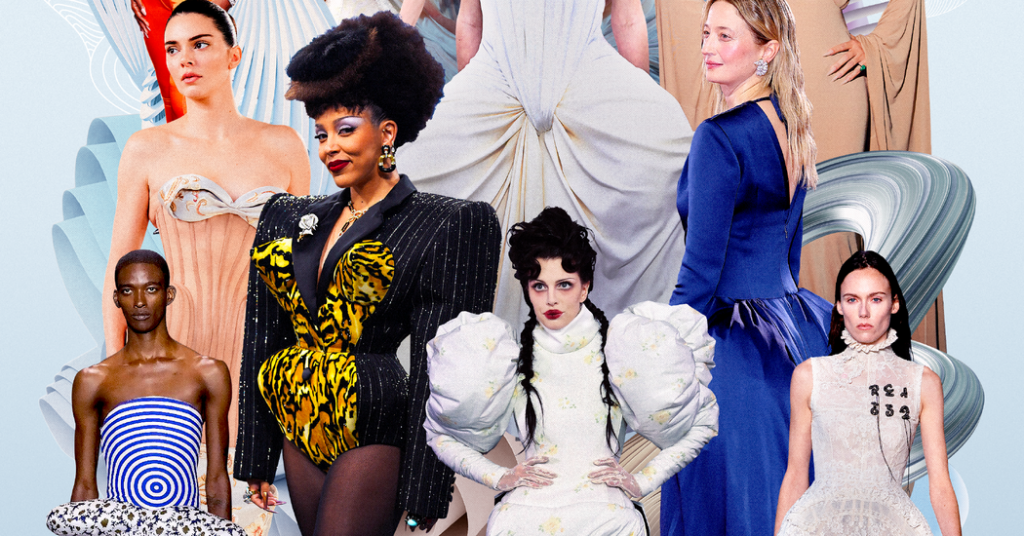
So long, body positivity. You have been crushed under a mountain of GLP-1s, corsets, panniers and bustles. So long, paying lip service to the virtues of loving ourselves just as we are. Designers, medicine and technology have come together to create what may be the defining runway and red carpet trend of the next quarter-century: remaking ourselves just as we want.
After shrinking the physical self down to nothing with the revolutions of Ozempic and Mounjaro, we are embracing clothes that shape it into an extreme facsimile of itself. As the couture shows loom and awards season gets underway, the question is, how far can this go?
Enter fashion’s new age of reconstruction.
It began last season at Dior, where Jonathan Anderson made his debut with panniers so big they looked like bouncing rubber balls. Panniers also showed up at Christopher John Rogers. At Gaultier, Duran Lantink added cartoon curves to his bodysuits. At Schiaparelli, Daniel Roseberry carved points onto hip bones and whittled the waist with corsetry. So did Meruert Tolegen and Dilara Findikoglu.
There was Alba Rohrwacher at the Venice Film Festival in Mr. Anderson’s Dior with an enormous bustle at the back; there was Julia Fox at the amfAR London gala in bulbous Marc Jacobs, with giant puffed sleeves and equally giant puffed hips, and an extra puff at the calf for good measure.
There was Lauren Sánchez Bezos, pretty much everywhere, lacing herself into ever-tighter corsets; there were various Kardashians sharing their plastic surgery tips, and Meghan Trainor, Amy Schumer, Mindy Kaling and Lizzo, former outspoken proponents of the ”thicc” life, showing off their new, skinnier selves in (yes) more corsets.
And there was Ariana Grande at the Golden Globes in Vivienne Westwood with a Marie Antoinette poof, and Chase Infiniti in a mirrored Louis Vuitton top cantilevered over the hips. And Teyana Taylor at the premiere of “The Rip” in an Ashi Studio dress with heart-shaped hip appendages.
Even Skims, the shapewear company, has begun to offer undergarments with extra padding at the hips and bottom and bras with built-in, visible nipples. Little wonder Lyst, the fashion search engine, singled out “Wearing the Body” as one of six trends that will define 2026.
“Every single person I know is sort of 10 to 20 percent of what they were six months ago,” said Mr. Roseberry, the creative director of Schiaparelli. “People are going through a transformation.” It reminded him, he said, of a famous Cristóbal Balenciaga quotation about perfecting the body.
What was it? “You don’t need a body,” Mr. Roseberry paraphrased. “When you come to me, I’ll give you a new body.”
That wasn’t actually it. According to Diana Vreeland, Balenciaga said: “A woman has no need to be perfect or even beautiful to wear my dresses. The dress will do all that for her.” But the way Mr. Roseberry remembered it was clearly … well, formed, and informed, by current reality.
Mr. Roseberry said that though he had tried to break the cycle and put out “a totally corset-free collection, what the clients want is not that at all.” What they want, he said, is more and more of the manufactured silhouette.
“Fashion is just mirroring back this rabid desire,” he said. “We’re not dictating it any more. We’re servicing it. And it’s everywhere.”
No ‘Natural’ Bodies
“The body is never, ever natural,” said Valerie Steele, the director of the Museum at the Fashion Institute of Technology and the author of “The Corset: A Cultural History.” “It has always been fashioned — through tattoos or high heels or tooth filing — built up through body building or broken down through diet.”
The difference between body modifications of the past, she said, and the current situation is that “because the technology involved has gotten more sophisticated, expectations have, too — and people’s expectations are that it should be as easy and painless as possible.”
Once upon a time, modifying the body involved pain or work (or both): deprivation, extreme exercise, binding, needles, knives. Now it can be achieved with an injection and a dress, and the pain is largely economic. Though that, too, may be changing, as GLP-1s get ever cheaper and drug companies race to develop them in pill, rather than injectable, forms.
In the meantime body modification is being driven not just by medical innovation but by a variety of contemporary phenomena, starting with the swing to conservatism and its valorization of the classically feminine body.
“The rise of right-wing gender politics has paralleled, not coincidentally, the shrinking of waists and the embrace of the hourglass,” said Victoria Pitts-Taylor, a professor at Wesleyan University and the author of “Surgery Junkies: Wellness and Pathology in Cosmetic Culture.” It’s a convergence of the return to the political ideals of the mid-20th century and the return to the ideal female body as imagined by the Hollywood of that time.
“The perfect body is now defined as slim but curvy in a very conventional way,” Ms. Steele said. “And we have dresses to render this idealized body.”
Susie Orbach, a British psychoanalyst and the author of the book “Bodies,” took a similar stance. “It’s not bound feet,” she said, “but it’s the cultural equivalent.”
At the same time, as the fight over women’s bodies and who gets to control them becomes public, women are seeking more control over their own flesh. Erasing it or reshaping it is a statement of choice — and, sometimes, security. Being contained, held in and otherwise encased can also be a cocoon.
As Ms. Findikoglu, a designer who made her name in part by redefining the corset through flexibility, said: “These garments were created by men to restrict women and put them almost in a cage, immobilizing them to make them look pretty. But I wanted to give them a new meaning and break that cycle.” The response she most often gets from the women who wear her clothes, she said, is that the corsets make them feel “powerful.”
It’s much the way the artist and lingerie designer Michaela Stark uses her corsets to “emphasize those parts of the body — the stomach, fat on the arms, fat on the thighs — so that they become recontextualized and allow us to see beauty in areas that we might otherwise never be able to see,” Ms. Stark said.
Add the fact that, Mr. Roseberry said, we now live in a mediated reality, where everything can be filtered, face-tuned or otherwise manipulated. Why not assume you can do the same with your body? Reshape it, remake it, reinvent it at will? Especially because, he continued, people often feel pressured to “catch up with that fantasy that you’ve projected.” The IRL you is essentially chasing the virtual you, which has raised the stakes. According to Lyst, searches for “sculpted” clothing were up 52 percent in 2025 from the previous year, and searches for “bustle” grew by 35 percent.
“It’s like mercury lining baby cribs,” Mr. Roseberry said. “We have no idea how bad this might be for us.”
Where Is It Going?
Ms. Pitts-Taylor described the current point in time as “a ‘Hunger Games’ moment,” referring to the way the citizens of the Capitol, Suzanne Collins’s imaginary haven of the elite, distinguish themselves from the workers of the Panem districts by transforming their bodies into fashion statements.
“It’s unstable,” Ms. Orbach said. “Because of the drugs, people have a lot of confidence that having achieved X state, it will be sustainable physically, but I don’t know if it will be sustainable emotionally.”
There is a possibility, she said, that constantly “putting on” a body will create even greater dissonance between the physical self and the psychological self. We have essentially reversed the classic Freudian cause-and-effect thesis in which psychological trauma is expressed physically, she said. Now dissatisfaction with our physical state is causing psychological discomfort.
This is especially true because, as Ms. Pitts-Taylor pointed out, body modifications historically signaled membership in a tribe or other social group and were thus fixed. But now, she said, “identity is wrapped up in consumerism, our culture of visibility and the constant flow of information and images that are commodifiable.”
“So the speed at which we are engaging with this long human practice has accelerated,” she continued. “Body modifications have become untethered to stable identities.”
If there is a single truism in fashion, it is that for every trend there is a corresponding backlash. That means that if at this point the constructed body, with its padded hips and bottom, pushed-out breasts and pulled-in waists, has reached its zenith, then deconstructing the artifice may be the next big thing.
Indeed, as Mr. Roseberry began to plan for his January couture show, he was, he said, “chasing a different fantasy — something that’s more free, where movement is more of a priority.” Some celebrities, like Kate Winslet, who once favored a corset but has recently turned to tuxedos on the red carpet, have begun to speak out.
People have “become obsessed with chasing an idea of perfection to get more likes on Instagram,” she told The Sunday Times. “It upsets me so much.”
Ms. Stark believes that people are craving authenticity. “I think something that a real human touches, or a real human feels, or that looks like a real human, is going to become more and more valuable,” she said. Hence the rise in products selling “natural” beauty. Can an embrace of the natural body — whatever that is — be far behind?
The problem is that, as Ms. Steele observed, “natural” in this sense is a manufactured idea. We have been changing our bodies for so long, reshaping them according to … well, fashion — with supplements and lasers, stays and laces and horsehair — that it’s hard to know what natural would look like.
Just how extreme our distortion field has become may be clear next May, when the Met Gala takes place and attendees’ looks are borne across the globe on the winds of TikTok and Instagram. What is the theme of the exhibition the party celebrates?
“The dressed body,” said Andrew Bolton, the Costume Institute curator in charge. At least as seen in (or created by) art. Just imagine the outfits.
Vanessa Friedman has been the fashion director and chief fashion critic for The Times since 2014.
The post The Year of Manufacturing the Body. And Booty. And Boobs. appeared first on New York Times.