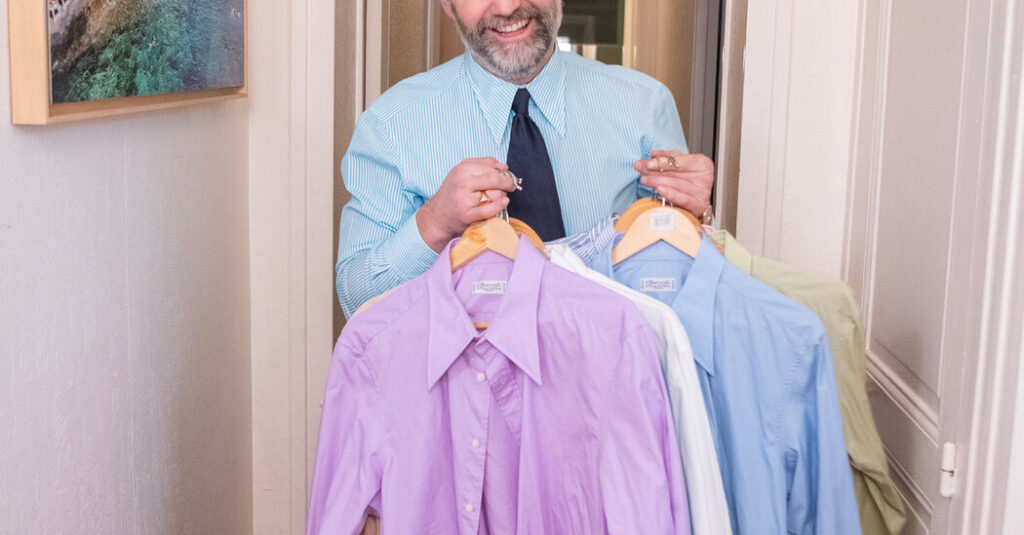
“It’s a bit like the atmosphere of a bazaar here — we don’t like things to be too orderly,” said Anne-Marie Colban, the proprietor, along with her brother, Jean-Claude, of the storied Parisian shirtmaker Charvet. “We want people to be able to touch, see and experience fabric, and so nothing is too figé [fixed], as we say in French.”
We were surveying the ground floor of the boutique at 28 Place Vendôme, where ties in jewel-toned silks and vibrant jacquards are displayed against pale oak paneling; tables are piled with pocket squares, silk knot cuff links and bow ties; and shelves are filled with the shop’s iconic leather slippers in rainbow hues.
“Color is important for us,” Ms. Colban, a petite, quietly spoken woman in her late 60s, said. Perhaps more important than color is the abundance of choice. On the second floor, where bespoke shirts are ordered, there are thousands of bolts of fabrics, spanning oxfords, poplins, piqués, silks and linens.
If you’re looking for classic white, you can choose from more than 100 shades and 400 textures and weaves. From there, endless options unfold, including cut, collar, cuffs and button varieties.
Clients are often greeted and guided by Ms. Colban herself. “We think it’s very important to say when something is not right for you,” she said, noting, for instance, that complexion should greatly influence color selection.
Little of this process has changed in nearly two centuries. Charvet dates back to 1838, when Joseph-Christophe Charvet opened his shirt shop on nearby rue Richelieu. The current site has been the headquarters since 1982, when it was run by Ms. Colban’s father, Denis Colban, a fabric supplier who acquired the company from the founder’s family in 1965.
In the age of internet shopping and fast fashion takeovers, Charvet still stands as a bastion of the kind of rarefied and ultra-attentive experience that Émile Zola wrote about. Zola was a customer, as was Marcel Proust, Jean Cocteau, Charles de Gaulle, John F. Kennedy, Yves Saint Laurent and Coco Chanel, whose beau, Boy Capel, introduced her to the shirtmaker.
For his recent Chanel debut, the artistic director Matthieu Blazy collaborated with Charvet on a tuxedo-style shirt with a bib front, wingtip collar and long tail. The off-the-rack shirt will retail for around $4,000 — but not at Charvet.
“This will be sold only at Chanel because it’s a Chanel shirt,” Ms. Colban said of the partnership, branded as a “conversation.”
Charvet also sells ready-to-wear shirts, made from the same fabrics in the same workshops as its bespoke styles. The latter start at $900, while these are priced from $500. That puts them around the same price as Dries Van Noten or Ralph Lauren Purple Label but considerably less than the Row, Saint Laurent and Loewe.
But clients don’t come here for the branding or the hype. While the company won’t confirm current customers, they are easy enough to find: a passionate cult who relish the entire process, from pushing through the door on Place Vendôme to the handwritten receipts.
Here, six longtime clients discuss their relationship with the shop.
Marc Beaugé
“When you are into fashion in Paris, you will eventually end up at Charvet,” said Marc Beaugé, 45, the editor in chief of L’Etiquette magazine, who has been a customer for 24 years. His first purchase, he regrets, was a black shirt inspired by the indie rock scene of the early aughts. Think Interpol. “You have to make mistakes to develop your style,” he said, laughing.
Today Mr. Beaugé owns several pairs of slippers and pajamas, 30 pairs of wool socks, two pairs of silk tuxedo stockings, about 30 ties, plus some 15 shirts with his own bespoke collar named Le Salliant, its design defined by its long, very narrow shape. He habitually visits the store late on Saturday afternoon and stays long after the front doors have closed.
“They never make me feel like I should leave,” he said.
François Simon
“Charvet was a legendary address for me, symbolizing a lifestyle I never thought I could achieve,” said François Simon, 72, France’s most renowned (yet incognito) food critic and author, who still keenly recalls being intimidated by the store, not to mention the extensive measurement process.
“Never before had a stranger — except for a doctor — come so close to my body,” Mr. Simon said.
The store is now a place of habit, and he owns eight bespoke shirts, including one in denim and another in butter-soft velvet, as well as scarves, slippers and even a swimsuit. “For me, putting on a Charvet shirt is a special moment,” he said. “I use it as armor when I have an important romantic or professional date. I feel that with it, everything will go well.”
Sarah de Mavaleix
The stylist Sarah de Mavaleix, 32, was given her first piece of Charvet, a navy woven belt, by her mother at the age of 15. From time to time the shop was mentioned in her family, and it slowly grew on her as something different from other places.
“It was not a ‘shop,’” she said. “It was Charvet.”
Ms. de Mavaleix estimated that she has up to 35 shirts, plus several men’s nightgowns that she wears as dresses, along with belts, silk scarves, cashmere scarves and the trademark slippers. She visits on a near weekly basis, pulling looks for fashion photo shoots or shopping for herself and can linger for hours, choosing a collar shape or the right shade for the mother-of-pearl buttons. Recently, a red shirt with a late-’70s pointy collar joined her wardrobe.
“They never push you,” she said, “and they will also say no when something appears to be wrong to them.”
Hirmane Abdoulhakime
Hirmane Abdoulhakime, 45, founder and artistic director of the tennis label the Ace Club, is a more recent Charvet convert, introduced by his friend Mr. Simon around 2019. He has since ordered a custom shirt on a near annual basis, opting first for the classic Oxford before venturing into stripes. “When you first visit Charvet, you experience a whole range of emotions because you have so many choices,” Mr. Abdoulhakime said of his deliberation.
His shirts are on regular rotation, especially in important meetings when, he said, they help him rise to the occasion. He has had to adjust his measurements several times over the years, though he takes pleasure in the process. “When you go there, time stops, and when they take your measurements, you don’t know if it’s going to last 20 minutes or an hour,” he said, adding, “Once you’ve tasted that level of service, there is no coming back.”
Yves Ville
For the past 20 years, Yves Ville, 65, a prominent Parisian gynecologist and obstetrician, has rarely been seen without a Charvet bow tie. “I wear them every day,” Dr. Ville said, “but I had to wait to have a few gray hairs first because you can’t wear a bow tie when you are young.”
He estimates that he now has 50 different styles and encourages others to master the tie without a mirror to embrace a flair of asymmetry. He favors Charvet for its woven silks, which have a certain weight and volume and, in particular, a vividness of color that beckons from the street front. “They don’t need to advertise,” he said. “You only need to walk past the window, and you have to stop.”
Marianne Fersing
The fashion consultant Marianne Fersing, 50, first visited Charvet as a recent graduate from the now-defunct Studio Berçot, a fashion school where teachers had often spoken of the legendary shop. Ms. Fersing couldn’t afford anything at the time but recalls being given a full tour of the store by Anne-Marie Colban herself.
Ten years later, she returned to place an order for her first custom shirt. She now has 10 of them. The last, ordered in June, was a cream silk crepe de Chine blouse with covered buttons, which is ideal for a tuxedo.
The Charvet team, though steeped in tradition, is not stuck in its ways, Ms. Fersing said. “I very often cut the collar of my shirts and leave them with a raw edge, and they are not surprised or shocked at all by that.”
James Hill is a photographer working on a regular basis for The Times since 1993. He is currently based in Paris.
The post The Cult of Charvet appeared first on New York Times.