Kenneth E. Gulley, the mayor of Bessemer, Ala., confesses to some befuddlement as to why the people in his community would oppose the construction of a $14.5 billion artificial intelligence data center in a woodland just outside of town. “A data center is probably the most unintrusive thing,” Mr. Gulley said in his office one morning earlier this month. “You know, it’s like a big computer sitting in your backyard.”
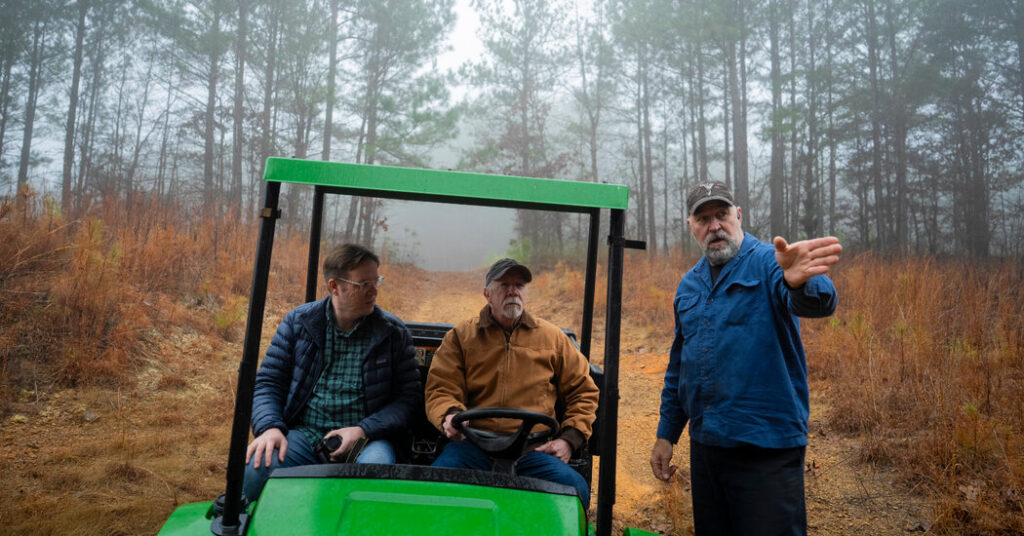
Several residents whose backyards may soon adjoin a digital facility the size of 18 Walmarts freely acknowledge their displeasure. “This is as pristine a forest that you’ll find in the foothills of the Appalachian Mountains,” said Ron Morgan, a diesel machinist and retired military veteran, who drove a reporter through the dense timberland behind his house in an all-terrain vehicle. “And if they have their way, all this will be gone.”
Mr. Morgan’s sentiments are echoed by his neighbor Marshall Killingsworth, who bought his own land 58 years ago and now fears that the hoot owls in his backyard will no longer serenade him at night. Also fretful is Ronnie Buchanan, a retired rubber plant manager whose family has lived adjacent to the proposed site since 1979. “If that data center takes in all the water everyone says it will, it’s going to flood my land,” Mr. Buchanan said. “I’ll have to move.”
The seemingly overnight explosion in A.I. usage by American businesses and individuals has spawned a corresponding proliferation of facilities to store and manage all that digital information. As it stands, around 5,400 data centers currently exist in the United States. By 2030 they are expected to multiply by almost 50 percent. In a social media post on Jan. 12, President Trump expressed his view that “Data Centers are key” to America’s pre-eminence over China in the A.I. arms race.
But the president’s cheerleading of A.I. — codified in an executive order last month in which he declared that the administration will “sustain and enhance the United States’ global A.I. dominance” — has not spurred equal fervor for the data center in Bessemer among Republican political leaders in Alabama. Senator Tommy Tuberville and the state’s governor, Kay Ivey, have not issued statements celebrating the project, and they did not respond to requests for comment.
Alabama’s other senator, Katie Britt, also a Republican, said in a statement that she hoped that the facility would not raise utility costs. “I remain motivated to ensure that ratepayers are not footing the bill for data center buildouts,” she said.
Representative Terri A. Sewell, an Alabama Democrat whose district includes Bessemer and who also declined a request for comment, said during a House hearing last year that some of her Bessemer constituents were “voicing their deep concern” about the project.
Mr. Gulley, the city’s mayor, expressed weary exasperation. “It’s the largest single project in the state of Alabama’s history,” he said. “I would have liked to have heard more from those other individuals.”
But as multibillion-dollar economic projects go, A.I. data centers lack ribbon-cutting allure. Their warehouse-like appearance and the continuous 50-decibel whir of their server fans do not project neighborliness. Any local tax revenues they might bring in are, to some extent, often offset by abatements that states like Alabama have put in place to attract such businesses to begin with.
Their work forces tend to be small, requiring a highly skilled labor pool most likely drawn from elsewhere. “You can’t spin them as big job creators,” said Michael Hicks, an economics professor at Ball State University in Muncie, Ind., who has written extensively about data centers. “And beyond that, after all the tax incentives are offered, the local effects of these data centers are so vanishingly small, there’s no discernible economic benefit.”
Data centers also pose risks. Cooling their servers requires enormous amounts of water, potentially straining the local supply and driving up utility costs in the process. “In the short run, at least, growing demand for energy by A.I. and the development of data centers will increase household and business costs of electricity,” Mr. Hicks said.
And while data center operators often pledge to rely on clean energy, a study published last year by the Gerald R. Ford School of Public Policy at the University of Michigan, in partnership with the Michigan Environmental Justice Coalition, concluded that such goals are “often delayed or abandoned altogether, resulting in the direct commissioning of new fossil fuel power plants to keep these facilities online.”
The resulting air pollution from such emissions was found by a Harvard Business Review study last year to cause “significant respiratory-related health consequences that are estimated to cost up to $20 billion per year in the United States by 2028.”
Once a Steel Boomtown
Bessemer (population 25,100) might be expected to welcome a $14.5 billion economic investment with open arms.
Once a steel boomtown and manufacturer of Pullman railroad cars, the self-described “Marvel City” lost its economic moorings with the gradual decline of the domestic steel industry. Today, much of downtown Bessemer remains boarded up. The majority-Black city’s poverty rate of 31 percent was three times that of the nation as a whole in 2024, according to the most recent data available, the same year that the state took over the city’s failing public school system to address its academic and financial woes.
Early last year, TPA Group, an Atlanta-based real estate development firm, convened a secret meeting with several state and local officials in a conference room of the Bessemer Public Library. Everyone in attendance was required to sign a nondisclosure agreement that would remain in force until public zoning hearings took place months later.
According to three attendees, TPA unveiled a slide presentation of what it called Project Marvel. The firm, which declined repeated requests to be interviewed for this story, had already built at least one data center in Georgia, and a second Georgia facility was in the works.
The firm was now setting its sights on 675 woodland acres about five miles from Bessemer, in an unincorporated area of Jefferson County. The land had previously been annexed by the city for a landfill project, but the project was scuttled by local opposition. The acreage had ample access to electrical power, as well as water from the Warrior River Water Authority, which pumps its water from the Black Warrior River.
The land’s Mississippi-based owner was willing to sell the 675 acres for what TPA said would be a 100-acre data center campus.
Local officials said that TPA’s representatives at the meeting told them the data center would generate 990 construction jobs and 330 full-time jobs, and bring the Bessemer school district roughly $25 million in annual tax revenue. The officials said TPA also assured them that the project would not damage any wetlands or threaten any endangered species.
City and county officials interviewed for this story said that they independently verified TPA’s economic claims. But such estimates pertaining to data centers have been disputed. In TPA’s home state, Georgia, a government audit last month found that the data centers there had produced less than one-third the jobs and economic value that had originally been projected. Mr. Hicks, the Ball State professor, said that the projected job gains from the Bessemer data center struck him as “wildly high” and estimated that such a center would more likely “have 40 workers on a shift, so perhaps 120 to 160 overall.”
Still, said Aaron Killings Jr., Bessemer’s city attorney, who attended the meeting, “it was just no question about whether we should proceed.”
But questions did arise from the area’s residents once they learned about the rezoning plans.
“We tried talking to the mayor and other city officials,” said David Havron, an accountant whose property lies about 200 yards from the site. “They told us they had signed NDAs and couldn’t reveal anything.” Mr. Havron and other residents enlisted two Birmingham, Ala.-based groups, the Alabama Rivers Alliance and the Southern Environmental Law Center, to help them organize opposition to the data center. A third group, the Center for Biological Diversity, petitioned the U.S. Fish and Wildlife Service to classify the Birmingham darter, a fish newly discovered in one of the land’s creeks, as an endangered species.
Still, Bessemer city officials remained confident that Project Marvel would be widely viewed as a winner for the community. “We can’t allow just a few people to impede the progress and the work that is going to take place here, because it’s going to have such an incredible impact,” said Michael Turner, the superintendent of Bessemer’s public school system, which stands to reap millions in tax revenue from the data center.
‘Bigfoot Is Not Out There’
A rude awakening greeted Project Marvel at one of the first public hearings in June. The audience chairs were filled with residents wearing red T-shirts to indicate their opposition to the data center. Representatives of the Birmingham environmental groups were also present. “The city and TPA did not anticipate this amount of resistance,” Mr. Killings said. “We just got caught off guard.”
The residents who were interviewed for this story said Project Marvel’s proponents seemed dismissive of their concerns, including what they see as a threat to the area’s wildlife. During one hearing in June, a TPA representative, Brad Kaaber, said, “There are no bald eagles out there,” which prompted Chester W. Porter, a Bessemer City Council member and a data center supporter, to suggest that all claims of protected or exotic species on the acreage amounted to hyperbole.
“So Bigfoot is not out there, correct?” he said.
Unamused, Mr. Havron, who had come to the meeting prepared to raise environmental concerns, stepped up to the public microphone and held up a photograph of a bald eagle in one of his pine trees.
Those who favored the data center maintained that many of the concerns expressed by opponents lacked a factual foundation. Jefferson Traywick, the Jefferson County economic development adviser, acknowledged that some of the concerns were valid. “There are worries about excessive noise and light that I would consider legitimate,” he said in an interview. “But then you get into people telling me that A.I. is the mark of the devil, or that it’s going to create more storms over Birmingham, or that it’s going to emit brain cancer-causing pollutants.”
Mr. Traywick was referring in part to a 70-year-old Bessemer woman who challenged the City Council at one of the meetings, saying, “You can’t say it won’t cause cancer.”
On Nov. 18, the Bessemer City Council voted, 5 to 2, to rezone the land for a data center. But by then there was another roadblock. It turned out that a highway extension that had been in the works for decades would be routed through the same acreage where the data center would be built. TPA, unaware that the land was already spoken for, announced this month that it would buy an adjacent 900 acres of land so that the two endeavors could coexist.
Of course, moving the data center will mean a new zoning application, which will also mean a second round of noisy hearings. “There’s going to be a lot more public disclosure in this second phase,” Mr. Killings, the city attorney, said in an interview. “We know we’re not going to make everybody happy. But this time around, we’re going to put it all out there.”
Mr. Porter, the City Council’s most vocal defender of the data center, said that he hoped for less hand-wringing from his Bessemer neighbors.
“I mean, we’re in the 21st century,” he said. “A.I. is here.”
Robert Draper is based in Washington and writes about domestic politics. He is the author of several books and has been a journalist for three decades.
The post Trump Pushes A.I. Data Centers, but the G.O.P. Is Cool to One in Alabama appeared first on New York Times.