When the world-renowned Scottish poet and lyricist Robert Burns died at age 37 in 1796, there was only one significant portrait of him — a modest oval painting by the artist Alexander Nasmyth. But many scholars later speculated that Henry Raeburn, one of Scotland’s most revered artists, had also created a painting inspired by the original.
The 200-year quest for this missing treasure of Scottish history has been chronicled in numerous written accounts. Most notably, according to the Edinburgh-based scholar William Zachs, Arthur Conan Doyle, the creator of Sherlock Holmes, reported in the International Psychic Gazette about 100 years ago on a séance that was held to try to find the painting.
“Burns fanatics were looking for it because it was described as a portrait of the greatest Scotsman painted by Scotland’s greatest artist,” Zachs said in a video interview.
Now, thanks to some sleuthing by Zachs and other experts, the painting has been recovered and is on display at the National Galleries of Scotland to coincide with Burns Night on Sunday, an annual holiday that honors the poet with traditional Scottish food, dance, readings and music.
Zachs, 65, owns a collection of about 40,000 items linked to Burns, 18th-century Scotland and other periods of interest. So when a friend texted him last March about a painting of Burns on sale at a London auction house, Zachs called Duncan Thomson, a former director of the Scottish National Portrait Gallery who is regarded as a world expert on Raeburn.
The pair scrutinized a high-definition photograph of the auction painting on their phones and saw that the artwork, estimated to fetch a modest $400 to $700, fit the description of the portrait that Scotland had been seeking for over two centuries.
Three days later, Zachs entered a bidding war for the piece, eventually securing it for about $113,000.
The auction house, Wimbledon Auctions, said that the painting’s significance was unknown when the work went up for sale last year. “A contact of mine was helping to clear a house in Hampton Court” — an affluent part of London — “and he said that we should try to auction it for the family,” Felix Turner, the auction house’s director, said by phone.
“We unloaded the van, and the painting came in, and I looked at it, and I thought, ‘It actually looks quite good.’” But by the time he had done further research, he had already posted his estimate online, Turner said, “so I couldn’t change that.”
Zachs, an American who has spent four decades building up his collection since moving to Scotland in the 1980s, said the missing portrait was painted about six years after Burns died, for use in a new edition of Burns’ works that the poet’s brother was producing.
“In my own collection of things to do with Robert Burns, I have a letter that pinpoints the moment when a decision was made to engage Henry Raeburn as the painter,” said Zachs, whose collection can be viewed by appointment at his Blackie House Library and Museum.
According to Zachs, the portrait was commissioned by the London-based publisher and bookseller Thomas Cadell. But after that, the trail went cold, said Patricia Allerston, the chief curator at the National Galleries of Scotland. “It’s likely that when the firm folded sometime later, the painting was sold,” she said.
Zachs said that all of the experts he showed the painting to had vouched for its authenticity. “Duncan Thomson made the initial attribution. Lesley Stevenson, head of conservation at the National Galleries of Scotland, followed, along with other National Galleries of Scotland curators,” Zachs wrote in an email.
Stevenson said in a video call that “Raeburn really favored a twill weave canvas,” and she noted that the painter “added a very small amount of the red pigment vermillion in almost every layer, which gives his portraits a warmth that makes them so appealing.”
Those materials match the recovered painting, which was slightly yellowed with age when Zachs bought it, so he sent it to Simon Gillespie Studio in London to be restored.
“It was in an unusually good condition,” Emily Jenkins, the studio’s managing director, said in a video call, explaining that although the studio does not authenticate artworks, she believed the painting was a Raeburn. Simon Gillespie, the studio’s founder, added, “Revealing the picture without yellow varnish and dirt, it becomes blatantly obvious.”
Deepening the mystery, the studio also found that the painting had been restored 100 years ago.
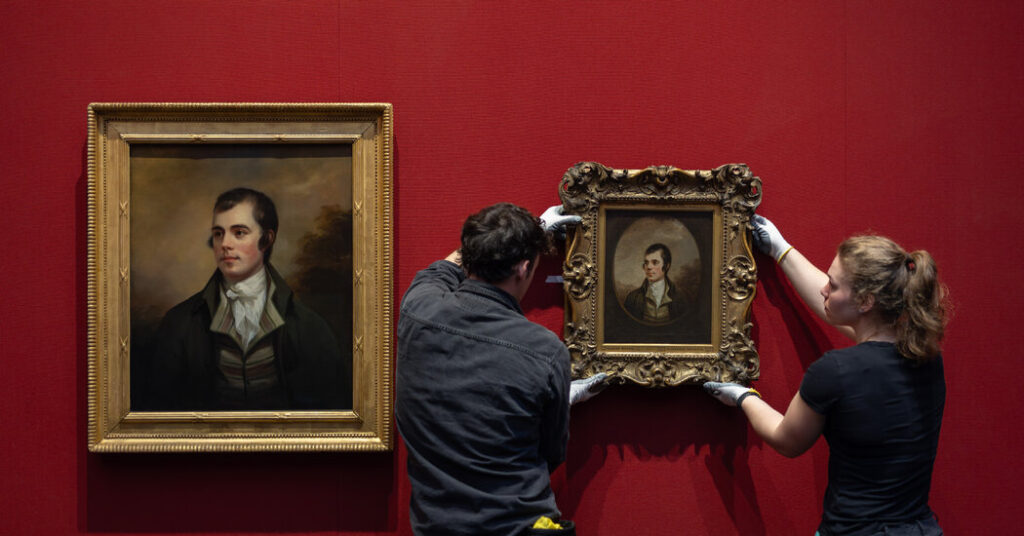
The depiction of Burns is currently hung next to the Nasmyth portrait that inspired it, alongside several other lifelike Raeburn works. Stevenson said Raeburn really knew how to make viewers feel as if Burns were in the room. “He really has captured a real person,” she said.
She added that people kept searching for the likeness over all those years, because “Robert Burns’s importance to Scotland can’t be underestimated.”
The post A 200-Year Mystery: Finding the Missing Portrait of Scotland’s Top Poet appeared first on New York Times.