The open split that emerged this week between the United States and some of its closest allies highlights the seismic changes that are in store for the global economy amid the transition from full-blown U.S.-led globalization to an unruly new order.
For decades, U.S. policymakers promoted global economic integration as a way of delivering peace and prosperity. Now foreign leaders and investors are reassessing those ties, putting more emphasis on avoiding geopolitical dangers, especially those emanating from a less predictable United States.
Commercial links between nations made the global economy more efficient. But they created vulnerabilities that the U.S. and other governments weaponized using tariffs, financial sanctions and supply chain restrictions. President Donald Trump’s recent threat to impose tariffs on European allies that opposed his plan to gain ownership of Greenland exploited Europe’s dependence on Washington.
The clash put at risk transatlantic trade worth nearly $1 trillion as well as a new U.S. trade deal with the European Union, which included $600 billion in promised European investment in the United States. Though the immediate crisis has passed, allied leaders vowed they will not leave themselves open to such threats again.
“Something fundamental has shifted,” said Neil Shearing, chief economist for Capital Economics in London. “It’s about power, dependency and coercion. There will be an effort to reduce strategic dependency on the United States.”
The post-World War II global economy rested on an American foundation. The U.S. Navy protected global sea lanes, making it safe for giant cargo vessels to carry goods between distant ports while investors counted on U.S. treasuries as a “risk-free” asset.
Now the U.S. is pursuing an unapologetic “America First” approach, wielding power to get what it wants, no matter the cost in global goodwill.
For investors, the strength of the U.S. economy amid the boom in artificial intelligence outweighs concern about any erosion in Washington’s global standing. Stock and bond prices sank when the president threatened to seize Greenland and recovered a few days later when he announced “a framework of a future deal” over the mineral-rich island.
But the new U.S. posture and the resulting drive by many nations to replace efficiency with resilience will leave a subtle imprint on the global economy that will expand over time.
Abandoning the rules-based global order in favor of a new regime dominated by great powers will likely raise the cost of capital, threaten the fortunes of some American businesses and make the commodities needed to build redundant supply chains more expensive.
Already, as worries about U.S. economic and security policies grew over the past year, the price of gold, a traditional crisis haven, rose by nearly 80 percent. A member of the European Parliament last week urged the European Commission to develop a payment system to replace Visa and Mastercard after warning that “Donald Trump can cut them off overnight.” And prices for commodities such as copper, which is up more than 30 percent over the past year, are likely to head higher as nations build their own semiconductor and pharmaceutical plants rather than rely on imports.
Even before the Greenland imbroglio, there were doubts about the U.S. government’s reliability. Foreign central bankers and finance ministers privately worried that the Trump administration might interfere with Federal Reserve tools designed to help other nations during a financial crisis, according to Adam Posen, the president of the Peterson Institute for International Economics.
Those “swap lines,” which loan dollars to foreign central banks when needed, are controlled by the Fed. But since on any given day the U.S. might raid a foreign capital and capture its president (Venezuela); launch bombing strikes (Iran); or threaten to seize the territory of an ally (Greenland), foreign officials no longer are sure what to expect from the United States.
Trump’s repeated threats to fire Fed Chair Jerome H. Powell have only inflamed their fears.
“There is now explicit discussion among foreign governments that we can’t rely on the swap lines. A particular bank in a particular country gets into trouble and you go to the Fed for emergency dollars and suddenly somebody from the Trump administration says, well, before we press the button for the transfer, please give us this on letting us buy your port, or committing to buy our weapons, or committing to vote this way in an international organization,” Posen said.
Once they learned of the doubts, Fed officials took steps to reassure their foreign counterparts, according to a person familiar with the matter, who asked for anonymity to discuss sensitive conversations.
Still, that loss of faith can be glimpsed in the decline of the U.S. dollar against smaller advanced economy currencies, such as the Norwegian krone or New Zealand dollar, and the tightening spread, or interest rate differential, between corporate bonds and treasuries.
Even the most creditworthy companies typically must pay higher interest rates to borrow money from bondholders because creditors see them as more likely than the federal government to default. But corporations now are paying just 0.72 percentage points more than Uncle Sam to borrow money. That’s half the spread they paid three years ago and the smallest since 1998, according to market data.
Many overseas managers of government investment funds, pension funds and central bank reserves are moving some of their money into other currencies rather than rolling them over into fresh dollar-based investments. AkademikerPension, a small Danish pension fund, announced last week it would sell its $100 million treasury holdings, citing worries over the U.S. public debt.
“Fund managers are hedging against dollar downside risk in ways they haven’t since the ’70s or early ’80s,” Posen said.
So far, these shifts are small. The dollar’s international dominance, while frequently challenged, is likely to endure for years, according to most economists.
But the new world that is emerging is likely to witness a shortage of investment capital, as European nations plus Canada rush to rearm and try to catch up with technology leaders in the U.S. and China. Fast-growing Asian nations that once sent capital abroad are finding uses for it at home.
“We are moving to a world where global interest rates are going to be higher because there will be more demand for a given pool of world savings,” said Marcello Estevao, chief economist for the Institute for International Finance.
That would be bad news for the U.S., which owes its creditors more than $30 trillion and is running crisis-sized annual budget deficits even though the economy is growing.
Through 2035, the federal government will need to borrow more than $21 trillion to cover its annual shortfall, according to the Congressional Budget Office. The government pays an average interest rate of 3.4 percent on its current borrowings, a figure that has risen in each of the past four years. For each 0.1 percentage point increase in the rate, the government’s 10-year interest bill rises by $351 billion.
Whatever doubts existed about Trump’s determination to scrap the post-World War II international system, which he insists shortchanged the United States, dissolved amid the Greenland crisis.
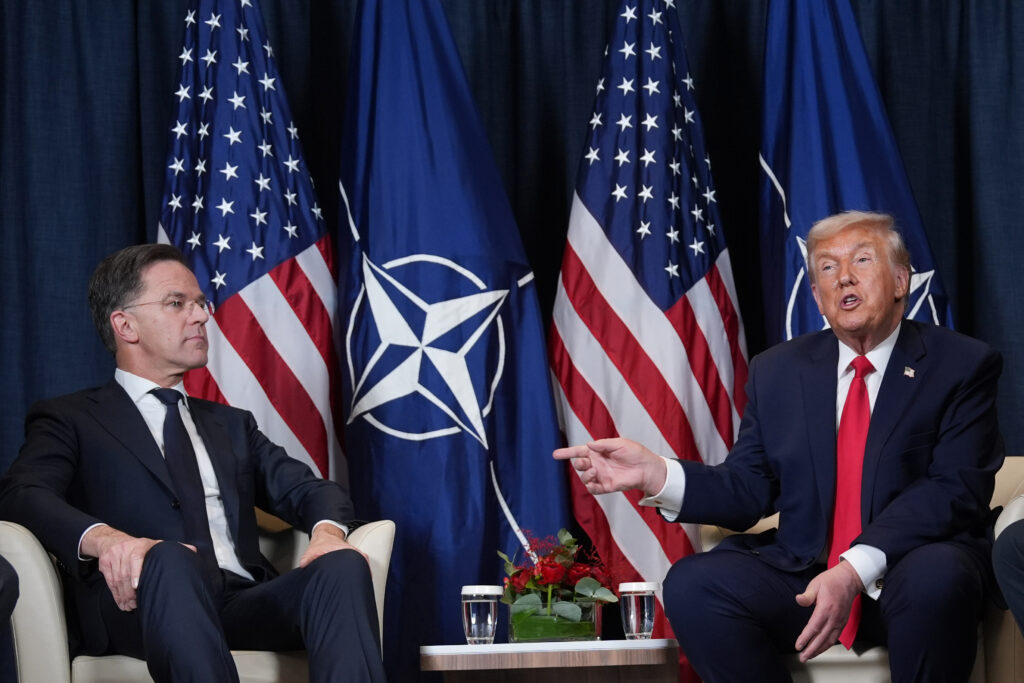
During several days at the World Economic Forum in Davos, Switzerland, the president and his top aides disparaged European nations as weak, overregulated and uncompetitive. Canadian Prime Minister Mark Carney, in an address that drew a standing ovation, proclaimed a “rupture” in the transatlantic alliance.
“Friends can have disputes while still remaining friends. President Trump has repeatedly affirmed his commitment to America’s time-tested allies, and ensuring that our allies carry their weight and do what’s right does not undermine this commitment,” said Kush Desai, a White House spokesman.
Trump administration officials say the U.S. enjoys unique advantages as the world’s largest economy boasting the deepest capital markets, which will make it difficult if not impossible for nations to reduce their U.S. ties. Treasury Secretary Scott Bessent last week derided talk of a move out of the dollar as “a false narrative.”
Speaking at the forum, Trump touted his success in reviving what he said was the “nightmare” economy he inherited. And he vowed to retaliate in unspecified ways against any country that dumped its holdings of U.S. government securities.
“If they do, they do. But you know, if that would happen, there would be a big retaliation on our part, and we have all the cards,” he told Fox Business.
The administration insists that its “America First” credo does not mean “America Alone.” But in the absence of a clear road map to a new global arrangement, analysts, investors and diplomats are drawing their own conclusions.
“I think President Trump is intent on jettisoning the Atlantic Alliance and the overall world order that we’ve known for 80 years. And what he wants to put in its place is what I would call a tripolar global dictatorship” alongside Russian President Vladimir Putin and Chinese President Xi Jinping, said Roger Altman, founder of Evercore, a New York investment bank, and a former deputy treasury secretary.
U.S. support for the rules-based order was premised on the notion that global growth would allow the world to avoid a repeat of the 1930s experience of depression and war, even if American taxpayers bore a disproportionate burden in underwriting the system. It worked: the global economy today is roughly nine times larger than in 1960, according to World Bank statistics. And after suffering three major conflicts between 1871 and 1945, the continent avoided large-scale combat until Russia’s 2022 invasion of Ukraine.
But Trump has long resented Europe as a free rider on U.S. security and sees globalization as an elite failure that hollowed out American factory communities and sapped national strength. In Davos, he still referred to Europe and Japan as “partners” and said they would prosper in his wake.
But the president made it clear that prosperity would happen on his terms, that other nations would do well by “following what we’re doing” in economic policy.
“The United States has really gotten used to living in a world that reflects American desires, American wants, American demands in ways that are invisible to most Americans. And now we’re in a world where other countries don’t have the incentive to go along with that anymore,” said Henry Farrell, professor of international affairs at Johns Hopkins SAIS in Washington.
The post Trump is breaking the old global order; allies brace for economic risks appeared first on Washington Post.