When the New Year Grand Sumo Tournament in Tokyo reached its adrenaline-pumping conclusion on Sunday, thousands of spectators cheered as star athletes were feted inside Japan’s most prestigious wrestling ring.
But someone was missing: Japan’s prime minister, who typically hands out a giant gilded trophy at the tournament.
Sanae Takaichi, the first woman to serve as prime minister in Japan’s history, skipped the ceremony, yielding to a longstanding ban on women inside the sumo ring, known as the dohyo. She dispatched the Japanese education minister, a man, to read a certificate on her behalf; officials said she wanted to respect sumo’s “traditional culture.”
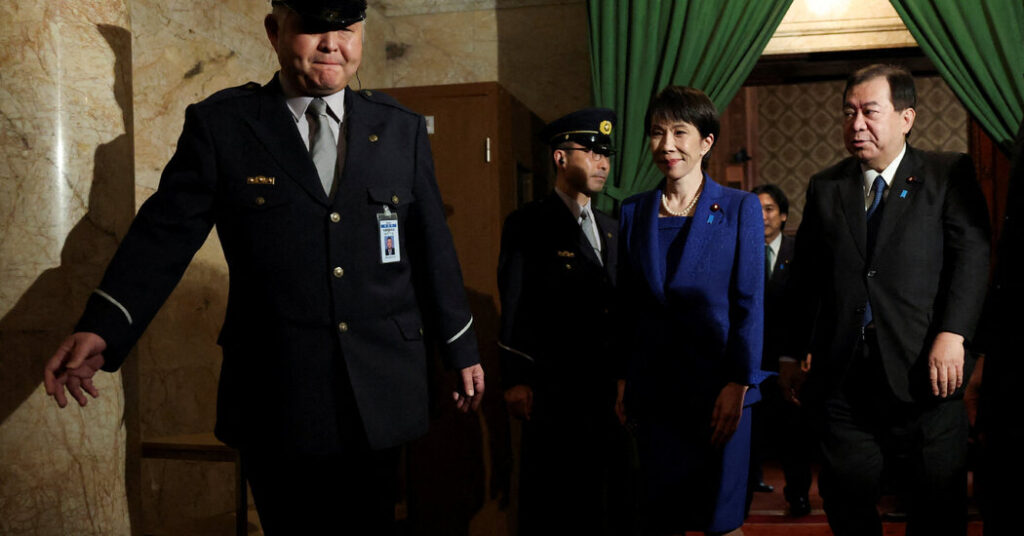
The decision was in keeping with the cautious approach to gender issues taken by Ms. Takaichi, a hard-line conservative who is seeking to expand her power in a snap election next month. Since breaking the glass ceiling in October, she has rarely spoken about the historical significance of her election, choosing instead to define feminism on her own terms.
Rather than denounce sexism in Japanese society, Ms. Takaichi has leaned into public discussions about her clothing and appearance. She has emphasized traditional values, balancing her career with caring for her ailing husband. And she has sought to project an image as a warm, determined leader who loves to “work and work and work and work.”
While Ms. Takaichi’s election has helped normalize the image of powerful women in Japan’s patriarchal society, her critics say that she should do more to promote gender equality.
“She is sending the message that a woman is not an ornament — that women can be outspoken and driven,” said Kumiko Nemoto, a sociology professor at Senshu University in Tokyo. “Yet her vision of feminism has done little, so far, to advance the cause of gender equality.”
During the campaign, Ms. Takaichi promised to bring “Nordic levels” of gender equality, which are typically closer to 50 percent, to her cabinet. But only two of the 18 members she appointed were women. That came plainly into view during a visit to Japan this month by Giorgia Meloni, Italy’s prime minister. Ms. Takaichi invited Ms. Meloni, the only other female leader among the Group of 7 nations, to pose for photographs with the women in her cabinet.
Like other conservative women in politics, including Ms. Meloni and Margaret Thatcher, the former British prime minister, Ms. Takaichi has embraced policies that critics say have eroded women’s rights. She opposes changing a longstanding law that requires married couples to share a surname, and she has backed efforts to preserve the male lineage of Japan’s imperial family.
Her supporters say that she embraces a different type of feminism, one that focuses on concerns about women’s safety and health. She has endorsed, for example, an effort to build more bathrooms for women in Parliament.
Waka Ikeda, a commentator and researcher, wrote this month in The Japan Times newspaper that Ms. Takaichi was pushing a version of conservative feminism that was rooted in the idea of working within existing structures, rather than “revolutionary transformation.”
“This isn’t anti-feminist,” she wrote. “It’s a different feminist tradition, one that resonates with Japan’s silent majority.”
Ms. Takaichi hinted at her vision when she invited two dozen women serving as ambassadors to Japan to her office this month. She told the ambassadors that she had aspired to be Japan’s prime minister — not its “first female prime minister.”
“I go about my daily work without giving much thought to it,” she said.
She warned about the “glass cliff,” a phenomenon in which women are appointed to steer organizations through crisis, only to be set up for failure.
“It leads to the prejudice that women are not suited to being leaders,” she said. “Let’s work hard together and produce results in order to eradicate such words.”
Ms. Takaichi has at times been the subject of sexist tropes. When President Trump visited Tokyo shortly after her election, commentators dissected her body language, saying she appeared too friendly when she locked arms with Mr. Trump.
Her sartorial choices — she favors blue suits and black handbags — have also been a frequent topic of discussion.
A lawmaker in Parliament recently criticized her clothes, saying that she should wear “Japan’s finest fabrics and those crafted by its top artisans.”
Ms. Takaichi responded with a lengthy meditation on social media about the stress she felt choosing clothes for high-profile events like the Group of 20 summit in South Africa. She wrote that she was heeding the lawmaker’s advice and had spent several hours selecting “clothes that don’t look cheap” and that “won’t get me looked down upon.”
The Grand Sumo tournament, which took place over 15 days this month, was seen as a test of how substantially Ms. Takaichi might seek to change Japan’s cultural norms. She skipped another sumo event in November.
Minoru Kihara, the chief cabinet secretary, said earlier this week that the government, in deciding how to deal with the sumo awards ceremony, was considering the “prime minister’s intention that she would like to value the traditional culture.”
The Japan Sumo Association said in a statement that it was “committed to the success of the traditional culture of Grand Sumo.”
Sumo aficionados expressed disappointment that Ms. Takaichi did not present the trophy as many of her male predecessors had. Over the years, several female officials in Japan have lobbied the association for permission to enter the ring. The group has rejected their requests; it came under fire at one point for forcing a female mayor to speak from a podium outside the ring instead.
Ms. Takaichi “is the last person who wants to change women’s rights or promote feminism,” said Shizuka Wada, an author who has been critical of sumo culture. “This tradition will never change so long as she is prime minister.”
Women have long been banned from professional sumo rings in Japan. In the Shinto faith, one of the country’s main religions, they are considered impure because of menstruation.
Tomoko Nakagawa, a former mayor of the city of Takarazuka, said Ms. Takaichi had a chance to help advance women’s rights. As mayor in 2018, Ms. Nakagawa was rejected by the sumo association when she tried to make a speech inside a training stable.
“Women are treated as unclean even in the modern era,” she said. “Will she allow such a tradition to last in the future? I expect the prime minister to raise some questions at some point.”
Javier C. Hernández is the Tokyo bureau chief for The Times, leading coverage of Japan and the region. He has reported from Asia for much of the past decade, previously serving as China correspondent in Beijing.
The post Why Japan’s Leader Won’t Enter the Male-Dominated Sumo Ring appeared first on New York Times.