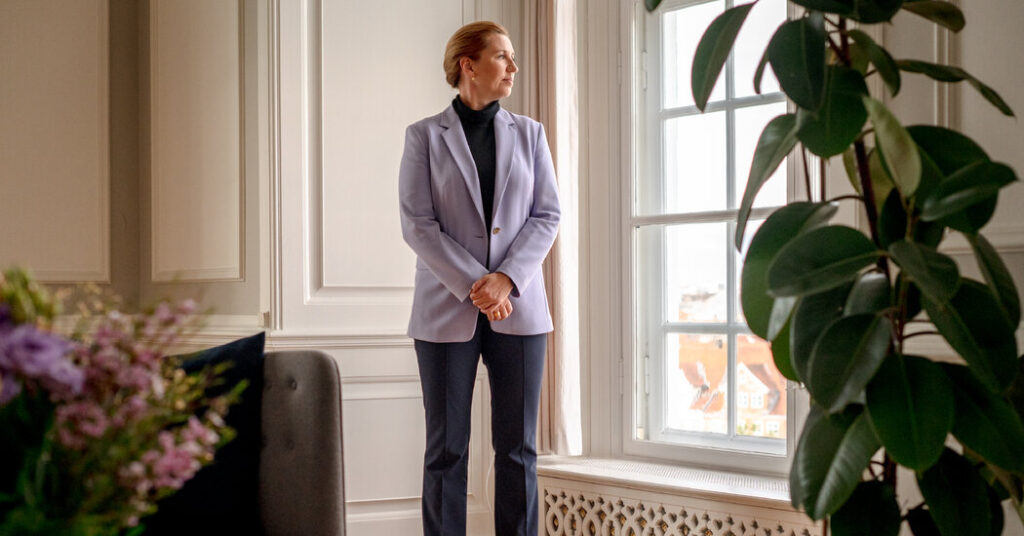
Mette Frederiksen has never tolerated bullies.
When she was in high school, Ms. Frederiksen, Denmark’s prime minister, stood up to a pack of skinheads for teasing immigrant kids.
It didn’t go so well. She got socked in the face.
But this week, she ducked a punch, a big one.
After escalating threats from President Trump about seizing Greenland, Denmark’s gigantic overseas territory, Mr. Trump seems finally to have backed down.
In a speech to the world’s financial elite in Davos, Switzerland, Mr. Trump said he would not use force to take Greenland. Later he said he and NATO leaders had worked out “the framework of a future deal” that would make everyone happy. That remains to be seen.
Of course, there were other factors to Mr. Trump’s reversal, like rising congressional opposition and falling stock markets, but there’s no doubt that Ms. Frederiksen’s carefully crafted defense helped block Mr. Trump from getting something he really wanted.
For months, Ms. Frederiksen has played a nervous game of brinkmanship with Mr. Trump, and it looks like she has won — for the moment.
As negotiations continue, Ms. Frederiksen remains locked in an unwanted struggle, trying to calibrate how to make clear to the mercurial Mr. Trump that the answer to his demand that the United States have Greenland is a hard no, without antagonizing him into threatening to snatch it away again.
Already, she has signaled her resistance to one of the compromises that Mr. Trump appeared to be considering — the establishment of American sovereignty over military bases on Greenland. Sovereignty, she insists, remains a “red line.”
We spent time with Ms. Frederiksen this fall, in Greenland, where she agreed to a rare sit-down interview in an old house overlooking the sea. We asked her if she felt Mr. Trump was acting like a bully.
“He is able to speak in a very clear way,” she replied.
“So am I.”
That quiet resolve, rather than flattery, has set her apart from other European leaders when it comes to handling Mr. Trump. It has made her extraordinarily popular at home. Opinion polls in Denmark show her party surging. Elections are later this year and the polls suggest she’s primed to win a third term.
Her rising support reflects just how much Greenland means for her country, let alone for Mr. Trump and Greenlanders themselves.
For Mr. Trump, the island represents the extreme of his imperial ambitions: seizing an enormous land from a NATO ally in what would be the biggest territorial acquisition in American history.
For the 57,000 Greenlanders, a mostly Inuit population with long and complicated ties to Denmark, their future is at stake.
And for Ms. Frederiksen, who swept into office in 2019 as the youngest prime minister in Danish history, the dispute is undeniably existential, threatening her country’s very identity, composition and stature on the world stage.
This week’s fast-moving developments demonstrated her tactical skills. After Mr. Trump, declared that since he didn’t win the Nobel Peace Prize he was giving up on peace and would push ahead on Greenland, she rolled up her sleeves, too.
She imported troops from her own coalition of the willing — including Britain, Germany, France and Iceland — to Greenland. She rallied Europe to speak out in Denmark’s defense. She resisted Mr. Trump’s threats of tariffs.
Until that moment, many Danes had resigned themselves that there was little their country could do if indeed Mr. Trump moved on the island.
Ms. Frederiksen’s risky strategy to call in foreign troops, albeit a tiny contingent of a few dozen and ostensibly part of an Arctic training exercise, was a signal that any military action that Mr. Trump took “would be very nasty and ugly,” said Bent Winther, a Danish political commentator.
Her point was that, “if you’re going to take Greenland by force, you’d have to put British and French and German officers in handcuffs,” Mr. Winther said. “I think that was part of the game.”
Ms. Frederiksen’s sparring with Mr. Trump has come to define her leadership. It started from her very first weeks in office in 2019, when she arrived at the age of 41 as the head of the center-left Social Democrats.
That summer, during his first term, Mr. Trump suggested that the United States buy Greenland, which has been part of Denmark for more than 300 years.
Trump Administration: Live Updates
Updated
- Federal judge extends deportation protections for Burmese migrants.
- Renée Fleming won’t perform at Kennedy Center concerts.
- The U.S. says its first boat strike since Maduro’s capture killed 2 in the eastern Pacific.
Ms. Frederiksen dismissed it as “absurd,” which provoked Mr. Trump to cancel a trip to Copenhagen and call her remarks “nasty.”
Does she regret saying that?
“It’s a closed chapter,” she said in the interview.
But Mr. Trump reopened that chapter again, on Jan. 7, 2025, even before his inauguration, when he said for the first time that he wouldn’t rule out using military force to get Greenland.
That same day, the president’s eldest son, Donald Trump Jr., made a lightning quick visit to Nuuk, Greenland’s capital, in the depths of winter, ostensibly for business. His appearance drew a band of pro-Trump social media influencers dressed in bulky snowsuits and American flags who passed out $100 bills, which turned off many Greenlanders.
The next week, Ms. Frederiksen held a heated phone call with Mr. Trump. According to European officials who were briefed afterward, Mr. Trump berated her for 45 minutes. She did not want to talk about that one either.
“A phone call between two colleagues has to be a phone call between two colleagues,” she told us.
Mr. Winther, who co-wrote a biography about her — “Mette F” — in 2019, traces her cool self-assuredness and penchant for underdog causes to her childhood home.
Her father, Flemming Frederiksen, was a typographer, union leader and active member of the Social Democrats. He worked in a newspaper production room as the paper was transitioning into the automated era and stood up for workers about to be rendered obsolete.
“When people ask me: ‘When did you get interested in politics?’ I don’t know what to say,” Ms. Frederiksen said during our interview. “I cannot remember not being interested in politics.”
She was shy, she said, but also strident. After recounting the run-in with the skinhead in high school, she said, “I don’t know if it tells something about my character, maybe it tells us more about his.”
The first political party she joined was the youth wing of the African National Congress. She rapidly rose through the ranks of the youth wing of the Social Democrats, winning a seat in 2001 to Denmark’s parliament. Mr. Winter said she arrived with “extraordinary confidence, you know, the confidence you can only feel when you are very young.”
She was 24.
Back then, she had a different look — casual clothes, spiky hair. She quickly gained a reputation for being a strong public speaker and unafraid of taking on party elders.
Her tenure has been marked by crisis. During the Covid pandemic her government abruptly ordered a cull of millions of minks (raised for fur), fearful they could spread the virus. It was a controversial decision and resulted in several high-level resignations.
She survived the fallout and ultimately was credited with guiding Denmark through those years with relatively low infections while keeping public services as open as possible.
After Vladimir V. Putin ordered the invasion of Ukraine, she called for Europe to act. She was among the first on the continent to commit F-16 fighter jets to the Ukrainian military and boosted weapons production for Ukraine.
Her country, like some others, has been the victim of unsolved drone incursions widely believed to have been instigated by Russia, perhaps as payback.
On immigration, she has put in place some of Europe’s harshest asylum rules — including utilizing camps abroad and family separations. The moves have been criticized by human rights groups but have sharply reduced arrivals and shored her up politically.
When we spoke with her in September, she was visiting Greenland to apologize for Danish doctors forcing contraception on Greenlandic women and girls, part of a long abusive colonial legacy.
Most Danish political analysts give her high marks for how she has handled Greenland.
“It’s difficult for me to really find any major errors,” said Ulrik Pram Grad, a respected academic on Greenland.
Mr. Grad said that as Mr. Trump began to get aggressive about Greenland, Ms. Frederiksen did a good job of coordinating with Greenlandic officials and rallying European capitals, such as London and Paris, “trying to get our message out of other people’s mouths.”
The reason? Denmark needs Greenland. With it, Denmark is the world’s 12th largest sovereign state. It sits on the Arctic Council, the leading international forum for Arctic affairs. It keeps its special (though now troubled) relationship to the United States, which has been protecting Greenland since World War II and maintains a military base at the northern end of the island.
“When they don’t have Greenland anymore, they will lose 98 percent of their area,” said Pele Broberg, the leader of a Greenlandic political party that has been critical of Denmark.
“So it’s very simple,” Mr. Broberg said. “They’re important as long as they own us.”
Mr. Frederiksen, for her part, has supported Greenland’s autonomy.
“The future of Greenland belongs to the Greenlandic people,” she said. “It’s more two countries now working together than an old colony, with all what is included in that.”
Throughout the 50-minute interview, Ms. Frederiksen was more comfortable talking foreign affairs than about her own life. She is on her second marriage, with a Danish cinematographer, Bo Tengberg, and together they are raising five children.
Outside politics, she finds respite in spending time at the family summer house, cooking and preserving food, and staying fit through spinning.
She said one of her most important guiding principles was keeping Europe’s alliance with America strong — or at least intact. As recently as 2024, she said that she wouldn’t allow “a single piece of paper” to slip between the two sides.
In the past week, she has said that she still believes in a close relationship with the United States, citing “a common interest in ensuring our security.”
“Some Europeans have loved the U.S. because of dollars and ‘Dallas’ and so on. That’s not how I am,” she told us. “I really believe that everything would have gone wrong for Europe if it wasn’t for D-Day and for the big role of the U.S. in ending the Second World War.”
“You saved us,” she said. “And by the way, you have done that again and again.”
“So my starting point is that I will do whatever I can to keep us together in this world, and therefore I’m not starting a conflict,” she said. “I’m trying to solve a conflict.”
Jeffrey Gettleman is an international correspondent based in London covering global events. He has worked for The Times for more than 20 years.
The post The Woman Who Stands Between Donald Trump and Greenland appeared first on New York Times.


