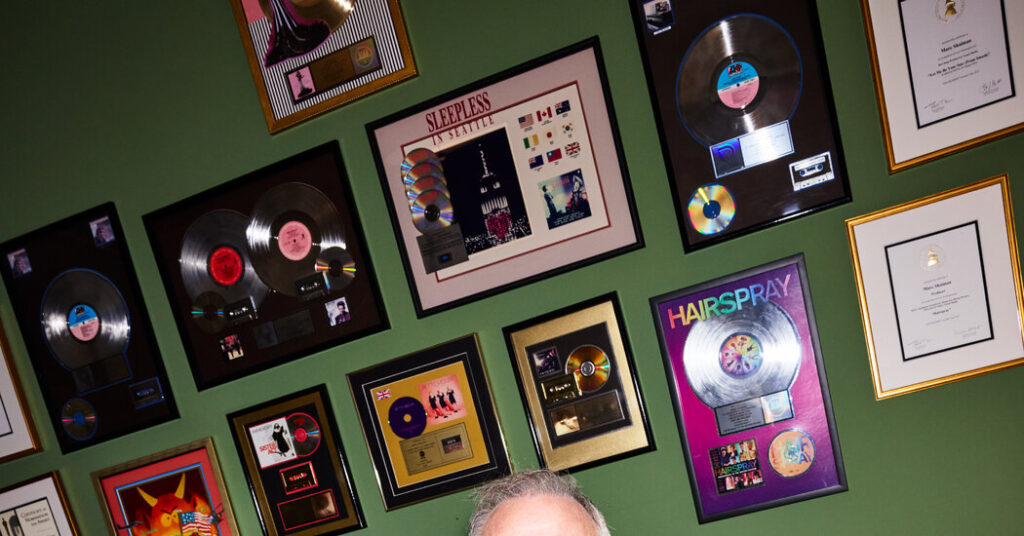
A lot of dreams have come true for Marc Shaiman, Broadway songwriter, soundtrack savant, Jewish Eeyore and human Spotify. (Go ahead, ask him: He knows every song.) And yet each fruition seems to have prompted an equal and opposite karmic blowback. In 2012, after bragging to his mother that he’d “rehearsed with Billy Crystal all day and recorded with Bette Midler all night,” she pricked his ego balloon by saying, “So, maybe through them you’ll meet someone important?”
Shaiman, 66, relates that story, along with hundreds of other hair-raising, name-dropping tales of success and comeuppance, in “Never Mind the Happy,” a memoir of his 50-year musical career to be published this week by Post Hill Press. (The title was his mother’s response to being wished a “happy and healthy new year.”) “If showbiz puts you on a pedestal on Tuesday,” he writes, it’s only to have a better shot at your anatomy on Thursday.
The pedestal is impressive, though, especially when you consider that he climbed it on the strength of innate talent. No one in his family had musical interest, let alone musical ability, yet Shaiman wasn’t even out of his teens when he started working with Midler. In his 20s, he wrote scrappy, zany East Village shows with Scott Wittman, his lyricist partner and, for 25 years, romantic partner too.
Together, they eventually reached the “truly promised land” of Broadway with the huge hit “Hairspray” in 2002, while Shaiman continued his Hollywood career scoring dozens of popular movies (“Sister Act,” “Beaches,” “When Harry Met Sally …”). He even had a nine-second cartoon cameo as Big Gay Al’s pianist in “South Park: Bigger, Longer & Uncut,” for which he wrote the songs with Trey Parker.
“It was an honor just to be animated,” he allows in the book.
That joke has a sting in its tail: Nominated seven times for Academy Awards, he has never won. (He’s an EG-T.) He still sulks about it, as well as the five Broadway shows that followed “Hairspray,” of which only one (“Martin Short: Fame Becomes Me,” in 2006) turned a profit. Also still rankling him are an endless series of manipulations by producers, betrayals by studios and his own sometimes bratty reactions to brush-offs by celebrities. Let’s just say that when he accompanied Nora Ephron at one of Short’s Christmas parties, the key he selected was not ideally suited to her voice.
But what bothers Shaiman most is that despite his achievements, few people seem to know who he is anymore. That was one reason he wrote the memoir, which he almost called “Google Me!”
The sulking would be intolerable — even he can barely tolerate it — if he weren’t such a teddy bear and talent, with songs and arrangements invoking those of golden age musical theater greats like Jule Styne, Hollywood masters like Nelson Riddle, soul legends like Sam Cooke and pop impresarios like Phil Spector. Any five of the hundreds of tunes in his catalog — say, “You Can’t Stop the Beat,” “I Know Where I’ve Been,” “They Just Keep Moving the Line,” “Let Me Be Your Star” and “Some Like It Hot” — should be enough to put him in at least a junior pantheon. But the music world he steeped himself in, and learned to emulate with a lover’s ardor, has mostly faded away, leaving him to wonder whether he should too.
Is he done with Broadway? In what may prove to have been an exit interview, he recently spoke with me, in the equipment-crammed music room of his New York City apartment, about the often-conjoined highlights and lowlights of his life, but also the compensations of love. (He married Louis Mirabal, a retired Navy officer, in 2016.) Whines and tears notwithstanding, he seemed to be creeping toward some kind of provisional peace. These are edited excerpts from our conversation.
I want to read you something I wrote in 2002, just before “Hairspray” opened in Seattle. “Saying that Shaiman is filled with dread is like saying he’s filled with blood. Despite the antidepressant Celexa and a panoply of anxiety-reducing fetishes, he can only aspire to pessimism.” Has that improved?
No, if anything, it’s worse. I remain unhealthily, persistently pessimistic. One would think your skin would get thicker, but my skin has gotten thinner and thinner and thinner.
I wonder if that’s just aging. I mean, literally, our skin gets thinner.
But after you’ve been in so many battles you’d think you’d have developed the ability to bounce back. That hasn’t been easy, especially these last few years.
You’re talking about those four post-“Hairspray” flops: “Catch Me If You Can” (2011), “Charlie and the Chocolate Factory” (2017), “Some Like It Hot” (2022) and “Smash” (2025). Some were great, most had great moments, all of them died young. But you’ve nevertheless had an amazing career.
The subtitle of the book is “Showbiz Stories From a Sore Winner.” So I admit, for anyone to read this or hear me complain, it’s ridiculous. Look at all that I’ve been given and was able to give out!
It strikes me that, like all of your songs, the book has a really strong rhythm: the alternation of what you call the plotz and the zetz — the dizzying joy and the knife in the side. Let’s start with some of your top plotzes.
I was a Bette Midler fanatic at 13, moved to New York at 16, and the first people I meet, Scott Wittman being one of them, live across the hall from one of Bette’s backup singers. A year later, I’m in Los Angeles playing for Bette, who says, “Stick around, I could use you.” My flight back to New York is canceled and I’m placed in the guest room of her home. Not even a hotel, not even the guesthouse in the back, but down the hall from her. We are suddenly living together like brother and sister. And that has remained our relationship for now 50 years.
Another plotz, obviously, is “Hairspray.” After years of fun but little-seen and not-very-remunerative downtown shows, you and Scott have a Broadway megahit and a Tony Award for best score.
The plotz is not only to have written it, but to have it be taken to heart by so many people, and for it to be so joyous. And joy is a part of me! You see it when Scott and I are accepting the Tony, which leads to my saying on national TV that I love him, and want to marry him — and then comes the kiss heard around the world. All unplanned. But talk about your plotzes and your zetzses. After that incredible moment with Scott, I came back into the audience, and my father, who was always a very genial person, was seething that I had not thanked my parents. At the moment I was like, “I’m not gonna let you ruin this moment for me.” But soon I was just full of terrible guilt and will be to the day I die.
You really can’t help it, can you?
I started young. When I was 12 the girls’ choir at my school was invited to perform the Carpenters hit “Sing,” with Karen Carpenter herself, at the Garden State Arts Center. I transcribed it, arranged it, taught them the harmony. But when the concert happened, they told me there was no room on the bus.
I’m going to try to pull you back. Accompanying Midler on that stunning Johnny Carson farewell in 1992 — when she sang “One for My Baby,” a song you picked and arranged for her — has to be the plotz of all plotzes.
Yes, even though it’s nothing I wrote. But I put no lines between writing music, writing lyrics, arranging, orchestrating, figuring out the concept, finding the perfect song. To me, it’s all one big ball of wax.
What is the wax? What is the thing that all those things are?
Communicating. I’m sure there are many people who wish I communicated less. But thank God I have music and lyrics to say what I hope to say.
Based on the fate of those post-“Hairspray” shows, do you worry that people don’t want to hear what you’re saying as much as they used to?
I think it’s maybe my fault some shows didn’t work, and I haven’t taken enough responsibility for that. Musically, I have held on too hard, trying to stay pure to the eras in which the shows take place. Maybe “Some Like It Hot” would still be running if I had been less faithful to the sounds of the ’30s and ’40s.
What are you saying? Even if it’s expensive to produce, shouldn’t the sound match the period?
Look at “The Great Gatsby,” a musical that takes place in the 1920s but that uses contemporary music and does a great job. Or look at the creators of “Maybe Happy Ending.” I was so jealous that they had this brilliant concept that just so happened to call for just a four-person cast. How blessed they are to have had the muse inspire them so. Scott and I gravitate toward shows and sounds that require bigger ensembles.
Why?
I guess because we grew up in the tail end of the golden age of Broadway. We were born too late.
You and Madame Rose.
“What I got in me, what I been holdin’ down inside me, if I ever let it out …”
Well exactly. You need the size of the songs because of the size of the feelings. That’s just not where Broadway is right now. It’s smaller. Not that smaller can’t be beautiful.
I don’t know that I am at peace with that. When Scott and I were working in England on “Charlie and the Chocolate Factory,” walking back to our hotel one night we saw a sign outside “Mamma Mia!” that said, “You already know you’re gonna love it.” I pointed to it and said, “There lies the future.” I’ve had a really long run and I’m very proud, but if they don’t really want what I do, why do it?
You don’t mean you’d retire!
I do. Because I should have included among the plotzes the fact that I’ve had two great love affairs in my life. That Scott and I were able to live through our breakup and continue to collaborate, and that I met Lou and we can all be friends, is a lesson that life sometimes does work out. The glass can be half full.
But only half.
Well, last week I finally had nothing to do for one day. No special lyric to write. No one asking me for anything. And by around 2:30, I was like: This is hideous.
Video production by Chevaz Clarke, Dan Fetherston, Lauren Pruitt and Luke Piotrowski.
Jesse Green is a culture correspondent for The Times.
The post The Plotzes and Zetzes of a Life in the Musical Trenches appeared first on New York Times.


