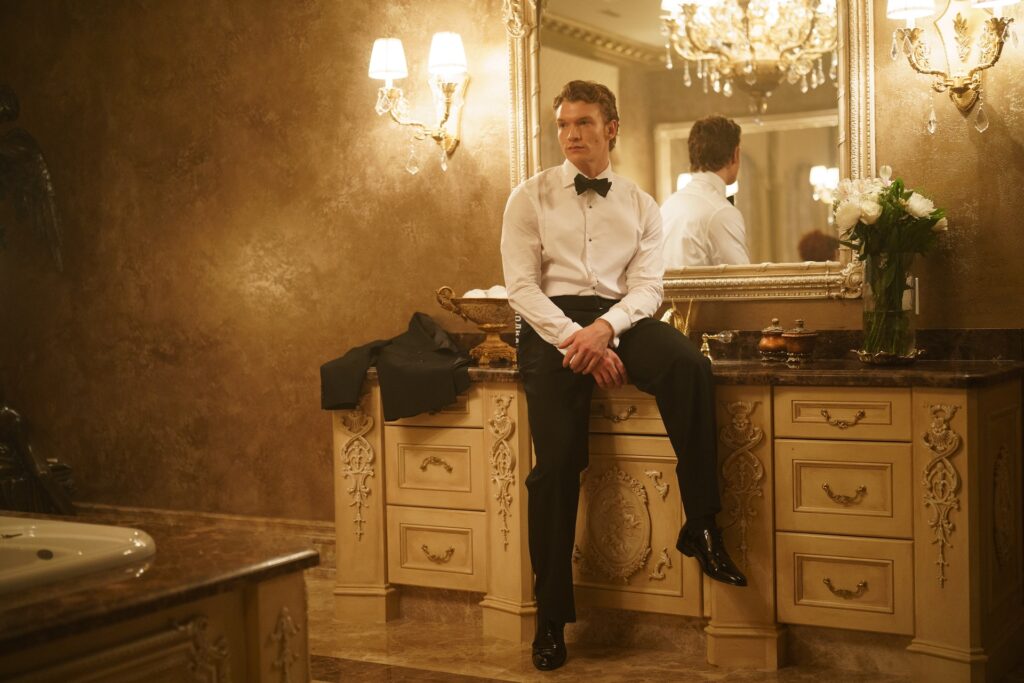
“Heated Rivalry,” a Canadian drama featuring a clandestine queer romance between two hockey players that has ignited online fandoms worldwide, has found unexpected success in Russia — the homeland of one of its lead characters — even though it is not officially available for streaming and LGBTQ+ content is heavily censored there.
Most Western streaming platforms ceased operations in Russia after the 2022 full-scale invasion of Ukraine, and Russian distributors rarely get rights to new Western projects, yet the series circulates widely thanks to lax piracy laws. In a country where the LGBTQ+ movement is legally designated as extremist, the show has nonetheless become a cultural flash point.
On Kinopoisk, Russia’s equivalent of IMDb, “Heated Rivalry” holds an average rating of 8.5 out of 10 from over 40,000 votes, placing it above long-established favorites such as “Game of Thrones,” “Breaking Bad” and “The Sopranos.” For comparison, “The Sopranos” stands at 8.2 with around 55,000 votes.
The HBO/Crave drama based on the books by Canadian author Rachel Reid revolves around a years-long secret relationship between Russian and Canadian hockey players. Although users can’t stream either service in Russia, a quick web search yields multiple pirate websites offering all episodes; it is also shared widely on VKontakte, the Russian version of Facebook.
Much of the discussion in Russia centers on the character of Ilya Rozanov, a Russian whose fraught relationship with his homeland mirrors the lived reality of many viewers.
He comes from a patriarchal family with deep roots in law enforcement, a background that resonates with many of his compatriots; his authoritative father is a high-ranking military officer, and his brother is a policeman. In the show, Ilya’s father berates him for an unsuccessful game and later his brother hurls a homophobic slur at him. The young hockey player is under immense pressure not to tarnish the family name or his country.
Russian audiences connected deeply with his understanding that his country would never fully accept him, or allow him to live openly as a bisexual hockey player or be in a committed relationship with another man within an increasingly conservative society.
Through Ilya, the series articulates a conflict rarely, if ever, depicted in Russian media — and a struggle faced by tens of thousands of LGBTQ+ people forced to hide their identity.
Any display of LGBTQ+ identity or advocacy for the rights of LGBTQ+ people is effectively outlawed in Russia following a Supreme Court ruling in 2023 that found the “international LGBT movement” is an extremist organization, on par with groups such as al-Qaeda.
Online fan groups dedicated to the show on Russian social media count tens of thousands of users, and the Russian Instagram reel sphere in recent weeks has been filled with clips praising the series.
“It’s a well-told story that makes many people around the world feel like they’re not alone,” one Russian fan said on Instagram.
Russians have especially praised Ilya’s monologue in which he explains why he will never return to Russia, fully aware that he would be seen as a disappointment to his family and that the rest of the society would forever label him an outcast.
“If you live as an openly gay man in Russia, you are constantly facing pressure and living in fear,” said a Moscow resident who spoke on the condition of anonymity out of fear for personal safety. “The best option for someone who wants to live openly and freely is to leave.”
Mikhail Zygar, a prominent Russian author and journalist who now lives in exile, wrote in an essay for Vanity Fair that he feels he knows Ilya. “In fact, I know quite a few people like him. I might even say that I have been him.
“Like the character, I was born toward the end of the Soviet Union, a time when homosexuality was still a criminal offense. My father was a military officer. I grew up in a society where coming out never seemed possible; it was always clear that being gay in Russia would mean being an outcast, being cursed, having no chance whatsoever,” he wrote.
The popularity of the show has prompted calls in Russia to purge it from the internet. Sorok Sorokov, a conservative Orthodox Christian group campaigning for “traditional values,” announced plans to submit requests to Roskomnadzor, the state media watchdog, and the prosecutor general’s office to punish websites that feature the show.
“The series is full of sodomite sex scenes. Russia already has a mortality rate higher than its birth rate, and yet our youth are shown propaganda of unnatural debauchery,” the group’s chairman, Georgy Soldatov, told Absatz Media.
Soldatov said the group would seek not only the show’s removal from streaming platforms but also punishment for any service that continued to host it.
The government narrative portrays something it calls the “LGBT organization” as part of a clandestine network that is designed to lure Russians into decadent Western ways and so must be fought.
The Supreme Court ruling branding the “movement” as extremist marked the culmination of a nearly decade-long legislative crusade aimed at erasing LGBTQ+ representation from Russian society and stripping rights from people in same-sex relationships.
The first so-called gay propaganda laws were passed in 2013, banning the dissemination of “information about nontraditional sexual relations” or content that could encourage children to “change their gender.”
The following year brought the Sochi Olympics, which are referenced in the series. In the episode, Western athletes discuss Russia’s new discriminatory laws, raising the stakes in Ilya’s storyline by underscoring not only the societal rejection he would face if he came out but also the potential risks to his safety.
In the decade since those Olympics, the laws have only grown stricter. The 2022 invasion of Ukraine brought a new wave of discriminatory laws, and the definition of “gay propaganda” was expanded from minors to adults while fines were introduced for virtually any public manifestation of LGBTQ+ identity. The enforcement has ranged from absurd to dystopian, from biographies of gay historical figures being sold with blacked-out chunks of text to police raids on bars and clubs friendly to LGBTQ+ people.
“This decision will protect our children, the future of the country, from the darkness disseminated by the U.S. and European countries. We have our own traditions and values,” Vyacheslav Volodin, the chairman of the lower house of the Russian parliament, said in late 2022 when the laws were significantly expanded.
In 2025, several managers linked to Russia’s largest publisher, Eksmo, were accused of LGBT propaganda for offering about a dozen queer-themed books. They were detained and questioned after searches of their offices, and while most have been let go, three senior managers at Popcorn Books and Individuum were placed under house arrest, where they remain.
Eksmo acquired a majority stake in Popcorn Books in 2023 following the success of its 2021 queer-themed bestseller “Summer in a Pioneer Tie,” which depicts a romantic relationship between a teenager and a camp counselor at a Soviet summer camp.
After the 2025 arrests, Eksmo appeared to distance itself from the publishing house, telling the business daily RBC that it “has no relation to LGBT propaganda.” Last week, Eksmo announced the closure of Popcorn Books, which confirmed its shutdown in an emotional statement, thanking readers for their support “even when we barely had the strength to go on.”
“You are our foundation — humane, sincere and open to different voices and experiences,” the publisher wrote on Telegram.
Censorship has also extended to movies and television shows. Russian viewers noted that queer or otherwise controversial scenes are routinely cut from films and television shows, and that even studios specializing in Russian-language voice-overs for pirated content alter scripts to remove sensitive themes.
Beginning March 1, a law banning films that “discredit traditional values” and promote drug use will take effect, granting regulators even broader authority to pressure cinemas and streaming services to remove content deemed unacceptable.
Roskomnadzor blocked 1.3 million pieces of content in 2025, a 59 percent increase compared with 2024. While tools like virtual private networks that circumvent these restrictions were the most blocked, the second-largest category was LGBTQ+ content, which saw a 269 percent increase.
The post ‘Heated Rivalry’ is a hit in Russia, where LGBTQ+ content is heavily censored appeared first on Washington Post.