Syria’s defense ministry said on Saturday that it would extend a cease-fire across all military operations for 15 days, hours after a weeklong truce with a Kurdish-led militia in the country’s northeast expired.
The ministry said in a statement on social media that the extension was in support of an operation led by the United States to transfer detainees from the Islamic State group held in Syria to Iraq.
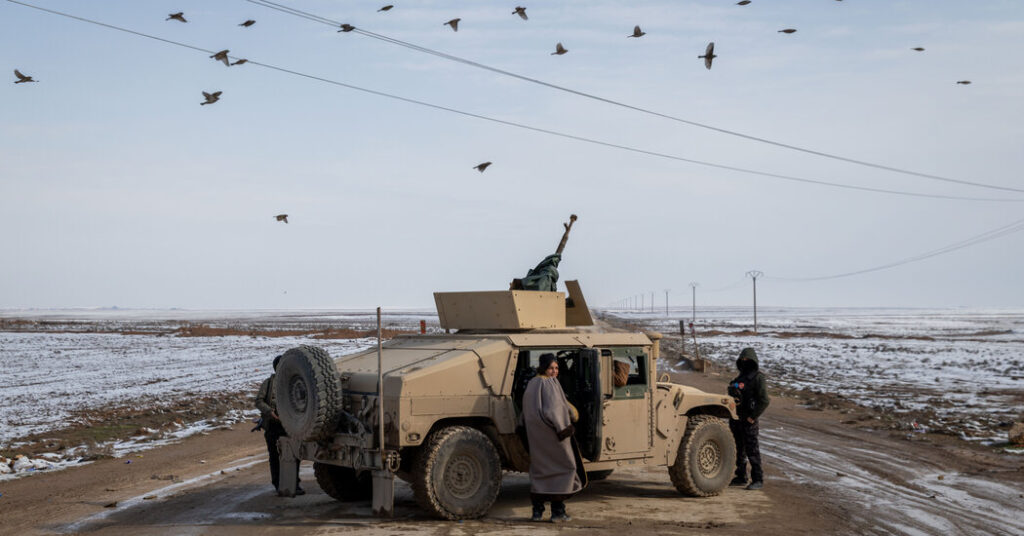
Syrian government troops have in recent weeks taken control of large areas of territory held by Kurds in eastern and northern Syria, including strategic assets like oil fields and dams, after intense clashes with the Kurdish-led Syrian Democratic Forces, or S.D.F.
As the Syrian armed forces took over parts of the northeast, the United States began relocating detainees from the Islamic State, also known as ISIS, amid concerns that thousands of former fighters and their relatives could break out of detention in those areas.
The defense ministry’s statement on Saturday made no explicit reference to the government’s conflict with the S.D.F., though the group said in a subsequent post on social media that an agreement had been reached through international mediation.
The Syrian government and the Kurds agreed last Sunday to an immediate cease-fire that called for the full integration of Kurdish troops into the national army, a longstanding demand of the Syrian government, as well as the handing over of administrative control of much of the northeast.
The Syrian state news agency SANA reported on Tuesday that the government had given the S.D.F. four days to submit a detailed plan for the integration of Hasakah Province, which was the only province left under the militia’s authority.
It was unclear whether a plan had been submitted, and a spokesman for the group did not immediately respond to requests for comment.
Analysts widely saw the truce deal as a capitulation, because the S.D.F. lost almost all of the concessions the Syrian government had offered in earlier negotiations.
SANA cited an unnamed government source on Saturday night as saying that the cease-fire had ended, and that it was weighing its next steps. And Syria’s foreign ministry had dismissed reports circulating on social media that the deadline would be extended, SANA said, citing a ministry official, Mohammad Taha al-Ahmad.
“All options remain on the table, alongside calm and dialogue, to enforce the law, preserve Syria’s unity and safeguard the rights of the Syrian people,” Mr. al-Ahmad said, according to SANA.
The S.D.F. had accused the government on social media of deploying troops in breach of the cease-fire, saying it was an effort to “undermine de-escalation and steer the situation toward war instead of political solutions.”
The government’s recent advances have strengthened President Ahmed al-Sharaa’s grip on Syria, more than a year after his rebel forces overthrew the dictatorship of Bashar al-Assad, whose family had ruled the country for decades.
Mr. al-Sharaa has sought to bring Syria’s diverse ethnic and religious communities under centralized rule with himself at the helm in the capital, Damascus.
He has also pledged that all of Syria’s minority communities will be protected under his government and, this month, signed a decree affirming Kurdish rights, including calls to restore Syrian citizenship to Kurds stripped of it after a 1962 census.
The S.D.F., which has long positioned itself as the defender of Syrian Kurds and administered a de facto state in northeastern Syria, has posed the most formidable challenge to Mr. al-Sharaa’s effort.
The Kurdish-led militia has resisted full integration into the government’s army, seeking autonomy over its territories and security in northeastern Syria.
Yet those Kurdish forces have also long been key partners of the United States, assisting in the fight against the Islamic State guarding American bases and managing detention camps and prisons that housed thousands of jihadists and their families.
The partnership appeared to come undone this week, after the U.S. special envoy to Syria, Thomas J. Barrack, said that Washington no longer viewed Kurdish-led forces as its main partner in the fight against the Islamic State. Mr. Barrack said he believed that the Syrian government was now ready to take on those responsibilities.
That apparent policy shift reflected Washington’s increasing confidence in Mr. al-Sharaa, who maintains a close relationship with President Trump.
Among the Kurdish militia fighters, “There’s a profound sense of abandonment and fear, layered with exhaustion,” said Nanar Hawach, a senior Syria analyst at the International Crisis Group, which focuses on conflict prevention. “For them, individual integration into the Syrian army isn’t a bureaucratic detail. It is the end of the project they have fought for.”
The cease-fire remained fragile and, this week, fighting broke out around two prisons in northeast Syria that housed ISIS members, highlighting the vulnerability of the agreement and raising fears that some may escape during the handover process.
On Wednesday, U.S. Central Command, which is responsible for American military operations in the Middle East, said that U.S. forces had already relocated 150 Islamic State fighters from a detention center in northeastern Syria to an undisclosed “secure location” in Iraq.
The military added that as many as 7,000 ISIS detainees currently held in Syria could eventually be transferred to facilities managed by Iraqi authorities.
As part of the cease-fire, the S.D.F. agreed to transfer control of the northern province of Raqqa and the eastern province of Deir al-Zour to the government.
Before the cease-fire was extended, the United Nations warned of a looming humanitarian crisis in some Kurdish-held cities in Syria, citing disruptions to electricity and water amid bitter winter conditions.
Farhan Haq, the deputy spokesman for the U.N. secretary general, said on Friday that all roads into Kobani, a Kurdish stronghold in northern Syria, were closed, and that disruptions to electricity, water and internet were limiting access to basic services. Food and essential supplies are at risk of shortages, he said, and while health facilities remain open, medicine remains limited.
The U.N. was working with its partners and local authorities to conduct additional assessments and secure access, he said.
For now, even as Mr. al-Sharaa makes territorial gains, he faces a crucial test, Mr. Hawach said.
“Al-Sharaa has an opportunity here,” he said. “If he can now demonstrate that integration means genuine inclusion, it would be the strongest signal yet that Syria’s new order is different from what came before.”
Reham Mourshed, Hussam Hammoud and Muhammad Haj Kadour contributed reporting.
Abdi Latif Dahir is a Middle East correspondent for The Times, covering Lebanon and Syria. He is based in Beirut.
The post Syria Announces Cease-Fire Extension, Hours After Truce With Kurds Expired appeared first on New York Times.