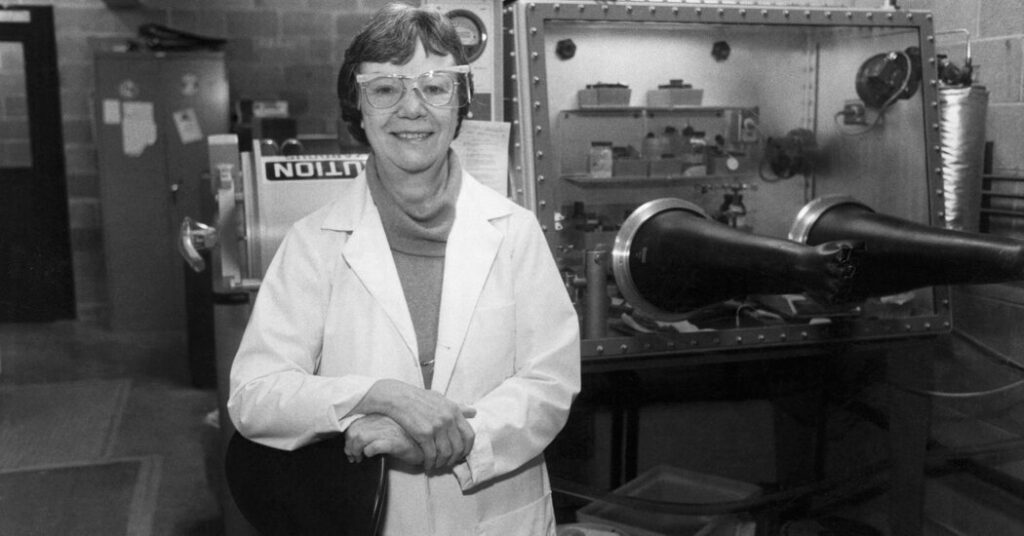
Edith Flanigen, an eminent chemist who rose to the top tiers of research at Union Carbide by creating synthetic emeralds and complex materials that help convert crude oil into gasoline, purify water and improve the manufacture of products like laundry detergent, died on Jan. 6 in Buffalo. She was 96.
Her sister Jane Griffin confirmed the death. After a stroke in 2021, Ms. Flanigen, who had lived for many years in White Plains, N.Y., moved in with her sister in Buffalo, their hometown.
Ms. Flanigen started her career at Union Carbide, in Tonawanda, N.Y., near Buffalo, as a research chemist in 1952. She was promoted to lead a key research team in 1968 and was the first woman to be named a corporate research fellow by the company five years later. In 1982, she was promoted again, to senior corporate research fellow, Union Carbide’s highest technical position.
“Practically every division of Union Carbide is reported to have called on her expertise in silicate chemistry, natural minerals, crystallography” and other areas of research, The Standard-Star of New Rochelle, N.Y., reported in 1982.
Ms. Flanigen was best known for her role in developing synthetic molecular sieves, or zeolites: crystalline materials whose structure traps, separates and transforms molecules, making them integral ingredients in numerous commercial applications, including breaking crude oil into gasoline and diesel fuel, treating wastewater, and reducing vehicle emissions.
“The first thing she did when she was hired was to learn how to grow zeolites at an industrial level,” Bob Bedard, who worked for her at Union Carbide, said in an interview. She later showed that it was possible to use other elements, in addition to aluminum, oxygen and silicon, to create a new generation of zeolites.
“We ended up with 13 elements and about 200 structures,” Ms. Flanigen said to Invention & Technology magazine in 2004, recalling a period when she headed the molecular sieve research team. “We would vote on which direction to go next. That was most unusual in corporate research. Nowadays you hear a lot about teamwork in industry; this was well before that.”
Mr. Bedard — who held about a dozen patents with Ms. Flanigen, who was granted 109, most in collaboration with others — described the impact of introducing new elements to zeolites.
“The world hadn’t thought that could be done, but she changed the way people in the field thought,” he said.
Her influence was apparent in the use of titanium, for which she had patents, and silicon — instead of aluminum and silicon — to create zeolites that were ultimately used in the cleanup of the radioactive water after the Fukushima Daiichi nuclear plant meltdown in Japan in 2011.
In 1992, Ms. Flanigen was the first woman awarded the Perkin Medal, the highest honor in American industrial chemistry. She received the $100,000 Lifetime Achievement Award from the Lemelson-MIT Program, which supports inventors, in 2004, and was inducted the same year into the National Inventors Hall of Fame. In 2014, the National Medal of Technology and Innovation was presented to her by President Barack Obama.
That year, Humboldt University of Berlin established the Edith Flanigen Award to recognize the achievements of outstanding female scientists early in their careers. It was discontinued in 2019.
Edith Marie Flanigen was born on Jan. 28, 1929, in Buffalo, the second of four children of Charles and Edith (O’Connor) Flanigen. Her father was a salesman for a lumber company, and her mother managed the home.
Chemistry began to intrigue Edith at Holy Angels Academy in Buffalo, largely because a teacher there, Sister St. Mary, focused her students on hands-on laboratory work. “I think that was probably the thing that turned me on,” Ms. Flanigen said in a biographical video for the National Science and Technology Medals Foundation in 2012.
In 1950, she received a bachelor’s degree in chemistry from D’Youville College (now University) in Buffalo and was the class valedictorian. Two years later, she earned a master’s degree in inorganic physical chemistry from Syracuse University.
When she started at Union Carbide, her sisters, Joan and Jane, worked with her in the same lab. The three young women were objects of curiosity.
“The human resources person used to give us psychological tests to determine why three women would decided to be chemists,” Ms. Flanigen told Invention & Technology.
There were other obstacles — like men with doctorates unwilling to work for her — “but to tell you the truth, they were not serious enough to block my advancement,” she told The Buffalo News in 2014.
“Edith was not easily intimidated as far as science was concerned,” Mr. Bedard said. “She was often the best informed if not the smartest in the room, and she had no fear of speaking up.”
“Edith was a role model for young women for many decades,” he added.
She continued her research at Union Carbide, and then at U.O.P., a joint venture of Union Carbide and Allied-Signal, until her retirement in 1994. She continued as a consultant to U.O.P., now owned by Honeywell, until a few years ago.
Ms. Griffin, her sister, is her only immediate survivor.
Ms. Flanigen and Norbert Mumbach, a colleague at Union Carbide, conceived a process to grow synthetic emeralds in the early 1960s. They were first used in early lasers but also sold as jewelry in stores. On a trip to speak to the American Chemical Society in Akron, Ohio, in 1969, Ms. Flanigen wore a five-carat lab-produced emerald; some emeralds grew as large as 50 carats.
“We knew the makeup of the natural emerald, so it was really a matter of finding the right chemicals, right pressure and the right temperature for growing the synthetics,” she said. At the time, she said, synthetic emeralds cost $50 to $200 a carat compared with as much as $10,000 a carat for the real thing.
In 2014, at the White House ceremony where she accepted the National Medal of Technology and Innovation, Ms. Flanigen wore a necklace of synthetic emeralds. It was part of Union Carbide’s Quintessa collection of laboratory-produced emeralds, rubies and sapphires.
Richard Sandomir, an obituaries reporter, has been writing for The Times for more than three decades.
The post Edith Flanigen, Award-Winning Research Chemist, Dies at 96 appeared first on New York Times.