YANGON — The election set to assure the continued grip of Myanmar’s military generals over their country wasn’t engineered in their fortressed capital, but in Beijing, say diplomats, analysts and others monitoring developments in the isolated Southeast Asian nation.
Myanmar has been in a violent civil warsince 2021, when its military ousted a democratically elected government, sparking armed opposition from pro-democracy groups and ethnic rebels.
For over a year, Chinese officials have helped to arrange a political off-rampfor Myanmar’s military generals that would allow them to retain power while adopting the veneer of civilian leadership. Their efforts culminate Sunday, as the military oversees a third and final round of voting in an election that has left no room for uncertainty.
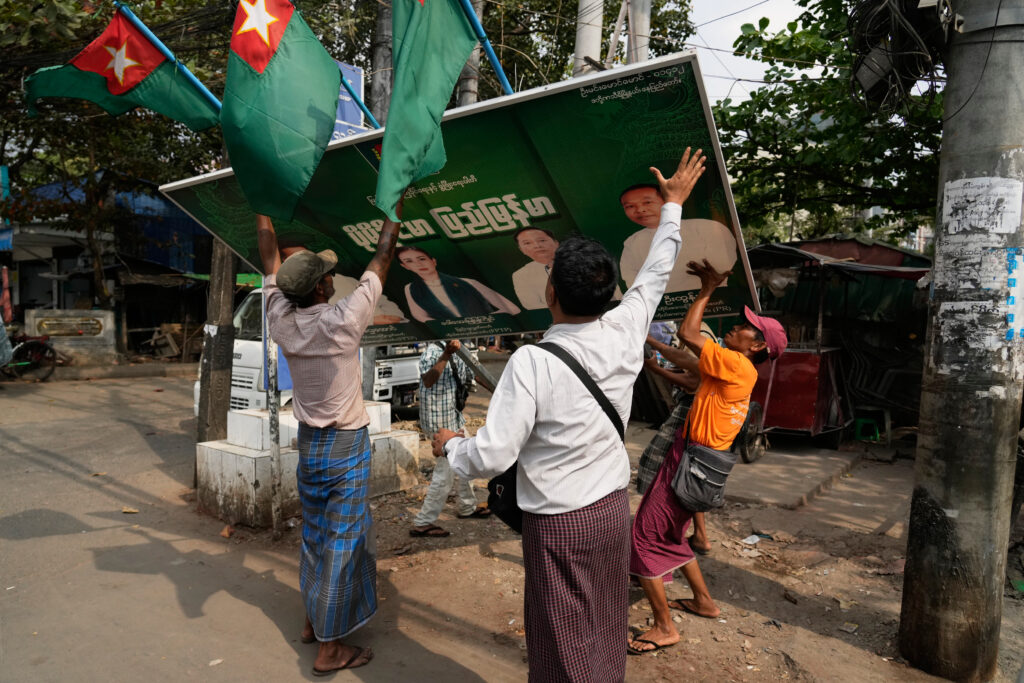
Myanmar’s pro-democracy leaders, including the Nobel laureate Aung San Suu Kyi, have been imprisoned or exiled, their party banned from participating in the contest. Polls are only being held in districts under military control and there’ve been widespread reports of people being coerced to vote. Even before this weekend, the military-backed Union Solidarity and Development Party had achieved a supermajority in parliament.
“After these years of hardship, people think USDP is who they can rely on for peace and stability,” San San Win, a USDP candidate in Yangon, said, smiling from her office Friday. “Well, we are ready to serve.”
While the Trump administration zeroes in on restoring “American preeminence” in the Western Hemisphere, China is moving swiftly to consolidate control over its own neighborhood, analysts say. In Myanmar, where U.S. influence and support for democracy is receding, Chinese authorities have been tightening its alliance with the military, which has been accused of widespread human rights atrocities, including genocide against the ethnic Rohingya people.
The elections “reflect the agreements” between Myanmar’s senior general Min Aung Hlaing and China’s leader Xi Jinping, Deng Xijun, China’s Special Envoy for Asian Affairs, said in December.
But to many in the country, they are theater. “Whether we vote or not, they will win because of their tricks,” said a 38-year-old musician in Yangon, who spoke on the condition of anonymity in fear of retribution from the regime. He didn’t vote and had told all of his friends and family not to as well, he said.
Still, there are others who hope the election, even if unfair, can prompt some change from the status quo.
Thet Hmoo Aung, 26, a candidate for the People’s Party, one of a handful of non military-affiliated parties that have been allowed to run, spent Friday morning on a last-ditch campaigning effort in his constituency in Yangon.
“Please vote … Yes, I’m running … The election is this Sunday!” he said, going from door to door. An elderly shopkeeper took his yellow flier and smiled, but said nothing.
It’s true that voters have mostly been too tired or too wary to engage with the campaign, admitted Thet Hmoo Aung. His party only won one seat in the national parliament during the first and second round of voting, and he’s worried those most sympathetic to its platform won’t turn out for the final round.
“If people don’t go to vote, someone they don’t like will be in power still,” he said. He was careful not to be more direct. The streets he was weaving through were among the biggest hotspots for the youth-led demonstrations that erupted in 2021 when the military seized power. But even mentioning those protests was dangerous: Just weeks earlier, another candidate in his party was sentenced to a year in prison for mentioning the term “2021 uprising” in a TikTok video.
In the lead-up to the election, diplomats and analysts had anticipated some violence from pro-democracy militias. But attacks have been small and sporadic. “The reality is the population is absolutely exhausted,” said Adam Castillo, an American operating a security consultancy in Myanmar.
The country’s economy has cratered under military rule. Foreign investors have fled and the Myanmar Kyat has collapsed in value. Onerous restrictions on imports and exports are stanching the supplies of food and medicine. Nearly half the population is in poverty, double the percentage of six years before, according to the United Nations.
In Yangon, Myanmar’s largest city and commercial center, life appears to churn on. But uneasiness lies just underneath the surface: Many of the young men in the city arrived not long ago, fleeing military conscription elsewhere. Teenage girls perched at shopping malls say they came after spending months in their hometown hiding from crossfire between the military and rebels. Virtually everyone seems to want to leave.
“I want to go so, so badly,” said Thiri Shoon Lae, 20. She took a break from high school when the coup happened and only restarted in 2023. As soon as she gets her diploma, she wants to find a way to leave Myanmar, she said. Her parents are supportive. “They say, ‘the sooner you go, the better,’” she said.
Myanmar’s military junta has been shunned by the international community since the coup and disinvited from meetings at multilateral organizations such as the United Nations and the Association of Southeast Asian Nations. Some countries may reengage the regime after the election, said Richard Horsey, senior Myanmar adviser for the International Crisis Group. China will likely lead the way.
“There might be some new faces — that much is true. But I find it very hard to imagine that this new administration will have the space or the will to really do what would be needed to put Myanmar on a positive track,” Horsey said.
Whether Myanmar’s people like it or not, however, there is no counter to China’s influence over the country’s future, said Khin Zaw Win, a former political prisoner who leads a think tank from Yangon. On top of U.S. reductions in programming and diplomatic presence, four European countries are set this year to close their missions in the country.
“What choice do we have?” said Khin Zaw Win. “China is the only one with leverage. And the only one who’s here.”
The post Myanmar’s military choreographs an election with Beijing’s help appeared first on Washington Post.