How to save the much derided people movers at Dulles International Airport? Rebrand them as “Direct Jet Transports.” Or, for short, “DJTs.”
That’s one of the proposals submitted for improving Dulles after President Donald Trump called the airport “a great building and a bad airport,” in December. And it’s received support from Susan Saarinen, daughter of Eero Saarinen, who designed Dulles and the wheeled conveyances that have served the airport since it opened in 1962.
“It’s a name that fits,” Susan Saarinen said in an interview, laughing. “Mr. Trump would like to name the airport after him, because he likes his name I guess, and he likes to name things. And if a DJT happens to work for that, it works for me.”
After Trump’s comments, Transportation Secretary Sean P. Duffy put out a call for ideas to improve the airport with a deadline of Jan. 20. He specifically criticized the mobile lounges, which were involved in two recent accidents, saying the administration “supports proposals that reduce the need or accelerate the timeline for removal of people movers.”
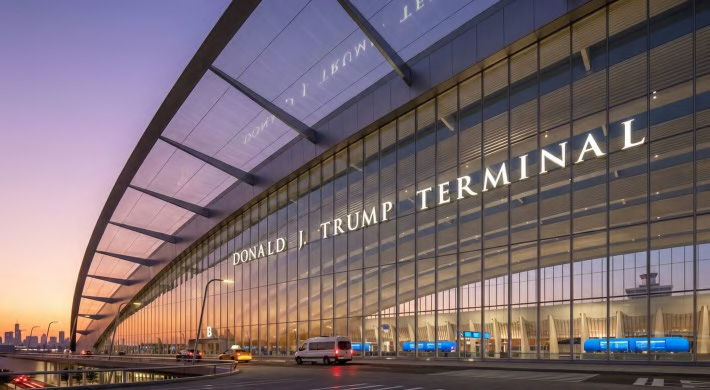
There were 31 responses and a handful of detailed suggestions. The Conservative Political Action Conference weighed in, as did architect David Adjaye, who designed the National Museum of African American History and Culture. None would demolish the famous sloped building, although the late Zaha Hadid’s firm in partnership with Bermello Ajamil would turn it into a shopping mall framed by an arch-shaped “Donald J. Trump Terminal.” Another group would name the partnership behind the redesign after the president, calling it the “Terminal Redevelopment & Upgrade Management Platform Airports” or TRUMP Airports.
Only one response honors Saarinen’s vision, his daughter said, and it’s the one that replaces rather than removes the mobile lounges.
“A bunch of the other proposals basically say, ‘It’s a beautiful building, let’s keep it as a building, but let’s not have planes take off and land there,’” Saarinen said. As the TRUMP Airports proposal puts it, “The Saarinen terminal provides the grandeur; the proposed modern extensions must provide the functionality.”
On the contrary, Saarinen believes that moving people to planes via small, agile vehicles rather than cumbersome bridges and concourses is “a great idea” that was “ahead of its time,” one whose functionality can now be fully realized.
That’s why she’s supporting aviation entrepreneur Jeremy Stone, a self-described Saarinen “fanboy” who has been working on an updated version of the mobile lounge for the past four years. A DJT is not her father’s mobile lounge, the creators emphasize. It’s a contemporary conveyance with open architecture, adjustable seating, and modern navigation equipment that can rise and fall to accommodate both low wheelchairs and high jets.
“It’s not common in the airport sector to see something come out saying, ‘Hey, what should we do? And you’ve got two weeks to tell us,’” said architect Francis Walker, who collaborated with Stone on the proposal. “Fortunately, Jeremy had the answer, because he’d been working on it.”
Stone’s group is now selling its idea with a bit of Trumpian spin, saying in their proposal that “ideally, China licenses the DJTs, giving President Trump credit.” Part of the pitch is that unlike new tunnels and terminals, modernized mobile lounges could be finished within Trump’s term and without a huge cost.
Dulles officials have said the mobile lounges must remain part of their plans for several decades to come because of the time and expense it would take to expand the Aerotrain, an automated train system that serves most but not all gates. The airport has invested $16.4 million to rehabilitate the current movers, but not replace them.
As explained in a video by Charles Eames, Saarinen’s friend and fellow architect, Dulles was designed as a long column from which passengers would be ferried out to their planes, a more economical use of space than hallways and jetways. But as the airport was built out, it developed a more conventional sprawl.
Other firms suggest expanding the Aerotrain or expanding out from the Saarinen terminal. One from Glydways, an autonomous vehicle company, would replace the mobile lounges with small electric shuttles. Its product is set to debut soon at airports in Atlanta and San Jose. Both ideas would require tunneling underneath the airport, an expensive and difficult endeavor.
It’s not clear what, if anything, will be done with these proposals. The Metropolitan Washington Airports Authority, which oversees Dulles, has been working on its own revitalization plan for several years. A new three-level, 14-gate, 435,000-square-foot concourse is expected to be completed in 2026.
“We always welcome ideas,” MWAA CEO Jack Potter said at a board meeting Tuesday. “We appreciate the administration’s interest.” But he suggested that Trump’s dour view of Dulles is out of date, ignoring recent improvements. The airport “is experiencing strong passenger growth and also enjoys some of the highest customer satisfaction ratings,” he said. “It’s an amazing accomplishment.”
The post To save Dulles mobile lounges, architect’s daughter would call them ‘DJT’s appeared first on Washington Post.