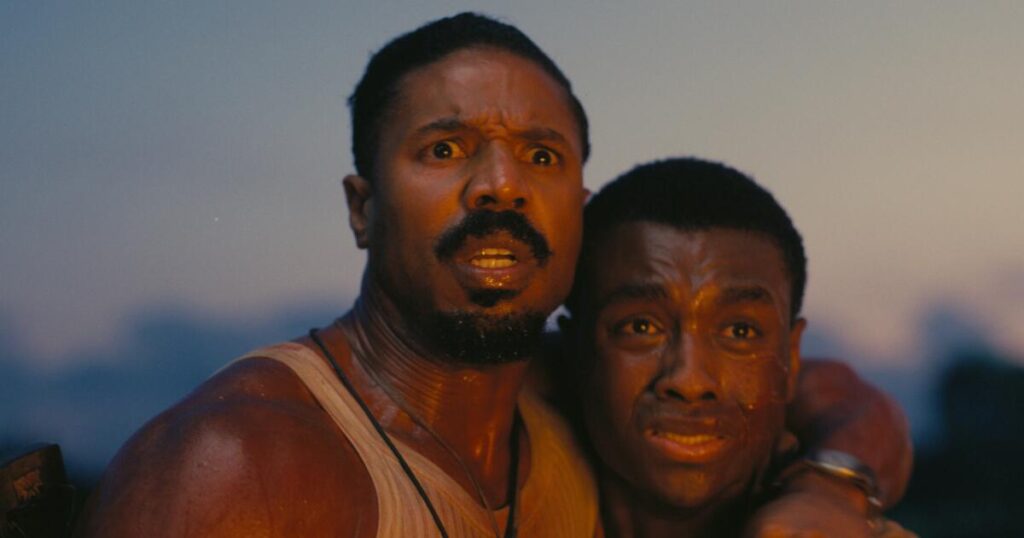
Oscar nominations are officially out, meaning for the next couple of months social media feeds will be saturated with debates over who and what is worthy of a statue. Leading that discussion is another Ryan Coogler masterpiece, this time “Sinners,” which is up for a record-breaking 16 awards, including best picture.
Set in the Mississippi Delta during the Jim Crow era, the film is often characterized as a horror movie, which is understandable given the villain is a vampire. However, what elevates “Sinners” beyond the gore — what makes it a delicious piece of historical fiction — are the details woven into the story’s fabric. From the presence of the Indigenous Choctaw people to the segregated sides of the same street, Coogler paints a picture of 1930s America with a documentarian’s brush. In traditional horror movies, fright is centered and dialogue is a backdrop. “Sinners” prioritizes the moment in time in which the fright occurs — both visually and sonically — making it as much a period piece as it is a movie with vampires in it.
How many Oscars “Sinners” will win is good fodder for all that social media debate. However, what is not debatable — in fact, what is painfully clear — is that Coogler made the best picture for our times. That’s because at its core “Sinners” is a story about belonging — both who does and who does not. There are no grand speeches about diversity undergirded by uplifting music. Instead, Coogler methodically reminds the audience that this country has always been a multiracial kaleidoscope by meticulously portraying life in America just a century ago.
The vampire Remmick is more than just an antagonist with fangs.
He is the immigrant son of an Irish man whose homeland was stolen and faith stripped away during the centuries of English rule. We don’t know how old the vampire is. But we do know that by 1690 roughly 80% of Ireland’s best farmland had been confiscated and turned into large estates for wealthy colonizers, displacing millions of people in the process. We know in 1845, potato fields — the primary source of food for the poor — became infested with a devastating fungus that destroyed 40% of the crop. The following year, nearly all of the potato fields had been infected, leading to years of famine.
Between 1846 and 1851, more than a million Irish people died from starvation or disease. And we know the vast majority of them did not have to die.
For while the Irish people fell from hunger, the healthy crops that were grown on their land were shipped to England, to feed their oppressors. Mass evictions — punctuated by women and children being dragged out of their homes in the dead of winter by British soldiers — compounded the devastation they endured. Countless fled to America and elsewhere in the hope of a better life.
By today’s standards, some immigrated to this country legally.
Most did not.
Almost all were greeted with racist hostility, sometimes by Irish Americans who thought distancing themselves from their desperate countrymen would grant them favor from the very people who despised them. Some pseudoscience in the late 1800s portrayed Irish Americans as members of a different race from other Northern European immigrants; they were not viewed socially as fully white until World War I. That was made clear from the “Irish need not apply” signs displayed in windows. It was evident by the anti-immigrant platform the Know Nothing Party adopted.
Who are they, you ask?
Well, you remember the way then-candidate Donald Trump claimed he didn’t know anything about Project 2025 or the way MAGA Republicans such as House Speaker Mike Johnson greet awkward questions with claims of “don’t know” or “don’t recall”? That is a strategy ripped from the pages from some of the ugliest moments in American history, some spearheaded by the Know Nothing Party. Ours is a history in which New York robber barons used the promise of belonging to splinter the poor into factions and manipulate them into fighting among themselves during the Gilded Age.
Perhaps this is why Jake O’Kane, a comedian and columnist based in Northern Ireland, recently said this about Irish American immigration agents: “You have betrayed your great-grandfathers and mothers who traveled on ships as immigrants to the country where you now hunt down immigrants. There is no Irish in you. You are house slaves.… Field slaves, they don’t want to take care of the massa. They don’t want to take care of the house. They want to burn the house down. And that is where you originated from. That’s the people you came from and now you are nothing but … house slaves.”
The history of the Irish in America is also why the “Sinners” vampire Remmick — in an attempt to convince Black people living under Jim Crow to join him — said: “I am your way out. This world already left you for dead. Won’t let you build. Won’t let you fellowship. We will do just that. Together. Forever.”
His argument was based in a truth that is apparent today, which is why “Sinners” touched those of us who know what it’s like to be othered in society. For those of us watching some of the worst moments in this country’s history be repeated at the behest of modern-day robber barons making billions, while children are snatched out of schools and the poor fight among themselves.
It will be weeks before we find out whether “Sinners” is named 2025’s best picture. But we already know that it offers the clearest picture of the evil we see around us.
YouTube: @LZGrandersonShow
The post ‘Sinners’ is the story of our moment, from a past chapter of ‘divide and conquer’ appeared first on Los Angeles Times.